One hill of wheat, pulled from a dry-farmed field in Bannock Valley, carried 168 heads. In the summer of 1913 the Rev. B. W. Rice, a Congregational minister, mailed it from Arbon to the Gem State Rural, which the American Falls Press later called “Idaho’s farm paper,” along with a letter on the valley’s crops, its land and its people, and on the two churches he was starting there. The Press passed the report along on August 7, 1913, under the heading “Wheat in Bannock Valley.”
Rice dated his letter from “Arbon, Power county, Idaho.” That address was new. Power County had been carved out only that January, and Arbon, which had been in Oneida County, now belonged to it.
A hill of wheat
The wheat was probably Odessa, though its name is garbled in the digitized text. Rice said four of the heads were pulled off and shelled, and they averaged 40 grains apiece. By the paper’s reckoning that came to 6,320 grains from the single seed the farmer had planted. The arithmetic is off as the scan reads it, since 168 heads at 40 grains would make 6,720, so one of the numbers may be misprinted or misread.
Rice did not pretend a whole field would match one hill. Still, he believed this valley could raise “100 bushels to the acre” if the wheat were set two feet apart each way and worked until it bloomed. “This too,” the paper added, “is dry farming,” meaning grain grown with no irrigation at all.
He pictured Bannock Valley as small, lying some 40 miles south and a little east of Pocatello. His figures for its height and for its square miles of wheat land are lost to the digitized text. Nearly all the land had been claimed, he wrote, and settlers were beginning to make final proof. That was the last step of homesteading: once a settler had lived on and farmed a claim for the years the law required, he proved up, with neighbors to vouch for him, and received title.
For 1913 he looked for wheat to make 26 bushels an acre and oats and barley around 50. Deeded land, already owned outright, was selling at $20 an acre, and good wood and fair timber stood within reach.
He was not the only one talking up the valley that year. In June, after a visit from Mr. Houk of Arbon, the Press reported, “Everything is lovely in the Bannock valley.” The same August issue that carried Rice’s letter quoted Jewell Horton, Arbon’s justice of the peace, who found things “fine and dandy in his neck of the woods,” and the paper expected Power County to harvest “over a million bushels of wheat.” In October L. B. “Ren” Evans, “one of the real live boosters for Bannock valley” in the paper’s words, said the grain then leaving the valley stood to what would follow, once every farmer began hauling, as Bannock Creek stood to the Snake River.
Gentiles and Mormons
Turning to “social conditions,” Rice counted 123 Gentiles and 295 Mormons in the neighborhood. In the language of the day a Gentile was anyone outside the Latter-day Saint church, and these, he said, were “energetic people” who had come from the eastern states.
He wrote from the home of “a Mr. Nunnelley,” where he was staying. That was most likely W. A. Nunnelley, whose family had come from Kentucky in 1909 to homestead at the valley’s south end; the Stories tell of their first winter there. Rice also described a scene at the Nunnelley house involving a piano and a number of good voices, but the scan is too damaged there to make it out.
His count did not square with others. Superintendent Ludwig Thomsen had put the Latter-day Saints at about a third of the valley that March, Rice’s numbers make them about seven in ten, and Robert W. Sturges, the student pastor of 1915, later reckoned them “about sixty per cent.” None of the three said how he arrived at his figure.
Two churches
Protestant work in the valley was two years old when Rice arrived. It had begun in April 1911 with a Sunday school in G. S. Butler’s home, as told in the first Protestant Sunday school and church. In March 1913 Thomsen, writing in The American Missionary, a Congregational missions magazine, reported that he had organized a second Sunday school at the south end:
The Highland Sunday-school in Arbon Valley starts out hopefully. This valley is one of the fertile sections of Southeastern Idaho, the Mormon section of the state. It is seven or eight miles wide, and twenty-five miles long, between two ranges of mountains. It is thirty-five miles from a railroad. The population is about one-third Mormon and two-thirds non-Mormon. The Gentiles have come there within the last five or six years, and are fast developing the land.
The north-end Sunday school, he added, had been meeting for a year and a half, about twelve miles from the new one. The south-end leader had been schooled at an American Missionary Association school in Kentucky. Thomsen did not name him, and although the Nunnelleys were Kentuckians, no source says the leader was one of them.
On July 13, 1913, a Congregational church was organized at the Central school, according to the valley history Mrs. E. A. Logan wrote for the Press in 1917. Less than four weeks later Rice’s letter described the work. He was doing community church extension, he said, and putting in two Congregational churches, the only religious work in the valley apart from the Latter-day Saints. “A pushing pastor and wife” would be sent soon, and the people were “laying aside sectarian differences” to pull together in the church union they had formed.
The pastor came the next spring. By early 1914 the Highland Congregational church had a building of its own, about twelve miles south of the Central school, on land given by Miss Mamie Nunnelley, and the school held its term there. The Press announced that the Rev. Thomas Dent Fee, pastor at Eagle Butte, South Dakota, had been engaged for “the two new Congregational churches which were organized last July.” Fee arrived on April 4, 1914, and preached his first sermon the following day to a large congregation. The papers found do not say how long he stayed, or whether a wife came with him.
In late May 1915 Sturges, a student at Union Theological Seminary from New York City, came out to serve the Congregational churches of Arbon valley for four months, preaching at Highland and at Arbon. That year the first school at Summit went up beside the Highland church, and the Stories also tell of the first congregations at Summit. The Summit area history says the community church there, built on an acre Mamie Nunnelley gave, was discontinued in the early 1920s. It had lasted a decade or so, and it began with a minister, a hill of wheat and a letter to the farm paper.
The original article
American Falls Press, August 7, 1913, page 6. Transcribed from the page scan.
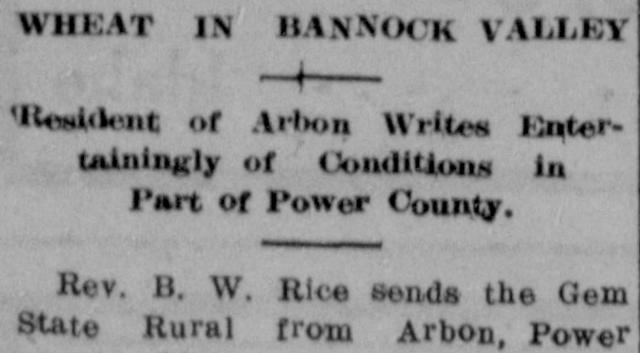
WHEAT IN BANNOCK VALLEY
Resident of Arbon Writes Entertainingly of Conditions in Part of Power County.
Rev. B. W. Rice sends the Gem State Rural from Arbon, Power county, Idaho, a sample hill of [illegible] wheat, grown in Bannock valley, which shows great thrift and yielding qualities. There were 168 heads on the sample, and Mr. Rice says they pulled off four heads and shelled them, getting an average of 40 grains, which would make 6320 grains for the one the farmer put into the ground.
“I don’t represent,” says Mr. Rice, “that a field will do this well, but I do think it will yield 100 bushels to the acre in this valley if planted two feet each way, and cultivated up to blossoming time.” This too, is dry farming.
Bannock valley is a small one, [illegible] feet elevation, 40 miles south and a little east of Pocatello, and contains [illegible] square miles of wheat land.
The land is nearly all taken, Mr. Rice says, and final homestead proof is starting now.
This year the wheat will run 26 bushels, and the oats and barley about 50 bushels. Deeded land can be bought for $20 an acre. There is good wood and fair timber within [illegible] of the place.
In speaking of social conditions, Mr. Rice says there are 123 Gentiles and 295 Mormons in that locality. The former are made up of energetic people from the eastern states. Mention is made by Mr. Rice of an incident at the home of a Mr. Nunnelley, where he was then stopping, a piano had been running [illegible] accompanied by a number of good voices. Mr. Rice is doing community church extension work, and is putting in two Congregational churches in that valley, which is the only religious work being done there, outside of the Latter Day Saints. He says that a pushing pastor and wife will be sent there soon, and that the people are laying aside sectarian differences and concentrating their denominational powers in the church union that has been formed.
Sources
- American Falls Press, August 7, 1913, page 6
- American Falls Press, June 19, 1913, page 4
- American Falls Press, August 7, 1913, page 8
- American Falls Press, October 9, 1913, page 3
- The American Missionary, March 1913, pages 759–760
- American Falls Press, April 2, 1914, page 11
- American Falls Press, April 30, 1914, page 1
- American Falls Press, June 3, 1915, page 4
- American Falls Press, September 23, 1915, page 5
- The American Missionary, January 1916
- American Falls Press, March 29, 1917, second edition, page 7