C. R. Butterfield came in from Crystal in October 1914 without having seen a newspaper in three weeks, not since he had been in American Falls for the county fair. The settlement he lived in had a post office of its own and no reliable way to get mail into it or out of it. A letter posted at American Falls, perhaps twenty-five miles off as a direct road would run, first rode the train south to Brigham City, Utah, then back north to Malad, then crossed the divide to Arbon and on to Pauline before anyone carried it the last miles to Crystal. The American Falls Press put his account at the top of its front page on October 15, 1914, and kept after the story for two more years.
The roundabout path had a history. Until 1913 the valley belonged to Oneida County, whose seat was Malad, and its letters had always come from there, as told in the first mail carriers. In 1913 it became part of the new Power County, governed from American Falls, but the mail still came up from Malad on a star route, the name for a route between post offices carried by a contractor.
A contract renewed at Malad
The contracts for Idaho’s star routes over the coming four years appeared in the Salt Lake Tribune on March 5, 1914. Malad City to Arbon went to a man from Malad City for $1,500. That same day the Press quoted J. W. Butler of Arbon, who had been in town the day before. People in his part of the county had wanted a route out of American Falls, he said, and the renewal was “a great disappointment to the people of his section.” By April the American Falls Board of Trade was pressing for such a route.
Two hundred thirty-nine miles of rail
Butterfield’s story that October laid the problem out mile by mile. The paper printed his name as “C. K.” Butterfield, though elsewhere it was C. R. “No mail route has ever been established to Crystal,” the Press reported. Mail reached the settlement only when somebody happened to go over to Pauline for it. Outgoing letters fared little better:
Mail leaves here for Brigham, 179 miles by rail, and then is taken back to Malad 60 miles by rail. From Malad there is a tri-weekly service to Arbon, 37 miles, over a divide that is sometimes impassable in winter except for letter mail which can be taken on horseback or on foot.
Beyond Arbon, a carrier went to Pauline twice a week, and the Crystal office sat another nine or ten miles past Pauline. Pocatello’s post office, by contrast, lay only eighteen miles from Crystal over a good road. A letter could take several days to arrive, or two or three weeks. Butterfield said he often carried a hundred letters at a time into Pocatello or American Falls to post them himself, and his neighbors did likewise. What the Press wanted was a new route of eighteen miles out of Pocatello.
Not every account agrees on how the mail moved. In 1912 the Press had reprinted a Pocatello item saying a star route from Pocatello to Crystal and Pauline had lately been set up, and a later local history, followed on the Crystal page, has neighbors going to Hawkins Basin for their mail. The papers of 1914 and 1915 say it came by way of Pauline. Both settlements had post offices of their own, as told in the first post office at Crystal and the first post office at Pauline.
“About the poorest mail service in Idaho”
In January 1915 I. W. Phillips, “one of the pioneers of Crystal,” told the Press that a mail route was the thing the settlement needed most. On February 4 a new correspondent from Pauline began the first “Pauline Paragraphs” by warning that sending in news every week would not be easy:
We, no doubt, have about the poorest mail service in Idaho. Our precinct, and also Crystal, both of Power County, are without an adequate mail service. We have petitioned our postmaster general until, I suppose his eyes have got sore reading them.
Both settlements drew their mail from Malad, forty miles from Pauline, while American Falls and Pocatello were each about twenty-seven miles away. An earlier petition for a route from American Falls had come to nothing. “The result is, we have carried our mail three years from Arbon to Pauline. And Crystal has put up with this for five years.”
In the same issue Butterfield was reported to have just got his first mail in two months, and the paper called the “parsimonious policy of the postal department” indefensible. The next week brought worse news. Postmaster General Burleson had announced that no new rural delivery or star routes would be started for an indefinite time, because of “the deplorable condition of Uncle Sam’s finances.” The Press answered that savings somewhere else ought to cover the $1,000 the route would cost.
Names from 346 families
By March 1915 W. F. Kowallis, bishop of the Meadow Ward at Pauline, had signed up the heads of 346 families in Arbon, Pauline and Crystal (the headline said 345) “who want a mail route established giving them direct connection with American Falls.” He looked for bids to be called soon on star routes into Arbon from American Falls and from Pocatello alike.
The spring brought something else instead. On April 24 an examination was held at the Arbon post office “for the position of mail carrier on R. F. D. No. 1.” Rural free delivery carried the mail out to farms along its route, and by 1916 Newell Leishman was its regular carrier, as told in the first rural mail route. Arbon itself still got its mail from Malad. In February 1916 snow so choked that road that the carrier changed horses four times.
The reports from Crystal did not line up. In December 1915 Elmer Benton, who farmed there, said mail now came three times a week from Pocatello, where before “sometimes it took weeks to get a piece of mail there from any outside point.” Yet in January 1916 Butterfield said the Crystal office had only now received its mail from October and November. “Getting mail out of the office is like getting money out of a busted bank,” the Press remarked, “you have got to wait until it just naturally drifts in.” Nothing in the papers accounts for the gap between the two.
A route from Pocatello
The answer came in October 1916, and papers as far apart as Parma and Salmon City carried it:
The contract for the star mail route between Pocatello and Arbon has been let to Lorin Bailey of Arbon. A road is now in operation between the towns and the route will also serve Crystal and Pauline.
On November 2 the Arbon column reported that people there took pride in getting their mail from Pocatello “several days sooner,” with Lorin Bailey carrying it, the story told in the first mail route from Pocatello.
When Mrs. E. A. Logan wrote her history of Bannock Valley for the Press in March 1917, the Pocatello route was supplying Crystal, Pauline and Arbon, and a rural carrier went three times a week to everyone living south of the Arbon post office. The valley, she wrote, now had “the best mail service in the county.” Bailey bought a car that April, though with snow still on the ground he could drive the reservation road only to a spot near the cement bridge at Pauline, and there he switched to a sleigh. More of that end of the valley appears in Pauline and West Fork.
Less than three years after Butterfield went without a paper, Crystal’s letters were coming by way of Pocatello, not Brigham.
The original article
American Falls Press, October 15, 1914, page 1. Transcribed from the page scan.
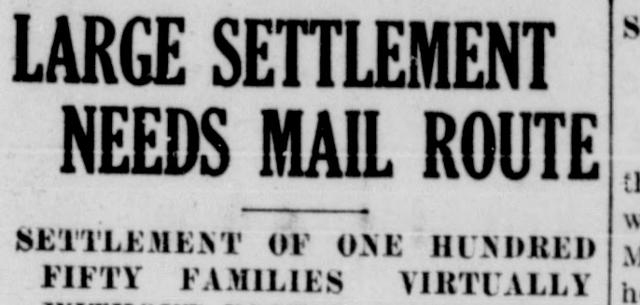
LARGE SETTLEMENT NEEDS MAIL ROUTE
SETTLEMENT OF ONE HUNDRED FIFTY FAMILIES VIRTUALLY WITHOUT POSTAL FACILITIES, ALTHOUGH HAS A POSTOFFICE.
Mail Goes 239 Miles By Rail, [illegible] Miles Over Two Star Routes and Stops Ten Miles From Crystal Postoffice—A New 18-Mile Route Would Give Them Service From Pocatello.
It does not seem possible that a prosperous farming community, only a distance of eighteen miles from Pocatello to the center of the community, should be left without adequate mail services for a period of more than three years. Yet such is the information brought by C. K. Butterfield from the Crystal settlement in the south eastern part of this county. Mr. Butterfield had not had a newspaper since he was here attending the county fair, three weeks ago. There is a postoffice at Crystal, and the settlement gets mail when any of the settlers go to Pauline, but that is not often. When they do go it is to get mail for the community. No mail route has ever been established to Crystal. There have been several advertisements for service via Hawkins, the end of a twice a week route, but traffic does not run that way and the going in the winter time is not the best. The department has never been able to secure anyone to take the contract at what it considered a reasonable price, and the matter has been permitted to drag along in this way until the neighborhood is about disgusted.
To get mail to Crystal from American Falls a distance of not more than twenty-five miles by a direct route that could be easily established, often takes several days, and sometimes two or three weeks. Mail leaves here for Brigham, 179 miles by rail, and then is taken back to Malad 60 miles by rail. From Malad there is a tri-weekly service to Arbon, 37 miles, over a divide that is sometimes impassable in winter except for letter mail which can be taken on horseback or on foot.
From Arbon to Pauline there is twice a week service. The distance to the Crystal postoffice from Pauline is nine or ten miles, and to the center of the settlement a little further, as the postoffice is located to one side of the settlement. From the Crystal postoffice to the postoffice at Pocatello it is a distance of only eighteen miles, and to the center of the settlement the distance is probably not more than fifteen miles, and the road is a good one.
The records of the Crystal office do not show that it does much business, because no one knows when mail deposited there will get started on its way. Someone must go to Pauline for the special purpose of taking the mail when it does go out. As a result of this Mr. Butterfield stated that he often took a hundred letters to Pocatello or American Falls to be mailed, and his neighbors do the same. Common justice to this thriving settlement demands that this condition be remedied.
Sources
- American Falls Press, August 22, 1912, page 1
- Salt Lake Tribune, March 5, 1914, page 4
- American Falls Press, March 5, 1914, page 5
- American Falls Press, April 9, 1914, page 1
- American Falls Press, October 15, 1914, page 1
- American Falls Press, January 21, 1915, page 5
- American Falls Press, February 4, 1915, page 4
- American Falls Press, February 4, 1915, page 5
- American Falls Press, February 11, 1915, page 4
- American Falls Press, March 11, 1915, page 1
- American Falls Press, April 8, 1915, page 4
- American Falls Press, December 9, 1915, page 8
- American Falls Press, January 13, 1916, page 1
- American Falls Press, February 24, 1916, page 8
- American Falls Press, May 18, 1916, page 2
- Parma Herald, October 19, 1916, page 3
- Idaho Recorder, October 20, 1916, page 6
- American Falls Press, November 2, 1916, page 12
- American Falls Press, March 29, 1917, page 7
- American Falls Press, April 26, 1917, page 3
- The first rural mail route, Stories, on this site
- Crystal, on this site
- The first mail carriers, Stories, on this site
- The first ward at Pauline, Stories, on this site