When the harvest of 1917 was in, the valley news in the American Falls Press began to read like a list of departures. Week after week the correspondents at Arbon, Pauline and Crystal reported another family shutting the house and going out for the winter. By the end of March 1918 the same columns were counting them home. Between the going and the coming back lay a mild, snowless December and then, in January, a blizzard of the sort the valley was famous for.
Going out for the winter was an old habit. The valley had belonged to Oneida County until Power County was formed in 1913, and its first settlers had done the same. A Press profile of D. J. Bowen that October recalled that the Bowens passed their first winters at Samaria, in the Malad Valley, until their ranch raised enough hay and grain to carry the stock through.
Off to town, school and wages
Some families left for the sake of the children. Doc Pruitt moved his household from the homestead above Rattlesnake Creek to a ranch near Pauline “to give the children better school facilities.” The Bells of Crystal Creek went to Logan, Utah, so the older children could attend the agricultural college. E. L. Davis’s family went to Pocatello, and Ethel Johnston, her mother and her brother to Malad. Lou Reese took his family from their West Fork ranch to his father’s place between Pauline and Crystal. Owen Wall went back to Kaysville, Utah, to live with his mother on the old homestead, planning to come back in the spring and put in his wheat. Carl Wright left for Blackfoot.
Others went where there was work: Ralph Ripley to Salt Lake until spring, and Ezra Burwell of Crystal to carpentering at Tyhee. Still others spent the season feeding a neighbor’s stock. Richard Thomas and Bill Richards “returned for the winter to feed cattle at John Bolingbroke’s ranch.” Carl Johnston moved onto the Wright place at Crystal. At West Fork, Will Jenkins fed cattle for Dave Daniels, and John D. Price did the same for his uncle, Henry Daniels.
Those who stayed
Not everyone believed in leaving. The paper’s traveling farm writer, who signed himself the Pilgrim, went looking for farmers who stuck it out. He found John Reddy and Mrs. Reddy a mile or so south of Crystal, who had lived on their place summer and winter since homesteading nine years earlier. “They do not believe that any farmer can be truly successful unless he remains on the farm throughout the year,” he wrote.
His best example was Roy Porter, a mile west of the Arbon post office. Porter’s father, C. D. Porter, also wintered on his own place a mile to the south. Roy had learned the lesson the hard way:
Last winter Mr. Porter and his family moved out, and in the spring the roads were so bad that they could not get back to the ranch in time to attend to the early spring work. Mr. Porter stated that as a result he was behind in his work all summer, and he has resolved to stay with the farm both winter and summer.
That “last winter” was the stock-killing winter of 1916–17. This year the Porters kept to the ranch, and that fall Roy finished much of the work that usually waited for spring.
An open December
For a while the stay-at-homes had the better of it. “The sunshine faucet is turned on,” the Pauline correspondent wrote late in November. In the first issue of 1918, in what seems to be the Crystal column, a writer marveled, “Imagine Christmas here in the mountains without snow,” and asked, “Why go to California for the winter.”
On the ranch of the Daniels family north of Pauline, “the hay stacks are getting off easy as the open fall is giving plenty of pasture.” D. G. Davis, Joe Arbon’s brother-in-law and partner, said that the winter before it had taken “three husky men” to handle the feeding and chores on the Arbon ranch, and this year “one reasonably husky lad” was enough. M. V. Tallon of Arbon, who had done his plowing in the fall to be ready for spring seeding, used the mild weather to freight wheat from the Pauline platforms to the railroad switch at Michaud.
Winter arrives
Then winter came. The Pauline correspondent announced it in the Press of January 15, 1918:
Old King Winter has begun his reign in earnest here at last. Several inches of snow has fallen and a blizzard was on Sunday. The kind of blizzards the valley is noted for. The sleighing is getting fine.
The Arbon column followed a week later: “Winter has come at last at Arbon. Lots of snow and cold winds.” Lorin Bailey, who carried the mail out from Pocatello, put away his car for a sleigh and changed teams at Crystal. David Lusk hauled a four-horse load of grain to Pocatello by sleigh. Every horse on the Wright place took sick, which people put down to the sudden turn in the weather, and Carl Johnston and the neighbors had so far pulled them all through. Crystal had another blizzard late in February. (How mail first came into the valley is told in the first mail route from Pocatello.)
Coming home
By March 12 the Pauline column was hopeful:
It looks as though we were going to have an early spring. The snow is going fast. We don’t feel to complain of winter we have had in the valley this year thus far.
“Many of the people that moved away for the winter are moving back to begin work,” the column went on. Earl Daniels and Zack Armstrong brought their families back from Pocatello. Dave and John Bolingbroke returned with their families from Malad, and Frank Burnett came back from Malad, where he had been living since harvest. Bert Daniels and his wife got home from Washington.
At Arbon, John Butler’s family returned from Dunlap, Kansas, John Fuller’s from Walla Walla, Emmett Lee from Jens, Montana, and the Davises from Pocatello. The columns did not always agree on dates. The Pauline column of March 19 already had a Mr. and Mrs. John Butler home from “an extended visit in the east,” likely the same family, while the Arbon column put the Butlers’ return at March 21. Nor did the papers ever say how many families had wintered away; they named only the ones their correspondents knew.
At Crystal, Carl Wright came back from Blackfoot and his partner from Chicago, and “Both are quite anxious to begin work on the farm again.” In April Myrtle Pack came home from Pocatello, where her children had been able to attend school.
By late March the Arbon column could report that the mail to Pocatello “is again being carried by automobile, going and returning the same day,” though at the month’s end Bailey still drove a buggy between Crystal and Pauline.
One family was not coming back. Parley H. Bailey, one of the Bailey brothers, was given a farewell party at the Central school on March 18. He sent his furniture to Pocatello to be shipped on to Richmond, Utah, “where he goes to make his future home.” Up the road, Roy Porter, who had never left, was already well ahead on the spring work.
The original article
American Falls Press, March 26, 1918, page 4. Transcribed from the page scan.
ARBON NEWS.
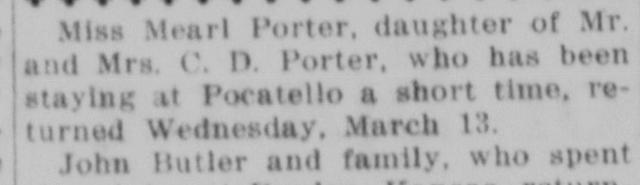
Miss Mearl Porter, daughter of Mr. and Mrs. C. D. Porter, who has been staying at Pocatello a short time, returned Wednesday, March 13.
John Butler and family, who spent the winter at Dunlap, Kansas, returned to their home at Arbon, March 21.
Thora Bailey, the four [illegible] old daughter of Mr. and Mrs. Lorin Bailey is now very sick with pneumonia. [illegible] of Pauline was in attendance.
The snow is about all gone at Arbon, but the roads are very muddy.
John Fuller, a former resident of Arbon, who with his family spent the winter at Walla Walla, returned to Arbon Monday, March 18.
James Bullock, the infant son of Mr. and Mrs. J. H. Bullock, is sick with pneumonia.
Mr. and Mrs. Roy Bindley, who spent the winter at Dayton, Washington, returned home Monday. Mrs. Bindley is much improved.
M. V. Tallon returned from Pocatello Monday.
Mrs. Emmett Lee returned home the first of the week from Jens, Montana, and Mr. Lee will be home in about a week.
C. D. Porter went to Pocatello Saturday.
On Friday, March 8, a children’s dance was given at the Central school in honor of Miss Connie Evans, daughter of Mr. and Mrs. T. R. Evans, it being her twelfth birthday. The dance began at 4 p. m. and lasted until 6:30 p. m., then all the children, thirty-seven in number, went over to the home of Connie Evans where ice cream and cake were served. An enjoyable time was had [illegible]
A play entitled “Hans Van Smash,” will be given by members of the Red Cross auxiliary of Arbon and others, at the Central school in the near future. Also, ice cream and cake will be served and the evening will be spent in dancing. All are invited. Watch for the date.
Mr. and Mrs. Eddie Davis were in Pocatello Sunday.
T. R. Evans was a business visitor at Pocatello Saturday, returning Sunday.
Mr. and Mrs. D. Porter and son, Orville, were Sunday visitors at Mr. and Mrs. M. V. Tallon’s.
A farewell party was given at the Central school at Arbon, Monday, March 18, for Parley H. Bailey. The evening was spent in dancing and refreshments and an enjoyable time had by all.
[illegible] Davis and family have moved from Pocatello to their home.
Mr. and Mrs. Duden McGarry and son are moving from the Roy Bindley place to the Parley H. Bailey place, which Mr. McGarry recently purchased.
Mrs. Mary Barker, teacher in the Pleasant View district, and her sister, Miss Nellie Peck, went to American Falls Monday. They returned Friday.
The mail from Arbon to Pocatello is again being carried by automobile, going and returning the same day.
Jos. Evans, son of Lorenzo B. Evans, [illegible] a Pocatello visitor Friday and Saturday.
N. H. Leishman went to Pocatello Saturday to bring out a load of furniture for Mr. McGarry.
Miss Lena Bundy, daughter of Mr. and Mrs. George Bundy, went to Pocatello Monday and will go from there to Yakima, Washington, for the summer.
Emmett Lee, who spent the winter at Jens, Montana, moved back to Arbon Sunday.
Parley Bailey moved his furniture to Pocatello Saturday and it will be shipped to Richmond, Utah, where he goes to make his future home.
Priesthood meeting will be held at Snowville, Utah, Saturday, March 30.
Mrs. Hyrum Secrist is home for a few days visit.
Miss May Ripley and Mrs. Annie B. Smith visited Louie Leavitt Sunday night.
Sources
- American Falls Press, October 2, 1917, page 2
- American Falls Press, October 26, 1917, page 3
- American Falls Press, November 2, 1917, page 3
- American Falls Press, November 13, 1917, page 1
- Weekly Reflex, November 15, 1917, page 10
- American Falls Press, November 20, 1917, page 3
- American Falls Press, November 27, 1917, page 2
- American Falls Press, November 27, 1917, page 3
- American Falls Press, December 11, 1917, page 3
- American Falls Press, January 1, 1918, page 2
- American Falls Press, January 1, 1918, page 3
- American Falls Press, January 8, 1918, page 3
- American Falls Press, January 15, 1918, page 3
- American Falls Press, January 22, 1918, page 4
- American Falls Press, February 26, 1918, page 4
- American Falls Press, March 8, 1918, page 4
- American Falls Press, March 12, 1918, page 3
- American Falls Press, March 19, 1918, page 3
- American Falls Press, March 26, 1918, page 3
- American Falls Press, March 26, 1918, page 4
- American Falls Press, March 29, 1918, page 8
- American Falls Press, April 30, 1918, page 4