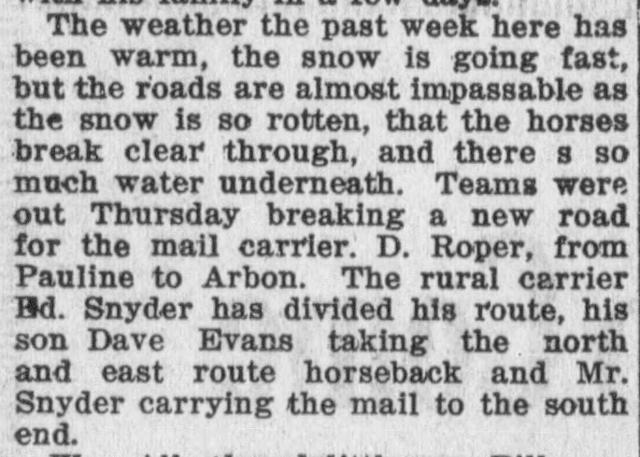
By the last week of March 1922 the snow around Arbon was melting fast, and it had gone so soft that a horse on the road sank clear through it into the water pooled below. Ed Snyder, who carried the valley’s rural mail, answered the thaw by cutting his route in two. Dave Evans rode the north and east legs on horseback, and Snyder took the mail to the south end himself.
The American Falls Press reported the arrangement in its Arbon column of March 31. Snyder had only just come back to work; two weeks earlier the column noted his return to the route after several days down with influenza. The same week’s news showed how hard the going was everywhere. The mail from Pocatello had failed to reach Arbon the previous Friday, with the Bannock Creek bridge under water and the flat beside it flooded, and on Thursday teams had been out breaking a fresh road from Pauline to Arbon for D. Roper, who carried the mail on that road.
The paper called Dave Evans Ed’s son. He was almost certainly David, the son of Ed’s wife, Hannah, by her first marriage, and so Ed’s stepson.
A widow on the homestead
Hannah was born Hannah Williams at Samaria, near Malad, on August 13, 1882. In 1898 she married David Bowen Evans, and they took up a homestead in the valley, which then lay in Oneida County. Her 1964 obituary dates the wedding July 5, 1898, in the Salt Lake Temple, while the family history of David Bowen Evans and Hannah Williams gives June 5. They raised six children, part of the Evans family of the valley. The sources split on David’s death as well. The obituary puts it in January 1912; the family history, citing his death certificate, has December 30, 1913.
In the spring of 1915 Hannah was a widow running the ranch. On May 6 the Arbon column let readers know she had “a fine line” of hats for children, misses and ladies, to be had at “the second ranch west above the Arbon postoffice.”
By late summer the column had wedding news for her:
Edward P. Snyder and Mrs. Hannah Evans were united in marriage, July 29, at Pocatello, Idaho. Mr. Snyder formerly resided at Denver Colorado, and Mrs. Snyder has lived here several years.
Ed, by his obituary, was a Nebraska man, born in 1883, who reached Arbon Valley while still young. Later accounts put the wedding on June 5, July 5 or July 28, 1915, but the Press item, printed a fortnight afterward, says July 29. A baby girl arrived at the Snyder home in April 1916, and another in June 1917. They were probably Barbara and Ruth, two of the three daughters the family history credits to Hannah and Ed.
Hail on the garden
In 1917 the Press sent a traveling correspondent, who signed himself “the Pilgrim,” out among Power County’s farms. That October he came to Mrs. Ed. Snyder’s acre of garden, two miles southwest of Arbon, where an early hailstorm had done heavy damage. Her cabbages had headed anyway, and he wrote:
Many other vegetables were completely destroyed, but the potato patch yielded enough to supply the household during the summer. Roasting ears and matured corn for seed, turnips, plenty of string beans and carrots were harvested. Mrs. Snyder has lived on this ranch seventeen years and this summer’s hail storm is the second one in all this time to destroy the garden of this farm.
Seventeen years on that ground matches the Evans homestead, so the gardener was almost surely Hannah. A second Ed Snyder and his wife lived over at Crystal, but they were not the same couple. In November the Pilgrim stopped again and found Ed, whose ranch lay two and a half miles southwest of the Arbon post office, planning 90 acres of spring grain. He had “had his share of trouble with mustard weeds,” and meant to beat them by planting only in spring.
Carrying the mail
Arbon’s rural free delivery, with a carrier taking the mail from the post office out to the farms, started in 1915, as told in the first rural mail route. Several men carried it in the early years. In October 1917 the Press named Brigham Bowen as “the rural mail carrier of Arbon.” A year later a notice of a carrier’s examination added, “During the war women are eligible as carriers.” In a storm that lasted five days in December 1919, “L. B. Evans, the rural carrier, only got part way on his route, having to return home.” That was Ren Evans, brother to Hannah’s first husband. In March 1920 the Press advertised one more examination for the job.
The Snyders had wintered in Utah and at Malad, and they came home that April. On June 11, 1920, a single line in the Arbon column said, “Mrs. Edward Snyder is now carrying the mail on the rural route.” That was probably Hannah. Whether she held the appointment in her own name or drove the route for her husband, the item does not say, and no one has yet gone through the post office’s carrier records. It is the earliest the papers read here put the Snyders on the route, and they do not show exactly when Ed started or when he quit. By March 1921 the column was promising patrons on the route mail every day, and by 1922 the carrier was Ed.
Sleigh runners and a stove
Ed’s obituary in the Salt Lake Tribune credits him with twenty-three years as Arbon’s rural mail carrier, along with running a farm, and says the family moved to Pocatello in 1943. Melinda Campbell’s history of Waldo Evans recalls that Ed ran errands in town for the families along his route. In winter he drove a truck cab mounted on sleigh runners, drawn by two horses and heated by a stove inside. Waldo, Hannah’s son, took the route over from his stepfather, she writes, and her history of his parents adds that he stayed on the homestead.
Ed Snyder died at his Pocatello home on August 12, 1958, at seventy-five. Hannah died in a Pocatello hospital on November 22, 1964, at eighty-two. Her obituaries in the Tribune and the Deseret News listed five daughters, twenty-three grandchildren and two sons, David of Boise and Waldo of Arbon, whom the Deseret News names as Evans. The digitized text mangles her first husband’s name, but the 1898 marriage, the Arbon Valley homestead and the Evans sons point plainly to David Bowen Evans.
When she died, Waldo, the son who had taken the mail route from his stepfather, was still at Arbon, on the homestead his mother had come to as a bride.
The original article
American Falls Press, March 31, 1922, page 7. Transcribed from the page scan.
ARBON NEWS.
Lizzie Davis is recovering from an attack of the mumps.
Dorothy Lee also has been entertaining the mumps and is now recovering.
Mrs. Melvin Bailey and Mrs. J. R. Bailey went to Pocatello Monday, where they will remain for several days.
The U. S. mail from Pocatello did not get here last Friday due to the Bannock Creek bridge being under water. The flat near there was all submerged due to the melting snow.
Miss Elizabeth Bailey visited last week in Pauline, at the home of her sister Mrs. Anna Lusk.
Mrs. Elmer Roderick and infant daughter returned home here, last Thursday from Pocatello, where they have been visiting the past week at the home of Mrs. Julius Abter.
Brigg Bowen visited last week at the home of his sister Mrs. Jack Price and family of Pauline, who were all ill with the “flu”. They are convalescing now.
Mrs. Jerry Baker came home from Malad a few days ago, where she has been visiting at the home of Mr. and Mrs. J. N. Arbon.
Arnold Mock and Len Carter, transacted business in Malad Tuesday and Wednesday.
Mrs. Marsdon Talion is ill at her home here.
Roy Porter came out from Pocatello last week to size up the snow drifts around his farm. He will move out with his family in a few days.
The weather the past week here has been warm, the snow is going fast, but the roads are almost impassable as the snow is so rotten, that the horses break clear through, and there s so much water underneath. Teams were out Thursday breaking a new road for the mail carrier. D. Roper, from Pauline to Arbon. The rural carrier Ed. Snyder has divided his route, his son Dave Evans taking the north and east route horseback and Mr. Snyder carrying the mail to the south end.
Wm. Allard and little son Billy returned home from Iowa, Friday, where they have been visiting with relatives the past month.
Word was received here of the death at Jackson, Wyoming, of Mrs. Daisy Blaine, of peritonitis. Her husband and four little children are left to mourn her loss, the youngest was five days old at the time of her death. Mrs. Blaine taught part of the term last year at the Valley View school.
Sources
- American Falls Press, May 6, 1915, page 4
- American Falls Press, August 12, 1915, page 4
- American Falls Press, April 20, 1916, page 1
- American Falls Press, June 22, 1917, page 8
- American Falls Press, October 26, 1917, page 3
- American Falls Press, November 30, 1917, page 3
- American Falls Press, April 30, 1918, page 4
- American Falls Press, October 4, 1918, page 3
- American Falls Press, December 19, 1919, page 1
- American Falls Press, March 12, 1920, page 2
- American Falls Press, April 23, 1920, page 7
- American Falls Press, June 11, 1920, page 6
- American Falls Press, March 18, 1921, page 2
- American Falls Press, March 17, 1922, page 4
- American Falls Press, March 31, 1922, page 7
- Salt Lake Tribune, August 13, 1958, page 28
- Salt Lake Tribune, November 23, 1964, page 21
- Deseret News, November 23, 1964, page 25