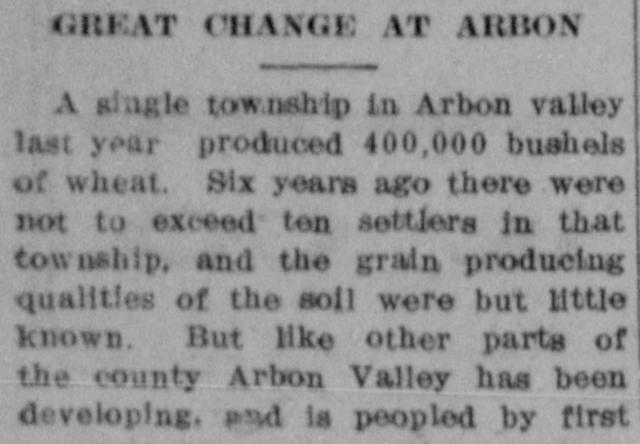
Six years earlier, by the reckoning of the American Falls Press, no more than ten settlers lived in a certain township of Arbon Valley, and nobody knew how well its ground would grow grain. In 1913 that one township raised 400,000 bushels of wheat. The paper led a short item with the figure on January 15, 1914, under the headline “Great Change at Arbon.”
It had been the first harvest since Arbon, Pauline and Crystal were taken out of Oneida County and put into the new Power County, and the Press had watched it all fall, from the threshing machines to the railroad.
Miles of stubble
On Saturday, September 6, 1913, a party of American Falls businessmen drove over to Arbon for a meeting at the Central school, where the valley organized its telephone company, as told in the first telephone line. What they saw along the way was stubble, “miles of” it. The Press of September 11 guessed that “the wheat crop of the valley will aggregate very nearly half a million bushels.”
The hard part, the paper said, was getting that grain to market. Hauling it to the railroad cost a farmer about twenty-five cents a hundredweight, or roughly fifteen cents on every sixty-pound bushel, and still the people were doing well. Given a railroad, the Press wrote, “the Bannock valley would certainly develop into one of the richest farming districts of the northwest.” Bannock Valley was the older name for Arbon Valley.
The same afternoon, back in American Falls, the county’s five locals of the Farmers’ Society of Equity merged into a single county body. The society pooled whatever its members grew and bought supplies in bulk, the Press had explained a week before, so that all of them got better prices. D. B. Ripley and L. B. Evans, two Arbon farmers the paper counted as prominent, came over for their local. T. O. Phillips of Crystal became vice-president. One director came from Arbon; the digitized page is hard to read at that spot, but the name looks most like Evans. “The company will handle grain and potatoes this coming fall,” the paper reported.
Called to Tulsa
On September 26 the Idaho Republican of Blackfoot printed Governor Haines’s choice of thirty men “prominently identified with dry farming,” and eleven women, to speak for Idaho at the International Dry Farming Congress and the International Congress of Farm Women in Tulsa, Oklahoma, from October 27 to 30. Dry farming was the raising of grain with no irrigation at all. Among the names were “Joseph Arbon, Arbon,” and “Mrs. Joseph Arbon, Arbon.” These were almost surely Joseph N. Arbon, at the time bishop of the Arbon Ward, and his wife Lizzie. His family’s account credits him and his father with bringing summer fallowing into the valley. Whether the couple went to Tulsa, no report yet found says.
Rock Creek to the Snake
Ren Evans was back in American Falls on Tuesday, October 7. The paper, which knew him as L. B. Evans and called him “one of the real live boosters for Bannock valley,” passed along his forecast. Threshing was nearly over, he said, and some wheat was already leaving the valley. But set beside the flow to come once everyone took up hauling, today’s trickle was “as Rock Creek is to Snake river.”
That afternoon the Equity’s county board voted to open an agency on the railroad at Michaud siding, buying grain and selling hay and coal, with T. O. Phillips at its head. The following week the Press reprinted an item from the Pocatello Tribune in which Harry C. Wones, the county clerk, said the American Falls elevators and warehouses were filling as fast as farmers could bring grain in from Rockland valley, Neeley, Arbon and the county’s other corners.
J. E. Keeler came to town on Tuesday, October 21, having threshed “what he considers a bumper crop”: 4,300 bushels of wheat, from acreage the scan does not show, and 1,500 bushels of dry-land oats off twenty acres. A day later David Daniels and a second Bannock Valley man said the farmers were “hauling out as rapidly as possible.”
Not every farm shared in the plenty. George Andersen, writing in 1967, recalled that the fall he and his brothers bought a threshing machine of their own, a purchase the Andersen family history places in 1913, their crops were “not too good.” Hauling to Michaud or to Malad meant three days on the road. Michaud had no houses and served no meals, so the men took along feed, bedding and food, at times in weather below zero, as he tells in his own account.
Three counts
Then came the January summing-up. After its township figure, the rest of the Press column, scrambled in the digitized page, praised the valley’s “first class men and women” and gave the credit to “the enterprise of the people who have made this great change possible.” It never said which township it meant. Six years could not stand for the valley as a whole: families had lived on the Arbon floor since the 1890s, though much of the land was claimed only after American Falls began its drive for settlers in 1908, as the Arbon family page tells.
That same day the Logan Republican had Bishop W. F. Kowallis of the Meadow Ward, at the north end of the valley, in Logan on Equity business. Dry-farm wheat had made about 23 bushels to the acre, he said, and the valley had grown 300,000 bushels. What held it back most was the lack of a railroad: “In the absence of railroad facilities, some of the farmers are compelled to haul their grain twenty-two miles to market.”
So the papers gave three numbers. In September the Press looked for close to half a million bushels from the whole valley. In January it gave 400,000 to a single township. Kowallis put the valley at 300,000. Not one of them explained how the count was made.
Frost, and fifty-six carloads
Frost came the next year. George Andersen remembered his family’s entire wheat field frozen on the morning of June 14, 1914, as told in the June frost. Even so, Gordon Williamson, who took in wheat at Michaud for the Inter-Mountain Milling Company, told the Press in February 1915 that Arbon valley farmers had sent “fifty-six carloads of wheat through his warehouse.” By January 1916 the Salt Lake Tribune was describing “a tract of 100,000 fertile acres, one-half of which is in wheat,” good for about a million bushels a year, and reporting early work toward a railroad into the valley. Grain buying reached Pauline in 1917, as the first grain warehouse tells.
The great change the Press had praised was still going on, one wagonload at a time.
The original article
American Falls Press, January 15, 1914, page 8. Transcribed from the page scan.
GREAT CHANGE AT ARBON
A single township in Arbon valley last year produced 400,000 bushels of wheat. Six years ago there were not to exceed ten settlers in that township, and the grain producing qualities of the soil were but little known. But like other parts of the county Arbon Valley has been developing, and is peopled by first class men and women. It [illegible] destined, with improved market facilities, to become one of the most wealthy and prosperous [illegible] of the county. Too much praise can not be given to the enterprise of the people who have made this great change possible.
Sources
- American Falls Press, September 4, 1913, page 1
- American Falls Press, September 11, 1913, page 1
- American Falls Press, September 11, 1913, page 2
- American Falls Press, September 11, 1913, page 8
- Idaho Republican, September 26, 1913, page 3
- American Falls Press, October 9, 1913, page 3
- American Falls Press, October 9, 1913, page 6
- American Falls Press, October 16, 1913, page 5
- American Falls Press, October 23, 1913, page 8
- American Falls Press, January 15, 1914, page 8
- Logan Republican, January 15, 1914, page 4
- American Falls Press, February 4, 1915, page 4
- Salt Lake Tribune, January 2, 1916, page 57
- George Lionel Andersen: the valley years, on this site