Twelve wagon loads of fat hogs left the south end of Arbon Valley on a Wednesday afternoon in July 1915, bound over the mountain for Malad. The drivers set out late in the day on purpose. “They left here late in the afternoon as they could make the trip while it was cool,” the American Falls Press reported on July 15.
It was one trip among many. All that summer and fall the paper’s South Arbon column, which carried the news of the Highland and Summit neighborhoods, kept noting wagons, rigs and cars headed south over the divide. Read week by week, it shows Malad as the town where the south end sold its hogs and grain, bought its machinery and supplies, and very often went to see a doctor.
Malad lay over the divide to the south and was the seat of Oneida County. Arbon had become part of the new Power County, run from American Falls, in 1913, yet the Highland school district still belonged to Oneida. In August 1915 the trustees of “District No. 12, Oneida county” bought a lot on Mamie Nunnelley’s land for a new Highland school, the one told of among the valley’s firsts.
A rough road over the divide
By the mail route, the Press had said in October 1914, Malad was 37 miles from Arbon, “over a divide that is sometimes impassable in winter.” In the worst of it only letter mail got through, carried across on horseback or on foot. The site tells of the valley’s first stage lines as well.
The road itself was new. Work on it over Jenson Pass had begun about 1910, as the Summit history tells, with a horse-drawn scraper and blasting powder, and a wagon of sacked wheat needed six horses to make the top. More of the road over the pass is told in the pages on Joseph C. Jenson and on the first engineered road out of the valley. The 1915 columns never name it; to the correspondent it was just the road between Arbon and Malad.
Its condition changed with the weather. On June 17 the column called the roads between the two towns “in splendid condition owing to the amount of good road work.” Then on September 2 the writer told of a late-summer storm:
Last Thursday there was a heavy rain just across the mountain and up to Malad, but it only sprinkled enough to settle the dust here. People who went over to Malad Friday said there was still puddles of water in the road and lots of mud.
By September 9 the report had shrunk to one line: “The road between Arbon and Malad is dreadfully rough at present.”
The road could be deadly as well as rough. In July the Luther Fellows family was on its way home from Malad when George Fellows, three years old, fell from the rig and was fatally hurt. His story is told with the valley’s tragedies.
Hogs in the cool of the evening, grain at threshing time
The twelve July wagons were not the only hog loads. In June Tracy Lee had taken one over for Lucien McLarry. On a Thursday evening early in September Gus Brahmstadt, George Bollinger and L. Hall drove thirty fat hogs of Brahmstadt’s across, and in October J. R. Stott and McLarry hauled two loads more.
Once threshing got going, grain went the same way. “Most of the heading is over and threshing is in full blast, crops are turning out good,” the column said on September 9, adding that Ed Hooker and Roy Smith had each taken a load of grain to Malad. A week later W. H. Smith and a neighbor each hauled wheat there for Mr. Nunnelley. Frank Sorensen, spelled Sorenson in the column, made the trip in November with “a four horse load of grain,” and while he was in Malad he lost a fine horse.
Some grain did go north instead. The mid-September Arbon news, on the same page of the Press, complained that on the Fort Hall Reservation the roads were “nearly impassable for those freighting grain.”
Machines, doctors and the train
When south-end farmers needed equipment, they mostly went to Malad for that too. Late in August Albert Lickingteller went after a header, the machine that clipped the heads off standing grain. Thomas King bought a new threshing machine and fetched it from Malad; by September 9 he and his sons had it home, and Mr. Mills set it up the next day, the first threshing machine at the south end as the site tells it. Nunnelley went over for a new sawmill belt, W. H. Smith for a new cylinder for his well, and Roy Smith, Jerry Baker and W. T. Ferguson each came back with a new car. Even the carpenters on the Highland school came from Malad, brought over by Mr. McIntyre, the contractor.
Malad was where the sick went, or where a doctor came from. In August, with Jack Folsom very sick, a Malad doctor crossed the mountain to see him. Clyde Johnson had a growth removed from his face there, and Mamie Nunnelley stayed a week in Malad having her teeth worked on. Guy Benson, the schoolteacher, got something in his eye while working on the new school and had to see a doctor, most likely in Malad.
Malad was also where the south end caught the train. In September Virginia Nunnelley headed back to Salt Lake City, and the Herman Noths rode with her as far as Malad. In October Mr. Nunnelley drove George Biggler there to take the train for Mendon.
Word arrived late
News came by the same road, and not always quickly. On June 24 the North and Central Arbon column reported that Mrs. Marsdon Tallon had learned of her sister’s death in the East only after a delay. “The dispatch was delayed in Malad for three days,” the column said, and by the time it reached her she could not get to the funeral.
Peaches from the south, a wire from the north
Some trips went farther still. In September the Press told of valley families going to Garland and Brigham, in northern Utah, for fruit, and once the fruit came to them. A Mr. Pett, who seems to have been from Brigham, “brought a wagon load of peaches, tomatoes and melons into the valley one day last week which was quite a treat to people living so far from market.”
On that same September 16 page, the Arbon news noted that supplies for the Bannock Valley Telephone line were coming in at American Falls. “We hope it means us,” the writer said, “as we would like to be connected up with the outside.” In early December the long-distance line from American Falls reached Arbon, as told in the first long-distance call. By late 1915 a new, level county road also ran north across the reservation toward Michaud, part of the story of the first state highway.
Malad kept its trade anyway. On June 29, 1916, the Arbon column reported Mr. Ripley and Hen Bailey setting out for Malad with two four-horse loads of fat hogs apiece, with a good price waiting at the Farmers’ Union. That August, by the Andersen family history, George Andersen went to work at the Malad grain elevator.
A year after the twelve wagons went over in the cool of the evening, the south end’s hogs were still going to Malad.
The original article
American Falls Press, September 9, 1915, page 2. Transcribed from the page scan.
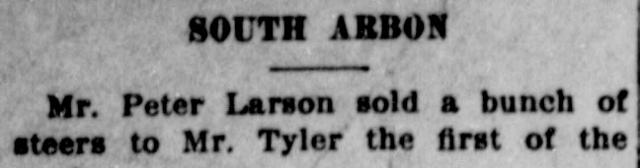
SOUTH ARBON
Mr. Peter Larson sold a bunch of steers to Mr. Tyler the first of the week.
Mr. W. A. Nunnelley has been suffering from stomach trouble.
Mr. and Mrs. A. S. McCauley have returned to their home in Dayton, Wash., after spending ten weeks with relatives here.
Mrs. Emma Sorenson and little son of Mendon, Utah, visited last week with their relatives, P. J. and Ammon Sorenson of this place, returning to their home the first of this week.
Harry Chapman and Homer Young are on the sick list.
Last Friday, Mr. Tom Stott got his over-alls caught on a set screw on the combine and tore most of his clothes off but he escaped with but slight injuries. His leg was bruised quite badly but he was able to go back to work.
E. O. Lee finished cutting his second piece of grain with his combine, last week and he says one piece made 20 bushels and the other 20. Most of the grain seems quite good but there has been but little threshing done so the farmers can not tell how it is going to turn out.
Mr. and Mrs. J. N. Ward, who have been spending most of the summer on their farm here, have returned to Malad, where they will remain for some time while Mr. Ward attends to business matters.
Messrs. L. E. Howell, Arlie and Willie King attended the dance at Sheep Creek Saturday night.
Mrs. Orvill Mikkelson has been seriously ill for the past week.
Mr. Albert Bird has rented his brother Matthew’s ranch for next year. Matthew is going east on a mission.
Mr. Thomas King has purchased a new threshing machine and will go to Malad after it the middle of this week.
Mr. and Mrs. George Bollinger visited Saturday night, and Sunday at the home of W. H. Smith.
Most of the heading is over and threshing is in full blast, crops are turning out good.
Miss Virginia Nunnelley of Salt Lake City, has been here a week visiting with homefolks.
Mr. [illegible] Smith had the misfortune to loose a young cow last week from bloat.
Mr. Gus Brahmstadt, George Bollinger and L. Hall made a trip to Malad Thursday evening taking thirty fat hogs over for Mr. Brahmstadt.
Mrs. Ammon Sorenson has been quite ill for the past week.
Mrs. Orville Mikkelson is recovering and hopes to be out again in a few days.
Mr. and Mrs. W. A. Nunnelley and daughter Mamie, Mr. W. H. Smith and Mrs. George Bollinger made a business trip to Malad Monday.
Mr. and Mrs. Emmett Lee entertained a number of the young people on Thursday evening and every one present had a jolly time. The evening was spent in making candy after which many games were played on the lawn and last but not least of all was a delicious lunch of which all people are fond.
Mr. Harvey Chapman is still on the sick list and is not able to work in the blacksmith shop.
Mrs. Gus Brahmstadt entertained the following people at dinner Thursday. Mr. and Mrs. Herman Noth, Mr. Albert Noth, Misses Mamie, Virginia, Irene and Thelma Nunnelley and Miss Olive Sorenson.
The road between Arbon and Malad is dreadfully rough at present.
The new school house is progressing nicely. The foundation is laid and they have begun on the frame work.
Dr. R. F. Noth and wife, Mr. and Mrs. D. W. Brown and son [illegible], of American Falls were the guests of Mr. and Mrs. Herman Noth last Sunday.
Mr. H. E. Chapman and family were Sunday evening visitors at the home of Mr. and Mrs. Jack Folsom.
Mr. Tom Stott who got his leg hurt on the combine has been quite lame for the past week.
A few days ago while Tracy Lee was doctoring a wire cut on one of his horses it jerked its leg up and threw iodine in both of his eyes. He feared at first his eyes were out but after a few days they were all right.
Misses Gena and Thelma Rust were visitors at W. A. Nunnelley’s last Monday.
Mrs. E. O. Lee and children visited at E. O. Smith’s Friday.
Mr. Thos. King and sons got back from Malad Friday with their new threshing machine and Mr. Mills set it up Saturday.
The many friends of Grandma Hayes will be glad to learn that she is much improved and is able to be out again.
Mr. Ed Hooker and Roy Smith each took a load of grain to Malad Thursday.
Mr. [illegible] Randall of Pauline was here, on business Saturday and stayed until Sunday.
Mr. E. O. Smith and daughter Elmira will leave Tuesday for a visit with relatives in Logan, Utah.
Mrs. Lee Hatfield is enjoying a visit from her mother, Mrs. Reed of Dayton, Wash.
Mr. Girkin and family have moved to the farm he recently purchased from Mr. Albert Swenson.
Miss Dorothea Neilson, of Pocatello, is visiting her mother, Mrs. [illegible], of this place.
Mrs. Paul Donelley and Mrs. Robert Stott spent last week with Mrs. Emmett Lee.
Mr. Nunnelley has finished sawing and has moved his engine down and will begin threshing this week.
Mr. Ed. Hooker had the misfortune to loose a fine cow last Sunday.
Misses Mamie and Thelma Nunnelley spent last Monday with their sister Mrs. Herman Noth.
Work on the new school building is progressing nicely.
Lois, the little daughter of Mr. and Mrs. Harry Chapman, was quite sick last week.
Miss Hilda Swenson of Logan, Utah is visiting relatives here.
Mr. W. W. Ralph, of Rockland, was over last week to see about his brother’s cattle here.
There has been a number of dangerous looking fires through this section and a lot of fence burned but there has been but little grain burned so far.
Sources
- American Falls Press, October 15, 1914, page 1
- American Falls Press, June 3, 1915, page 4
- American Falls Press, June 17, 1915, page 1
- American Falls Press, June 24, 1915, page 8
- American Falls Press, July 15, 1915, page 1
- American Falls Press, August 12, 1915, page 4
- American Falls Press, September 2, 1915, page 8
- American Falls Press, September 9, 1915, page 2
- American Falls Press, September 16, 1915, page 2
- American Falls Press, September 30, 1915, page 6
- American Falls Press, October 14, 1915, page 6
- American Falls Press, November 11, 1915, page 5
- American Falls Press, June 29, 1916, page 6