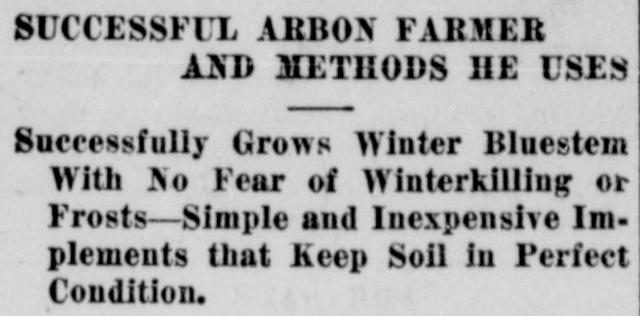
Smut was everywhere in Arbon Valley wheat in the fall of 1915. Power County’s new county agent spent several days among the farms that October and came home to American Falls carrying grain from one ranch where he could find none at all. It belonged to Henry Shandrew, and on October 28 the American Falls Press put the agent’s account of how Shandrew farmed on its front page, under the headline “Successful Arbon Farmer and Methods He Uses.”
Shandrew’s place was about four and a half miles south of the Arbon post office. The valley had two men of that name, a father and a son: the Press mentioned “Henry Shandrew Sr” in 1911 and “Mr. and Mrs. Henry Shandrew, Jr.” in 1916. The stories told here use the name without either label. They most likely mean the elder man, but they never say.
Good enough for San Francisco
The year before, the valley’s wheat had been healthy. In early December 1914 Shandrew told the Press a long dry stretch had farmers worried about their fall-sown grain, but that Arbon, unlike some districts, was “comparatively free from smut.” A week later the paper said he believed his Turkey Red could stand up at the 1915 exposition in San Francisco against “wheat grown by anybody anywhere,” and that he planned to send some to Jones, the director of exhibits. No one knows whether he did. The exposition’s catalogue lists J. H. Bullock among Idaho’s wheat exhibitors, fresh from first prize at the state seed show for his dry-land wheat. Shandrew’s name has not turned up in it.
The smut arrives
Smut, also called bunt, is a fungus that leaves a wheat kernel full of black dust. A Department of Agriculture bulletin of 1925 named it “the bunt, or stinking smut.” The defense was to treat seed before it went into the ground. In June 1915 the Press observed that the county had first suffered badly from smut the previous year, and by harvest an elevator company was offering to buy smutty wheat in sacks “at a reasonable discount.” In early October the South Arbon correspondent wrote that the Sorenson brothers’ thresher (the family spelled the name Sorensen) had suffered an explosion “caused by smut,” an accident the Stories entry describes. George L. Andersen, who had once swapped horses with Henry Shandrew, wrote years afterward that his crop in a dry year, dated on this site to 1915, “turned out to be real smutty” and brought a lower price.
As clean as a board
The man who went looking was a Mr. Kjosness. The county commissioners had taken him on in September 1915 to lay out demonstration plots on farms, gather farmers into clubs and call on places where something was going wrong. He returned from “the Arbon country” on a Friday in October, pleased with the welcome and with the better farmers’ readiness to try his demonstrations.
Shandrew, he said, was “one of the older settlers and a first class farmer.” His farm was “as clean as a board,” and his summer fallow, the ground he left unseeded for a season and kept free of weeds so that it would hold water for the next crop, was in ideal shape. It had not always been so. Shandrew once had very different notions of farming, until a term at the Utah Agricultural College at Logan “convinced him of the error of his former ways of doing things.”
After Logan he plowed twelve inches deep to build a reservoir of moisture, and he set the plow at a new depth each season so that it would not leave a plow sole, the packed layer that forms when the share runs at one depth year after year. In 1915 he went down only four inches, and the ground turned over “as mellow as a garden.” He had given up the disk. His tools were a plow, a harrow and a weeder of his own making, built like a drag from 3x8 timbers, which the agent said did work as good as a $100 to $200 machine. He ran it while the weeds were no more than an inch high and kept the place weedless.
The yields showed it. His winter Bluestem made 36 bushels to the acre and his Turkey Red 31, “of perfectly clean, and perfectly colored berries.” Neighbors who had “stubbled-in” their grain, drilling it into last year’s stubble with no plowing, had failures beside him. His garden grew three kinds of peas, table and sugar beets, berries, radishes, carrots and Burbank and Gold Coin potatoes.
Kjosness carried home samples of the grain and potatoes and remarked on the “total absence of smut” in Shandrew’s wheat, with smut plain to see elsewhere in the valley. The paper explained why:
Mr. Shandrew always treats his seed grain for smut and in telling of his experiences laughingly referred to one man he knew who was seeding in the dark of the moon to prevent smut, and using smutty grain for seed on land that had produced a smutty crop.
Frost had been hard on the valley too; George Andersen lost wheat to a June frost, probably in 1914. The agent thought good tillage was the answer to that as well:
His crops do not suffer from frosts. I have been told that winter Bluestem was an uncertain crop here. Mr. Shandrew does not find it so, and I am inclined to the opinion that frosts will be a very small factor in either wheat or forage crops when the soil is packed and a good seed bed formed by summer fallow.
The Idaho Republican at Blackfoot picked up the report and ran it again. The site’s Stories entry on summer fallowing puts the valley’s earliest dated case at George Andersen’s eighty acres in 1916, but Shandrew already had fallow ground in ideal condition when the agent saw it in October 1915.
A wheat that would not take the smut
That same year a federal plant scientist was also in the valley’s wheat fields. In 1925 the Department of Agriculture published Relative Resistance of Wheat to Bunt in the Pacific Coast States, and of all the common wheats it tested, only two came through immune. One was a strain of Martin, also called Martin Amber, a tall winter wheat with soft white kernels and heads without awns. It “originated from a plant selected from a field of wheat near Arbon, Idaho, by Carleton R. Ball in 1915,” the bulletin says. Ball’s wheat was “not especially productive or of high quality,” but it held promise for breeders who wanted bunt-resistant wheats with white kernels or awnless heads. In the same year Ball picked another plant, this one from a field of Defiance wheat in “Bannock Valley,” as the valley was once known, and from it came a resistant strain of White Odessa. The bulletin names no owner for either field, and no account of Ball’s visit has turned up in the Press.
The cost of treating seed
The cure carried its own risk. In October 1917 the Press printed a warning from an Arbon valley farmer who had lost a valuable horse that spring. Seed wheat treated with formaldehyde had been dumped onto a canvas wagon cover, the poison had seeped through to some alfalfa lying beneath it, and the horse died after eating a handful.
By 1925 the county agent, now L. E. Tillotson, was showing farmers a newer treatment, copper carbonate. His report for the year recorded the first demonstration in that community, begun “in the Arbon Valley this fall on the farm of Wm. Allard.” The older Shandrews were gone by then; Anna Shandrew’s obituary says the family moved to Avon, Utah, in 1919. The man who had laughed at sowing by the dark of the moon had left the valley, but the wheat that could not catch the smut had come out of its fields.
The original article
American Falls Press, October 28, 1915, page 1. Transcribed from the page scan.
SUCCESSFUL ARBON FARMER AND METHODS HE USES
Successfully Grows Winter Bluestem With No Fear of Winterkilling or Frosts—Simple and Inexpensive Implements that Keep Soil in Perfect Condition.
County Agent Kjosness returned from a several days’ visit to the Arbon country Friday, highly pleased with his trip. He met many of the farmers of that locality and is assured of their cooperation in whatever he may undertake. One thing that pleased him greatly was the willingness he found among the better farmers to undertake demonstrations under his direction. These demonstration plots will be of great value, he is certain, to the communities in which they are located.
With the character of that locality and the conditions which surround it, he was equally well pleased. As an evidence of what can be produced there by adopting good methods he referred to the record of Henry Shandrew, one of the older settlers and a first class farmer. Mr. Shawdrew’s farm is as clean as a board, he stated, and his summer fallow in ideal condition. Mr. Shawdrew formerly had ideas of farming that were far different from those he now uses, but a term spent at the Utah Agricultural college at Logan convinced him of the error of his former ways of doing things.
He put the new ideas he gained into use by plowing twelve inches deep, to create a reservoir to hold a larger amount of moisture than shallow plowing would retain. Each season he sets his plow at a different depth to avoid plow soles. This year he plowed only four inches deep, and the soil turned over as mellow as a garden, leaving an ideal seed bed and a perfect mulch.
He has abandoned the use of a disk, and advises against its use except on new land where there is sod. The tools he employs to put and keep his soil in perfect condition are all simple and inexpensive, consisting of a plow, harrow and a home-made weeder which can also be used for dragging. It is built like a drag with 3x8 timbers for side pieces, with cross pieces set perpendicular when used as a drag. These cross pieces are set on an incline, and extend a little below the side pieces so as to plow into the ground a little, when he uses it as a weeder. It does as perfect work as a complicated weeder costing from $100 to $200 and is not only inexpensive but so simple that anyone can make it.
He uses this weeder when the weeds are small, not more than about an inch high, with such good effect that he has a weedless place. These methods keep his ground packed, supplying a good seed bed with a sufficient surface mulch to keep moisture near enough to the surface to germinate the seed when planted.
The results of his methods are strikingly shown by the yields he secures and the variety of things he is able to produce. His winter Bluestem yielded 36 bushels per acre, and his Turkey Red 31 bushels, of perfectly clean, and perfectly colored berries. Some of his neighbors who stubbled-in their grain had failures in comparison. His garden produced three varieties of peas, table and sugar beets, several kinds of berries, radishes, carrots, and fine Burbank and Gold coin potatoes.
Mr. Kjosness brought home samples of Mr. Shandrew’s grain and potatoes and commented upon the total absence of smut in the grain, while there were abundant evidences of smut elsewhere in the valley. Mr. Shandrew always treats his seed grain for smut and in telling of his experiences laughingly referred to one man he knew who was seeding in the dark of the moon to prevent smut, and using smutty grain for seed on land that had produced a smutty crop. Mr. Shandrew was confident he could tell in advance what the result would be.
Mr. Kjosness was informed that there was one man in the valley who proposed to grow wheat for a long series of years with but one plowing. His yield, never large, fell to twelve bushels, then to eight, and then to practically nothing, while those who followed good methods secured good to splendid yields.
“In an other particular,” said Mr. Kjosness, “the results secured by Mr. Shandrew are worthy of note. His crops do not suffer from frosts. I have been told that winter Bluestem was an uncertain crop here. Mr. Shandrew does not find it so, and I am inclined to the opinion that frosts will be a very small factor in either wheat or forage crops when the soil is packed and a good seed bed formed by summer fallow, I believe that a good solid seed bed will give sufficient protection from frosts or winter killing to insure a crop.”
Sources
- American Falls Press, September 14, 1911, page 1
- American Falls Press, December 3, 1914, page 5
- American Falls Press, December 10, 1914, page 2
- American Falls Press, June 24, 1915, page 1
- American Falls Press, September 9, 1915, page 2
- American Falls Press, September 16, 1915, page 1
- American Falls Press, October 7, 1915, page 1
- American Falls Press, October 14, 1915, page 1
- American Falls Press, October 28, 1915, page 1
- Idaho Republican, November 12, 1915, page 3
- American Falls Press, March 30, 1916, page 7
- American Falls Press, October 23, 1917, page 3
- American Falls Press, October 26, 1917, page 3
- Cache Valley Daily Herald, November 28, 1930, page 8
- Official Catalogue of Exhibitors, Panama-Pacific International Exposition (1915)
- W. H. Tisdale and others, Relative Resistance of Wheat to Bunt in the Pacific Coast States, USDA Department Bulletin 1299 (1925)
- Copper-Carbonate Treatment for Stinking Smut of Wheat: Excerpts from 1925 Annual Reports of State and County Extension Agents, USDA (1926)
- George L. Andersen, “The valley years,” on this site