Bishop Wilhelm F. Kowallis came down to Logan in January 1914 on farmers’ business, and he brought the troubles of Bannock Valley with him. The valley had grown 300,000 bushels of wheat that year, he told the Logan Republican, which spelled him “Kawallis” in its headline. But there was no railroad, and some farmers were hauling their grain twenty-two miles to sell it. Then he named one more difficulty: “Another set back is a dearth of young ladies as many farmers’ boys desire to be joined in wedlock.”
His congregation was the Meadow Ward, at Pauline, at the valley’s north end. Three years after his Logan visit, on March 29, 1917, the American Falls Press ran a long history of Bannock Valley by Mrs. E. A. Logan, and a short part of it was given to Pauline’s beginnings. The newspapers of those years tell the rest, most of all the story of the ward and its first bishop.
A store at the lower end
Mrs. Logan placed Pauline at “the lower end of the Bannock valley.” She meant downstream. Bannock Creek flows north out of the valley, and the Pauline neighborhood followed it down to the line of the Fort Hall Reservation.
Its first business, she wrote, was John Noble’s. “Six years ago,” that is, about 1911, he put up a building and opened a general store. For a time it traded as Noble & Kowallis, until a notice dated at Pauline in November 1913 said Noble had bought out his partner. The site’s Stories tell of the first store at Pauline. Lumbermen came too: David Ripley, the Dawson brothers and William A. Nunnelley, whose lumber let the farmers put up new buildings, and Albert C. Thomsen kept a blacksmith shop.
School in a log cabin
Schooling started before the store. In 1910 Mrs. George Butler held classes for a few children in a small log cabin on West Fork. The next year Perry Howell took the school into another cabin, one of Ed Pellum’s, and later moved it into the Latter-day Saint church building, which was finished with a school in mind. Mrs. Logan called his work “highly satisfactory.” He went on to teach at the Central school when it first opened, and L. B. Howell taught at Pauline for the next four years.
In 1913 School District No. 13 voted bonds for a two-room schoolhouse, and it went up the same year. By 1917 Perry Howell was back, teaching there with Miss Mary Evans. The site’s Stories cover the first schools at West Fork and Pauline.
The post office
Mrs. Logan gave 1912 as the year of the post office, with John Noble as postmaster, but the Post Office Department’s records, as this site sums them up, show Fanny E. Noble appointed on September 25, 1911 (the first post office at Pauline). By the time she wrote, the office had moved into a Kowallis home, “whose wife is postmistress”; the first name is illegible on the page. The site’s records list Hestella Kowallis as postmaster from 1914. She was very likely Estella Abrams, who married the bishop’s brother John Kowallis, according to his 1949 obituary.
A ward called Meadow
Latter-day Saints at Pauline had a Sunday school by 1910, Mrs. Logan wrote, with J. H. Hansen as superintendent and John W. Lusk and John Bischoff to help him. A ward, the church’s local congregation under a bishop, followed. She gave its officers as W. F. Kowallis, bishop; Charles Myler and W. W. Jenks, counselors; and W. E. Dawson, clerk. At the same time the Sunday school was reorganized under J. D. Dawson, with F. E. Fredrickson and C. W. Knowles as assistants. Wards are grouped into stakes, and this one belonged to the Malad Stake.
She dated the ward to 1912, but the papers of the day show it a year earlier. In March 1911 the Arbon news in the Press announced: “The new meeting house at the north end of the valley will be completed this week and a big dance is being planned for Friday night.” The item does not say so, but that was probably the Pauline building. On June 28, 1911, the Salt Lake Herald-Republican reported a new ward in the Malad Stake, with Wilhelm Kowallis of Arbon, Oneida County, as its bishop. The paper printed his name “Kowalles,” and named the clerk as William Dowson, probably W. E. Dawson. Arbon lay in Oneida County until Power County was formed in 1913. The digitized page is badly jumbled, but “New Meadow” and “Ward” can still be made out.
According to his obituaries, Kowallis was born in Berlin, Germany, in 1884 and came to the United States as a small boy. He later served a mission in Indiana and married Bertha J. Abrams there in 1907. His mother was named Pauline, and church tradition, which this site records, says the settlement took her name (the first ward at Pauline).
The bishop at work
Kowallis worked for his neighbors well beyond the chapel. In March 1915 the Press reported that he had gone through Arbon, Pauline and Crystal and collected the names of 345 heads of families who wanted a mail route to American Falls. The digitized text of that article gives 346. The valley got a route from Pocatello the following year.
The meeting house also served for more than worship. In May 1915 the funeral of “Grandma” Horton, the wife of Elias Horton, was held there (the first burials in the Pauline Cemetery). “The house was crowded with friends who came to pay their last respects,” the Press wrote. Before the month was out, the ward held an entertainment there to pay for a fence around the church grounds.
A new bishop
The change came in the spring of 1918. On April 9 the Pauline column gave notice:
Meadow ward at Pauline is to be reorganized next Sunday, April 14th. It is desired that all members of the ward be present as conference will also be held the same day.
Before the month ended, the Arbon column told of a farewell party at Pauline for the former bishop and his family. The name is mangled in the digitized text, though it seems to read Kowallis. By June he had moved, and the Press noted that “Mr. Kowallis of Logan and formerly bishop of Pauline” had been visiting Crystal.
None of the 1918 items found for this story names his successor. In August 1919 a Bishop Howell attended the stake conference at American Falls “from the Meadow ward at Arbon.” Later reports call him H. Perry Howell, almost surely the same man who had taught Pauline’s children in a log cabin. That October the Pauline correspondent wrote of stake Relief Society visitors coming to “our little ward.” The next spring Bishop Howell sent the paper a frank account:
Due to the small number and rough weather, the members here are only attempting to hold the regular Sabbath sessions (Sunday school and Sacrament meetings.)
The other organizations, he added, would start up again once the ward had more members and the weather turned. In May 1920 W. E. Dawson and Robert W. Heatley, as the digitized text spells it (probably Robert Wheatley), were sustained as counselors. They replaced Edward Pohl and Clarence Knowles, who had moved away. By March 1922 a Bishop Robert Wheatley was in charge. At Erma Lusk’s funeral that month, Howell, who by then lived at Clifton, Idaho, spoke as a former bishop of Pauline.
Wilhelm Kowallis stayed in Logan, where he sold hardware and farm implements. He died there in June 1940, and his obituary in the Logan paper remembered his years as bishop of the Meadow Ward. The ward itself had been gone for eleven years by then. The site’s history of Pauline and West Fork records that it was dissolved in 1929 and that its last members joined the Arbon Ward. The settlement kept the name that tradition says came from his mother.
The original article
American Falls Press, March 29, 1917, second edition, page 7. Transcribed from the page scan.
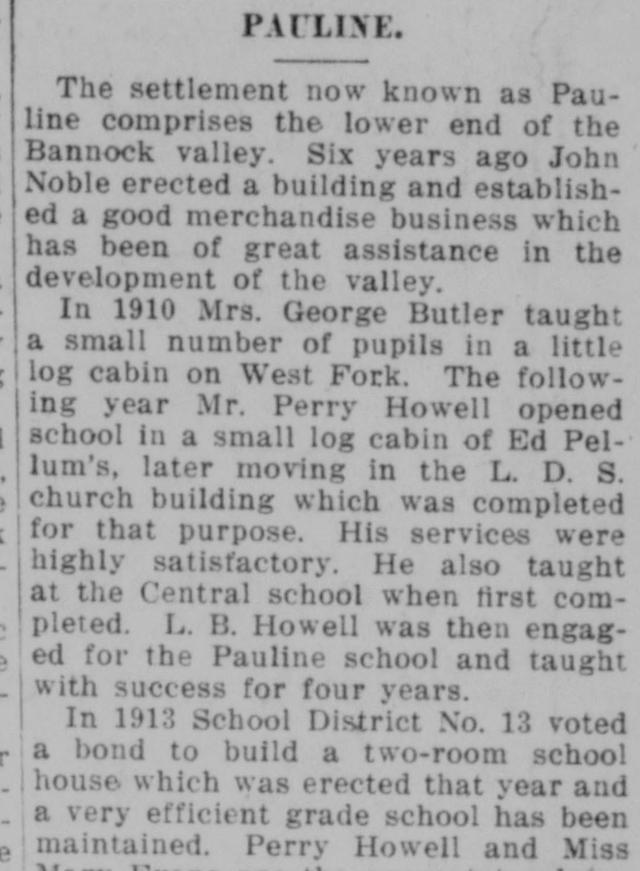
PAULINE.
The settlement now known as Pauline comprises the lower end of the Bannock valley. Six years ago John Noble erected a building and established a good merchandise business which has been of great assistance in the development of the valley.
In 1910 Mrs. George Butler taught a small number of pupils in a little log cabin on West Fork. The following year Mr. Perry Howell opened school in a small log cabin of Ed Pellum’s, later moving in the L. D. S. church building which was completed for that purpose. His services were highly satisfactory. He also taught at the Central school when first completed. L. B. Howell was then engaged for the Pauline school and taught with success for four years.
In 1913 School District No. 13 voted a bond to build a two-room school house which was erected that year and a very efficient grade school has been maintained. Perry Howell and Miss Mary Evans are the present teachers.
In 1912 a post office was established and named Pauline. John Noble acted as post master. The post office was later moved to the residence of [illegible] Kowallis, whose wife is postmistress.
David Ripley and the Dawson brothers, also William A. Nunnelley have done their share in lumber business in making it possible for farmers of the community to erect many new buildings.
Albert C. Thomsen runs a blacksmith shop which has been a useful factor in the progress of the farming industry.
The L. D. S. Sunday school at Pauline was organized in 1910 with J. H. Hansen as superintendent, with John W. Lusk and John Bischoff as his assistants. In 1912 a ward organization of the L. D. S. church was formed with W. F. Kowallis as bishop, Charles Myler and W. W. Jenks, his counselors. W. E. Dawson, clerk. The Sunday school was reorganized at this time with J. D. Dawson as superintendent and F. E. Fredrickson and C. W. Knowles his assistants.
Sources
- American Falls Press, March 11, 1911, page 4
- Salt Lake Herald-Republican, June 28, 1911, page 9
- American Falls Press, November 20, 1913, page 1
- Logan Republican, January 15, 1914, page 4
- American Falls Press, March 11, 1915, page 1
- American Falls Press, May 13, 1915, page 8
- American Falls Press, May 20, 1915, page 8
- American Falls Press, March 29, 1917, second edition, page 7
- American Falls Press, April 9, 1918, page 3
- American Falls Press, April 30, 1918, page 4
- American Falls Press, June 18, 1918, page 3
- American Falls Press, August 29, 1919, page 1
- American Falls Press, October 10, 1919, page 6
- American Falls Press, April 23, 1920, page 7
- American Falls Press, May 21, 1920, page 2
- American Falls Press, March 10, 1922, page 4
- Logan Herald Journal, June 18, 1940, page 1
- Deseret News, June 19, 1940, page 16
- Deseret News, March 7, 1949, page 20