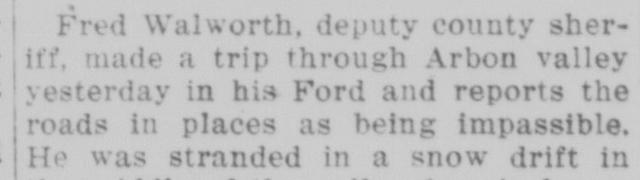
Fred Walworth set out through Arbon Valley in his Ford on Monday, June 4, 1917, and got stuck in a snowdrift in the middle of the valley. He sat there six hours. The deputy county sheriff did not see American Falls again until the next morning, and he told the American Falls Press that in places the roads could not be traveled at all. The worst of them lay west of the Pauline school, he said, and he meant to take the matter to the county commissioners in hope of getting them improved. Whether the commissioners did anything about it, no report has been found to say.
It had been that kind of year for anyone going to or from town. The valley, which had belonged to Oneida County until Power County was carved out in 1913, had just come through the stock-killing winter of 1916–17. Its mail came out by road from Pocatello, and its wheat went out by road to the railroad, so the Press kept close track of those roads from spring to the first snows.
A car to the cement bridge, a sleigh beyond
Late in April the Arbon column reported that Lorin Bailey, who carried the mail from Pocatello, had bought a car. He could drive it across the Fort Hall Reservation on the reservation road as far as Mr. Bolingbroke’s place, near the cement bridge at Pauline. From there on he went by sleigh. “We still have snow and plenty of it,” the column added.
When the snow let go, the water came. On Sunday, May 27, J. E. Keeler drove from Arbon to American Falls to bring his daughter Nina home from high school, and the bad roads made it a trip of twice the usual time. Around then Newell Leishman, the first regular carrier on Arbon’s rural mail route, took a turn bringing the mail out from Pocatello. Near the Swanson ranch, close to where Power and Bannock counties meet, the Portneuf had spilled over its banks and stood deep at either end of the bridge. Leishman made it through the mud and water to Rattlesnake, though at one crossing he had to ford, “the water coming up into the engine of the car.” “Newt says never again,” the column reported.
A week after that came the deputy sheriff’s long night in the drift. Roy Porter, who farmed a mile west of the Arbon post office, later told “the Pilgrim,” the paper’s traveling farm writer, that the roads that spring had kept his family from reaching the ranch in time for the early work. He ran behind all summer.
The wrong road to American Falls
Some travelers landed in the valley without meaning to. On June 12 the Arbon correspondent wrote that tourists headed for American Falls kept taking “the wrong road at Bannock near the pole line,” most likely at the railroad station of that name. Signboards gave the miles to American Falls, the correspondent complained, but did not point the way, and the graded Arbon road looked so good that drivers trusted it. Most of them got as far as John Noble’s store at Pauline before learning their mistake; Noble kept the first store at Pauline. Arbon was happy to have visitors see the place, the writer allowed, “but could not something be done to help the tourists.”
Six horses and a bobsled
In September the Pilgrim rode along with Lorin Bailey on the mail route from Pocatello up Mink Creek canyon to Crystal, then on toward Pauline and Arbon. Parts of the canyon road were “so narrow that if two outfits ever meet one of them will have to back up to a wider part of the road.” The radiator boiled over several times, and each time it was topped up with “extract of Mink creek.”
That November he wrote that Bailey “beats it to Pocatello,” as one of the carrier’s small daughters put it, three times every week. In summer the car made the round trip in seven to ten hours, depending on how much mail there was to hand out. The past winter had been another matter. Through the months of deep snow it took six horses to drag the bobsled through the drifts, and carrying the mail was hard work and at times risky. Lorin Bailey’s family history remembers the trip with a team over Mink Creek Pass as a full day each way to Pocatello and back; the shorter figure in the Press was for the car in summer.
Close calls and a broken bridge
Fall brought its own scares. One Monday afternoon in September, about three miles north of Crystal, the mail auto stage came around a curve nearly into the front of a touring car, and its driver kept clear of a wreck only by taking his car down the grade and around the other. The Press laid the blame on the touring car’s driver for failing to sound his horn. Two weeks or so later, two automobiles barely missed each other on a sharp curve between Pauline and Crystal. “Just why drivers of cars try to make these turns without sounding the horn is one of the inexplicable mysteries of the universe,” the Pauline correspondent wrote.
Then a bridge gave way. The Crystal column of October 9 told how Will Denning and his son Floyd were taking a load of grain over the Portneuf River bridge south of Pocatello, near the fair grounds, when “the bridge broke down.” Father and son came out unhurt. The horses and grain were recovered “with some difficulty,” but one sack of wheat was lost and a horse was “bruised quite badly.” Nobody yet knew whether the county would make good the damage, and no later word on it has been found.
By the end of October the Arbon column called the roads to Pocatello “in bad shape.” Ed Davis, who hauled goods for his Arbon store in a truck of his own, had broken it down on the reservation. In the same column of October 30, Newell Leishman had sold his car to Parley Bailey and was planning to spend the winter down in Utah.
Teams wanted
The roads stopped the grain next. Three trucks had been hauling sacked wheat from the platforms at Pauline to the railroad at Michaud, first three trips a day, then two, then one. Early in November the platforms stopped taking grain. Mud had nothing to do with it this time; the Press put it down to “the abominable condition of the roads throughout the protracted dry spell.” By November 16 the call from the wheat buyers was “Teams Wanted.”
Help came slowly. In April 1919 J. E. Keeler, the father whose drive to fetch his daughter had taken twice as long in May 1917, signed a call for bids as chairman of the valley’s new highway district. The job was graveling fifteen miles of Arbon Valley wagon road running south along Bannock Creek. That same year a state highway was designated from Pocatello to Arbon, and the road to town became the state’s road too.
The original article
American Falls Press, June 5, 1917, page 1. Transcribed from the page scan. The item was printed without a headline.
Fred Walworth, deputy county sheriff, made a trip through Arbon valley yesterday in his Ford and reports the roads in places as being impassible. He was stranded in a snow drift in the middle of the valley for six hours and didn’t reach American Falls until this morning. He will report the condition of the roads in that section to the county commissioners and see if an attempt will not be made to have them improved. The worst roads he found were west of the Pauline school.
Sources
- American Falls Press, September 14, 1911, page 1
- American Falls Press, April 26, 1917, page 3
- American Falls Press, May 29, 1917, page 5
- American Falls Press, June 5, 1917, page 1
- American Falls Press, June 5, 1917, page 2
- American Falls Press, June 12, 1917, page 4
- American Falls Press, September 18, 1917, page 3
- American Falls Press, September 21, 1917, page 3
- American Falls Press, October 5, 1917, page 3
- American Falls Press, October 9, 1917, page 3
- American Falls Press, October 30, 1917, page 3
- American Falls Press, November 2, 1917, page 3
- American Falls Press, November 9, 1917, page 8
- American Falls Press, November 16, 1917, page 1
- American Falls Press, January 1, 1918, page 3
- American Falls Press, April 25, 1919, page 4
- Melinda Campbell, “Lorin Bailey,” on this site
- The stock-killing winter of 1916–17, Stories, on this site
- The first mail route from Pocatello, Stories, on this site
- The first rural mail route, Stories, on this site
- The first store at Pauline, Stories, on this site
- The first grain warehouse, Stories, on this site
- Edward Henry Davis and Esther Rebecca Arbon, on this site
- The first state highway and graveled road, Stories, on this site