The Fullers thought somebody had driven up. One night near the close of the summer of 1917, John Fuller’s household in Arbon heard what sounded like an automobile pulling up to their gate and stopping there. They stepped outside, found the lane empty and went back in, puzzled. Nobody thought to look overhead.
The answer came with Hebe Woods the next morning. He stopped at the Fuller place to ask whether they had seen the aeroplane go over in the night. That, he told them, was what they had heard.
“The big bird”
The American Falls Press carried the story on September 7, 1917, in its Arbon column. Arbon had belonged to Oneida County until Power County was carved out in 1913, and the Press, printed at the new county seat, ran a regular letter of news from the valley. That week’s letter put the aeroplane in among a slow harvest, the postmistress’s holiday and the passing of a parrot.
According to the correspondent, the machine “came from the west and went on toward the southeast,” and Hebe had been near enough that “he could see the shape of it.” The Fullers were not the only ones. “Many others also saw the big bird,” the column said, and some of the people who had missed it were now to be seen at all hours scanning the sky in case another came along.
The column gave the date only as “last week,” which puts the night somewhere around the turn from August to September. It told nothing of lights, the time of night or the weather.
Both households were known in the valley. By April 1916 John Fuller and his wife were running the Central hall, with a dance there each Saturday evening. The man the column called Hebe Woods was most likely Heber Wood, a valley resident since 1911 or earlier, whose ranch the Press described in January 1918 as lying “well over to the east side of Arbon valley.” The Andersen family history remembers him from the hard winter of 1911–12, when Heber Woods and the Arnn family were nearly the only people outside the family that George Andersen and Beth saw before the snow went off.
A slow harvest
The rest of the letter shows what else the valley had on its mind that week. Since the late rains, green mustard had sprung up in the grain, combines and headers had been giving trouble, and plenty of fields stood waiting for the mustard to ripen before anyone would cut them. Clarence England had wheat that stood tall with long heads, yet the heads proved empty, a loss laid to frost at blossom time. Louie Leavitt, the postmistress, was away visiting at Albion, and Ethel Johnston was keeping the office. Mrs. Hy Secrists, as the column spelled her name, had lost Polly, the parrot she had raised from three months old and taught to say nearly anything; it died of pneumonia after ten years with her.
No word of a pilot
Nothing more about the flight turned up in the issues of the Press searched for this story, from late August through the county fair in the middle of September. No one put a name to a pilot, a route or a purpose.
The same paper made plain how hard it was to get an aeroplane into Power County at all that year. The Power County Fair at American Falls, opening the week after the Arbon column ran, billed daily afternoon flights as “the biggest attraction.” Its managers had a contract with a Seattle aviator and were told his “aeroplane was boxed ready for shipment.” He never arrived, and neither did a second flier who offered to stand in for him. Once the fair was over, the officers said in the Press that the broken contract was their only complaint, and that a straight answer from the man would have let them find someone else.
Elsewhere on the page with the Arbon letter, aeroplanes belonged to the war: a correspondent for the Paris Matin touring an American flying camp in France, and German machines over the Gulf of Riga.
Arbon had company in what it reported. That July and August, as Prairie Public’s Dakota Datebook has retold from the newspapers, people in western North Dakota told of hearing and seeing aeroplanes with lights after dark, and the guesses about them ranged from German spies to bootleggers to flying students.
Eyes on the sky
Two months on, the Press’s traveling writer, who signed himself “the Pilgrim,” came through the valley and took note of a solitary pine on the Mink Creek divide. It stood out from the valley north of Pauline and marked the road to the Mink Creek pass. Someday, he predicted, airships would carry the traffic, the automobile would be “relegated to the rear,” and the tree would serve as the “pilot’s guide.” Readers who found that far-fetched, he wrote, ought to recall how they once laughed at “horseless carriages.” “This old world keeps a-moving,” he said, “and progress is the order of the day.”
By January 1918 a young man from the area had joined the flying service. The Crystal column reported that Leroy Johnston had signed up for the aviation corps and was waiting at Salt Lake to be sent to Texas for training with six hundred more.
The site’s list of firsts dates the first airplane on record over the valley to July 30, 1929, when the pilot of a National Parks Airways mail plane reported a forest fire west of Arbon. The 1917 sighting came twelve years before that, but it rests only on what a few households saw and heard and on one country correspondent’s letter, with no record of any flight behind it. More of the town’s past is in the Arbon area history.
Whatever passed over that night, it left part of the valley looking up.
The original article
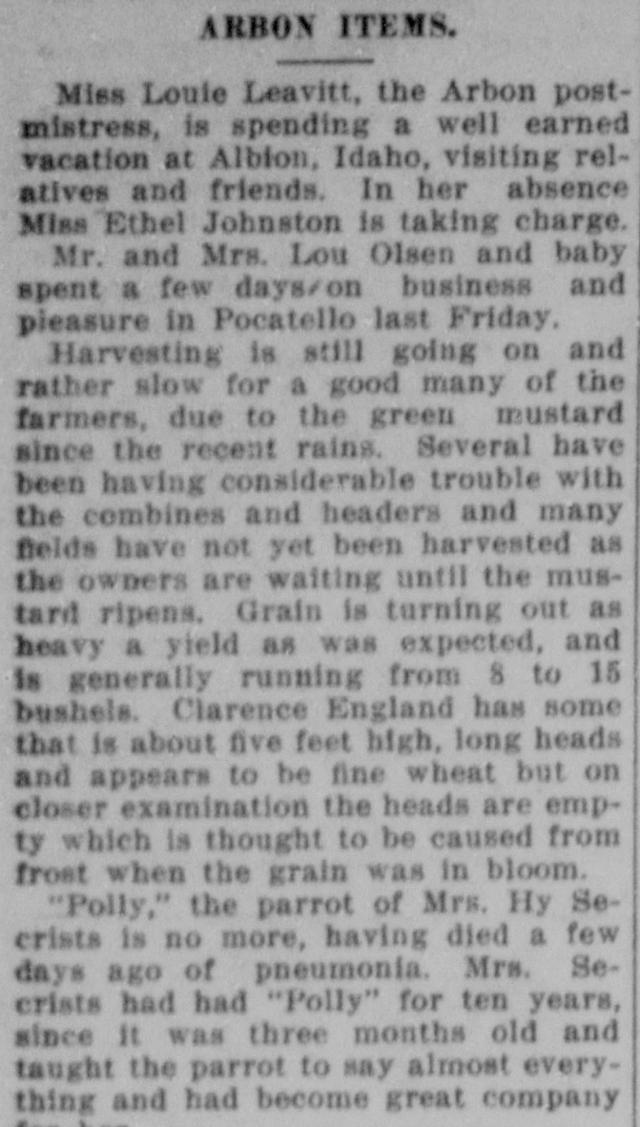
American Falls Press, September 7, 1917, page 8. Transcribed from the page scan.
ARBON ITEMS.
Miss Louie Leavitt, the Arbon postmistress, is spending a well earned vacation at Albion, Idaho, visiting relatives and friends. In her absence Miss Ethel Johnston is taking charge.
Mr. and Mrs. Lou Olsen and baby spent a few days on business and pleasure in Pocatello last Friday.
Harvesting is still going on and rather slow for a good many of the farmers, due to the green mustard since the recent rains. Several have been having considerable trouble with the combines and headers and many fields have not yet been harvested as the owners are waiting until the mustard ripens. Grain is turning out as heavy a yield as was expected, and is generally running from 8 to 15 bushels. Clarence England has some that is about five feet high, long heads and appears to be fine wheat but on closer examination the heads are empty which is thought to be caused from frost when the grain was in bloom.
“Polly,” the parrot of Mrs. Hy Secrists is no more, having died a few days ago of pneumonia. Mrs. Secrists had had “Polly” for ten years, since it was three months old and taught the parrot to say almost everything and had become great company for her.
Last week the family of John Fuller thought they heard car come up to their gate and stop and went out to see but could see no car, although it sounded like one near. Never thinking to look up they went back into the house and next morning Hebe Woods came to the Fuller home and asked them if they had seen the aeroplane the night before, which was the noise they heard. The aeroplane came from the west and went on toward the southeast. Hebe said it was so close he could see the shape of it. Many others also saw the big bird and several who didn’t may be seen any time now going around and looking up in the sky for another.
Miss [illegible] Klug of Raymond, Canada, has been visiting here for several days with her cousin, Miss Ethel Johnston.
Frank E. Jones of Pocatello was here last week visiting with relatives.
Miss Mary Evans who taught at Pauline last year returned a few days ago and will teach there again this term. Mr. Williams who taught at [illegible] will be over for the kiddies and about the [illegible] of September [illegible] their school work [illegible].
Perry Howell is to teach all grades at Central school this term.
[illegible] and Howard Keeler are [illegible] to the Idaho Technical Institute at Pocatello this [illegible] expect to move into Pocatello during the school term. Several others are contemplating leaving for the [illegible] this fall.
John Kowallis has taken up his station at Michaud siding to buy grain for the Farmers’ Society of Equity there. Mrs. Kowallis and children went to Utah to spend the winter.
Mr. and Mrs. John Noble motored to Pocatello Saturday and brought out a truck of merchandise, mostly good eats such as cantaloupe, watermelons and other things which the large crowds go to the Noble store for on Mondays.
W. H. Heninger was a business visitor in [illegible] the past week.
Ed Davis made his usual trip to Pocatello last week in his truck, bringing back a fine load of eatables.
The Zaring platform is progressing rapidly and grain will soon be received down there by the cement bridge north of the Pauline school building.
Several people are choke cherrying in the mountains these days, there being more and better choke cherries than usual this year.
The dance Saturday night at Central hall was well patronized, there [illegible] the largest crowd out for some time. Many Pocatello and Crystal people came out to attend the hop.
Mr. and Mrs. J. E. Keeler, J. W. [illegible], Howard and Mildred Keeler, Thelma Rust, Margaret Allard and Richard Bandy were a jolly party which motored into Pocatello Sunday afternoon in J. E.’s car, making the trip in one hour and fifty minutes, without any mishap.
Sources
- American Falls Press, April 27, 1916, page 6
- American Falls Press, September 7, 1917, page 8
- American Falls Press, September 11, 1917, page 1
- American Falls Press, September 18, 1917, page 1
- American Falls Press, November 6, 1917, page 3
- American Falls Press, January 8, 1918, page 3
- American Falls Press, January 29, 1918, page 4
- Prairie Public, Dakota Datebook, “Phantom Flyers,” May 16, 2022