A wagon creaked past the Pauline wheat platform at one o’clock in the morning, and the man who bought wheat there took it for a farmer running late. Before dawn the two men on that wagon were asleep under guard in a deputy sheriff’s house three miles down the valley, 29 sacks of stolen wheat in his yard and their team in his stable.
It happened early on Friday, November 9, 1917, at the north end of Arbon Valley, the country told of in the history of Pauline and West Fork. The American Falls Press carried the story on page one the following Tuesday, and over the next year it followed the two men to the penitentiary and out again.
Sacks piling up
Wheat buyers that fall were taking grain at platforms at Pauline and Crystal, so farmers no longer had to make the long haul to the railroad themselves; trucks moved the sacks on to the line at Michaud. By early November bad roads had held the trucks up for a time, and the sacks stood stacked and waiting. The valley’s first grain warehouse later grew from a platform at Pauline.
Ed England bought for the Zaring platform and lived just behind it. For several weeks the loads arriving from the south had been driven a quarter mile north to the scales at the tithing yard, weighed there, and brought back to be unloaded.
A lantern on the trail
So when England heard a wagon in the dark and went out, he was not surprised to see it pointed toward the tithing-yard scales. What caught his attention was that it never stopped at the platform. It rolled on south past it. England fetched a lantern and walked the wheel tracks up to the scales, where he found the wagon had been turned around, a move the paper took as meant to throw him off. He telephoned Deputy Sheriff Secrist, who lived about three miles south, and Secrist went north to the first crossroad to wait.
The night was very dark. From where he stood Secrist could hear the two men talking, and he heard them remark on the light still burning in his house. The wagon stopped. After some ten minutes Secrist slipped back home, “blew out the light and then took station behind a telephone pole in front of his yard.”
When the team drew level with the pole he stepped out and ordered the men to drive into his yard. He arrested them, stabled their horses, put the pair to bed in his own house and sat up over them until daylight. In the morning they were taken to American Falls, the Power County seat, and locked in the county jail. Until 1913 the valley had belonged to Oneida County.
The men owned up to the 29 sacks and asked Secrist to ring England “so they could square the matter. This Mr. Secrist declined to do.” The Press thought they had planned to come back the next day and sell the wheat to the very platform they had taken it from.
Two to fourteen years
The prisoners were Godfrey Harris, who had been threshing in Arbon Valley that season with his own outfit, and William Straugh, his hired man, both of American Falls. Harris’s threshing machine was stored at the Brahmstadt ranch. In its Friday issue the paper added that Harris had come from Washington state and that Straugh had once paid a fine for bootlegging. His surname turns up as both Straugh and Strough.
Both waived a preliminary hearing. On Wednesday, November 14, they stood before Judge Terrell at Pocatello, pleaded guilty and drew indeterminate terms of two to fourteen years. “TWO TO FOURTEEN YEARS FOR WHEAT THIEVES,” the Press headlined on November 16. The penitentiary chaplain, James Leitch, came for them on the evening of the 15th and took them to Boise. “But retribution came quickly,” the paper wrote, “and the men will eat breakfast this morning with Warden DeKay, as enforced guests at the penitentiary.”
The name stirred up one more bit of trouble. Someone told Andrew Stroh of Aberdeen that the man in jail was his son William, who farmed near Blackfoot. Father and son both made the trip to American Falls to clear it up, and on November 20 the paper set the record straight: “Stroh is Stro. Straugh is Straw.”
Neither man served anything like fourteen years. On October 8, 1918, the Press announced: “Pardons have been granted William H. Strough and Gottfried H. Harris, to take effect December 24.” The notice recalled the wheat stolen in Arbon and said the pair had been “caught with the goods” by Constable Hy Secrist. They walked out on Christmas Eve, a little over thirteen months after reaching Boise. It was not the valley’s last wheat case; the Stories pages tell of a later charge, against Joe Kulock in 1927.
The farmer with a badge
The 1917 stories name the officer only as Secrist. The pardon notice and later items make him, almost certainly, Hyrum Secrist, known as “Hy” in the valley columns. That March the Press had reported that he had put up a “fine bungalow on his splendid farm,” and that his son Jesse had finished a house on his own homestead. Mrs. Secrist was a sister of William Affleck and of Mrs. John Bullock of Arbon. When he first took on the deputy’s or constable’s work, the papers do not say.
He kept at it for years. In July 1920 the Arbon correspondent, in a column that also thanked neighbors for “keeping the sheep back,” wrote that Secrist had put in two weeks “riding the ranges, on the lookout for sheepmen, also arresting several for Trespassing.” On March 17, 1921, he rode with Deputy Sheriff Charles Torrance’s posse to W. H. Ball’s place near Pauline, where Ball’s first shot knocked the cap off Secrist’s head. Torrance was mortally wounded in that fight, as the Stories entry on the shootings recounts. In September Secrist and a deputy game warden from Blackfoot were out in the Crystal country “rounding up violators of the game law,” and toward the end of that year the county paid him for serving subpoenas and arrest warrants.
In the summer of 1922 Secrist took charge of the Saturday dances at the freshly renovated Central Hall in Arbon. That August a correspondent complained that moonshine had broken up one of them, credited Secrist with trying to make the hall clean and respectable, and warned it would be shut if that crowd kept on. In November Mr. and Mrs. Hy Secrist and Mr. and Mrs. Jesse Secrist went to Pocatello for the winter. Five years after he blew out his lamp and waited in the dark behind a telephone pole, the farmer-deputy was still the man Arbon called on when something went wrong.
The original article
American Falls Press, November 13, 1917, page 1. Transcribed from the page scan.
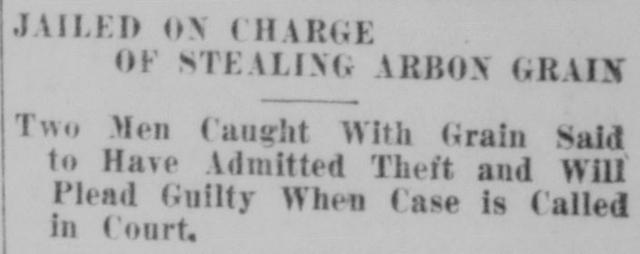
JAILED ON CHARGE OF STEALING ARBON GRAIN
Two Men Caught With Grain Said to Have Admitted Theft and Will Plead Guilty When Case is Called in Court.
Last Friday about 1 o’clock a. m. Ed England, buyer at the Zaring wheat platform at Pauline, who resides just in the rear of the platform, heard a wagon approaching the platform and thinking some farmer had come in late with a load to be weighed, he went out and saw the wagon heading for the tithing yard scales, a quarter mile north of the platform. The past few weeks it has been customary for the loads of wheat to go to these scales. Loads coming from the south go to the scales, weigh the load, and then return to the platform to be unloaded. Instead of stopping at the platform the wagon heard Friday morning continued south past the platform, and the suspicion of Mr. England was aroused. He went for a lantern and followed the tracks of the wagon from the platform to the tithing scales and saw that the load had been turned there. This evidently was done to throw him off the trail. Mr. England telephoned to Deputy Sheriff Secrist, who resides about three miles south of the platform, and this officer went north to the first cross road and awaited the coming of the wagon. It was very dark and he could hear the men talking and mention the fact that a light was burning in Mr. Secrist’s home. They stopped the team, and after waiting about ten minutes Mr. Secrist returned to his home, blew out the light and then took station behind a telephone pole in front of his yard. When the outfit was abreast of him he stepped out, halted them and told them to drive into his yard, placed the men under arrest, put the team into his stable, then put the men to bed in his home and stood guard over them until morning, when they were taken to American Falls and placed in the county jail. They confessed the stealing of the 29 sacks of wheat and wanted Mr. Secrist to call Mr. England up over the phone so they could square the matter. This Mr. Secrist declined to do. The intention of the two men, it is believed, was to return with the load the following day and sell it to the platform from which it was stolen.
The men’s names are Godfrey Harris and William Straugh. Harris has been in Arbon valley with his threshing outfit this fall and Straugh has been working for him. Both are from American Falls. The Harris threshing outfit is stored away at the Brahmstadt ranch.
The two men waived their preliminary hearing and according to reports they will plead guilty in the district court to the charge of grand larceny.
Sources
- American Falls Press, March 29, 1917, page 7
- American Falls Press, November 13, 1917, page 1
- American Falls Press, November 13, 1917, page 3
- American Falls Press, November 16, 1917, page 1
- American Falls Press, November 20, 1917, page 1
- American Falls Press, October 8, 1918, page 3
- American Falls Press, March 12, 1920, page 3
- American Falls Press, July 16, 1920, page 3
- American Falls Press, March 18, 1921, page 1
- American Falls Press, September 23, 1921, page 4
- American Falls Press, December 9, 1921, page 9
- American Falls Press, July 13, 1922, page 4
- American Falls Press, August 24, 1922, page 1
- American Falls Press, November 2, 1922, page 2