Snow lay more than a foot deep across Power County on Tuesday, November 2, 1920, and the roads were close to impassable. The voters came out anyway, and the valley’s three precincts in the county went three different ways. Pauline, at the north end of the valley, gave the Nonpartisan League’s independent ticket four votes or more for every one it gave anybody else. Arbon held heavily Republican. Crystal was close, and when its returns came in they decided, at least on the first count, which way the whole county went for United States senator, by one vote. On the League’s ticket for the valley’s seat on the county board stood a Pauline neighborhood man, Jack McCool.
A farmers’ league
The League had come calling three years earlier. In September 1917 A. E. Bowen, a League organizer from North Dakota, spoke to about a hundred farmers and businessmen at American Falls, seat of the Power County that had taken in the valley from Oneida County in 1913. As the American Falls Press put it, the League meant to win enough political control of Idaho to make the legislature act on “state owned elevators, packing houses and cold storage plants.”
On April 30, 1918, the Arbon column reported, in a badly garbled line, “a non partisan meeting” held one night at the Central school house. It was probably a League gathering, though the column never named it. By June 1920 the League had a county branch, headed by W. H. Griswold, manager of the Ford Motor Company at American Falls. He told the Press that 460 members had paid their $18 fee.
Jack McCool of Arbon
That July the League met in convention at American Falls. Mr. and Mrs. George W. Bandy went in from the valley for it, and the Arbon column added that “Jack McCool of Arbon also attended, being elected supervisor.” What office that was, the paper did not say.
His full name was John A. McCool. When he married Mabel Geesey of Fairview in September 1917, the column called him “John McCool, or Jack as we call him.” By 1920 his name was on the county jury list for Pauline.
Idaho had a new primary law that year, and the Press read it as a way to “prevent a political organization like the nonpartisan league from stealing the election at the polls from another party.” The League answered by putting up an independent ticket of its own by petition. On July 23 a notice over Griswold’s name told members to stay out of the party primaries altogether: “Every member is warned to stay away from polls of both Democratic and Republican primarys August 3rd, 1920.” Candidates in both parties, it said, would do all they could to coax League men into voting there.
By August the League’s petitions held 530 names. Among the signers the Press listed were W. E. and J. R. Dawson, Earl R. Daniels, Luther Estep and G. M. Houk. The same names appear on that year’s Pauline jury list, and they were very probably the same men.
Three valley men for one seat
A commissioner represented one of the county’s three districts, but the whole county voted for each of them, “the people voting for a member from each of the three districts,” as the Press had explained in 1918. The valley’s seat was the Third District. On the October ballot were E. C. England of Pauline, the Republican commissioner, asking for a second term; J. E. Keeler for the Democrats, very probably the Arbon farmer of that name; and John A. McCool on the League’s “Independent County Ticket.”
Readers of the Press were not getting a neutral account. The paper had called the League “an expression of socialism in its rankest form,” and its editor, K. E. Torrance, chaired the Republican county committee. On October 22 it printed the terms of his wager with Griswold. If the Republicans failed to elect six of their eleven county candidates, Torrance would wheel Griswold down the main street in a wheelbarrow, singing “The Star-Spangled Banner.” If the League failed to elect five of its nine, Griswold was to supply “the free ride and music.”
Election day in the snow
The snow did not keep people home. At least 1,933 ballots were cast, the most the county had ever recorded. The Republicans won every county office on their ticket, and England kept his seat. Out in the country the independents had run 63 votes ahead across the fifteen precincts, but American Falls itself gave the Republicans a margin of better than 300 and settled the matter. Pauline was named among the seven precincts that went nonpartisan “as high as eight to one, and never below four to one,” and Arbon among those the Republicans took “by heavy majorities.” Crystal was one of three counted as close; it leaned to the League.
The paper printed no numbers for Pauline. Part of the official abstract appeared on November 26, but its continuation on page 7 cannot be read in the surviving scan, so how McCool fared among his own neighbors is not known.
The Senate race pitted Senator John F. Nugent, a Democrat, against Frank R. Gooding, a Republican. Until Thursday night Republican headquarters had “conceded Nugent to the nonpartisans in the county returns.” Then Crystal reported, “surprisingly strong for Gooding, with the result that he carried the county by one vote.” The Press cautioned that a recanvass might yet turn up a majority for Nugent, and its own headline ran the other way, “NUGENT WINS BY SINGLE VOTE.” No later count has turned up to settle the county’s margin. Statewide, the Democrats conceded the seat to Gooding.
At Arbon, the column reported, “Election day at the Arbon precincts was very quiet.” Of 117 registered voters, 72 cast ballots. Several had moved out for the winter, and the roads kept others home. “Traveling with cars is impossible,” the column said. The judges that day were William Allard, who had served Power County in the legislature, T. B. Evans and Roy Porter. The clerks were Joe Evans and Mrs. Jennie Logan, very probably the woman who wrote the valley’s first written history.
Two years on
England ran again in November 1922. He carried Arbon 27 to 17 and Pauline by a single vote, but Rockland led a Democratic sweep that put Perry Lusk of the West Fork, the Democrat, in his chair. Pauline voted Republican that year by a thin margin, save for a few minor offices and the governor’s race, where H. F. Samuels, the Progressive, edged C. C. Moore, the Republican, 19 to 18. Four years earlier, in 1918, Samuels had been the League’s man for governor.
The histories of Pauline and West Fork, Arbon and Crystal tell more of the three precincts, and the first county commissioners from the valley have their own place among the valley’s firsts. Pauline had changed its party that year. It had not lost the habit of splitting its ballot by a vote or two.
The original article
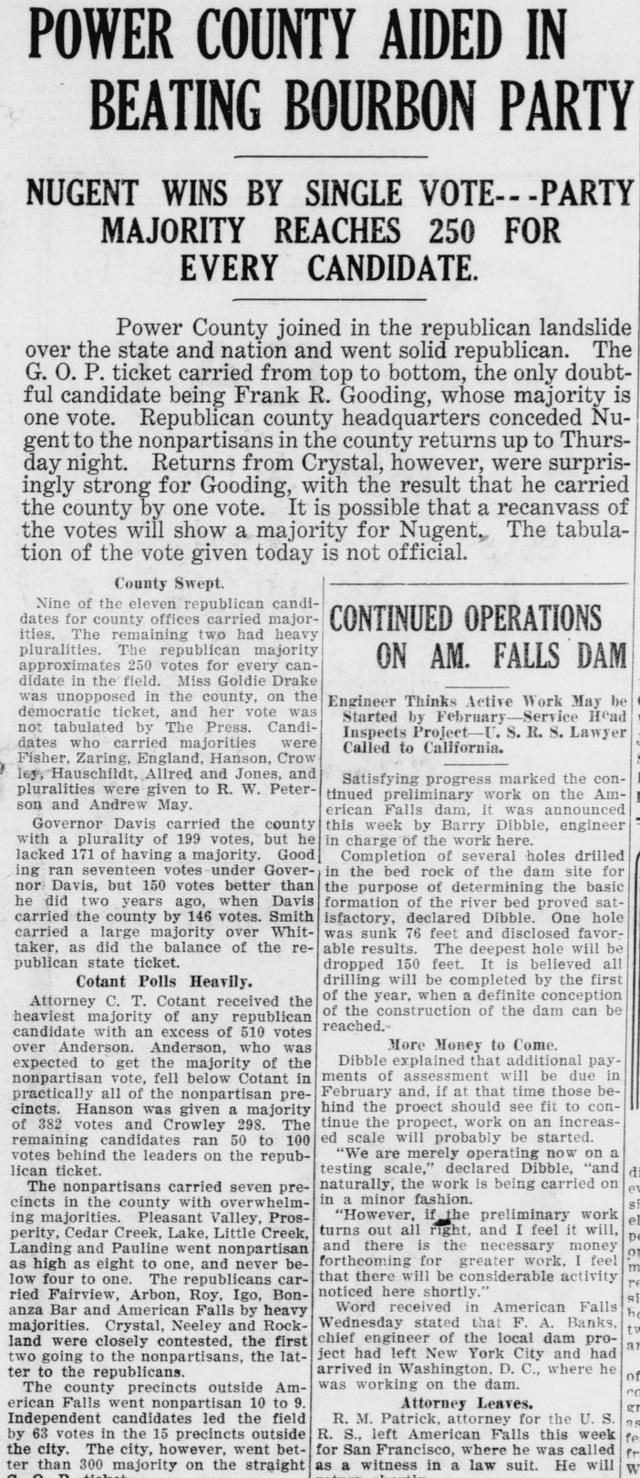
American Falls Press, November 5, 1920, page 1. Transcribed from the page scan.
POWER COUNTY AIDED IN BEATING BOURBON PARTY
NUGENT WINS BY SINGLE VOTE---PARTY MAJORITY REACHES 250 FOR EVERY CANDIDATE.
Power County joined in the republican landslide over the state and nation and went solid republican. The G. O. P. ticket carried from top to bottom, the only doubtful candidate being Frank R. Gooding, whose majority is one vote. Republican county headquarters conceded Nugent to the nonpartisans in the county returns up to Thursday night. Returns from Crystal, however, were surprisingly strong for Gooding, with the result that he carried the county by one vote. It is possible that a recanvass of the votes will show a majority for Nugent. The tabulation of the vote given today is not official.
County Swept.
Nine of the eleven republican candidates for county offices carried majorities. The remaining two had heavy pluralities. The republican majority approximates 250 votes for every candidate in the field. Miss Goldie Drake was unopposed in the county, on the democratic ticket, and her vote was not tabulated by The Press. Candidates who carried majorities were Fisher, Zaring, England, Hanson, Crowley, Hauschildt, Allred and Jones, and pluralities were given to R. W. Peterson and Andrew May.
Governor Davis carried the county with a plurality of 199 votes, but he lacked 171 of having a majority. Gooding ran seventeen votes under Governor Davis, but 150 votes better than he did two years ago, when Davis carried the county by 146 votes. Smith carried a large majority over Whittaker, as did the balance of the republican state ticket.
Cotant Polls Heavily.
Attorney C. T. Cotant received the heaviest majority of any republican candidate with an excess of 510 votes over Anderson. Anderson, who was expected to get the majority of the nonpartisan vote, fell below Cotant in practically all of the nonpartisan precincts. Hanson was given a majority of 382 votes and Crowley 298. The remaining candidates ran 50 to 100 votes behind the leaders on the republican ticket.
The nonpartisans carried seven precincts in the county with overwhelming majorities. Pleasant Valley, Prosperity, Cedar Creek, Lake, Little Creek, Landing and Pauline went nonpartisan as high as eight to one, and never below four to one. The republicans carried Fairview, Arbon, Roy, Igo, Bonanza Bar and American Falls by heavy majorities. Crystal, Neeley and Rockland were closely contested, the first two going to the nonpartisans, the latter to the republicans.
The county precincts outside American Falls went nonpartisan 10 to 9. Independent candidates led the field by 63 votes in the 15 precincts outside the city. The city, however, went better than 300 majority on the straight G. O. P. ticket.
Record Vote Cast.
A minimum of 1933 votes were cast Tuesday, despite the severe handicap of over a foot of snow and almost impassable roads. It is the highest yet recorded in the county. Little effort was found necessary to get the voters to the polls. Nonpartisan voters voted almost to the man. Republican precincts recorded an equally solid vote for the G. O. P. ticket. Seven hundred and eighteen votes, two fifths of the entire vote, was cast in American Falls precinct. Over half the vote was cast in American Falls and Rockland.
Reports from every precinct in the county record a quiet day at the polls. Voting was orderly in practically every instance. Thus far no contest has arisen and no question of illegal voting has marred the returns. The voters responded to the man and the verdict was decisive.
Money Changed Hands.
Considerable money changed hands Wednesday morning, following the returns from the election, much being won on Davis, Gooding and the election of the majority of the republican ticket. Little Cox money was in evidence at any time.
Returns from the east began to arrive in the city about 5 p. m. Tuesday. First bulletins predicted a tremendous majority for the republicans.
Sources
- American Falls Press, September 11, 1917, page 1
- American Falls Press, September 11, 1917, page 5
- American Falls Press, September 18, 1917, page 4
- American Falls Press, April 30, 1918, page 4
- American Falls Press, July 5, 1918, page 1
- American Falls Press, November 1, 1918, page 2
- American Falls Press, April 16, 1920, page 1
- American Falls Press, April 16, 1920, page 6
- American Falls Press, June 11, 1920, page 1
- American Falls Press, July 9, 1920, page 1
- American Falls Press, July 16, 1920, page 3
- American Falls Press, July 23, 1920, page 9
- American Falls Press, August 20, 1920, page 1
- American Falls Press, October 15, 1920, page 4
- American Falls Press, October 22, 1920, page 1
- American Falls Press, October 22, 1920, page 7
- American Falls Press, November 5, 1920, page 1
- American Falls Press, November 12, 1920, page 2
- American Falls Press, November 26, 1920, page 7
- American Falls Press, October 5, 1922, page 1
- American Falls Press, November 9, 1922, page 1
- American Falls Press, November 9, 1922, page 4