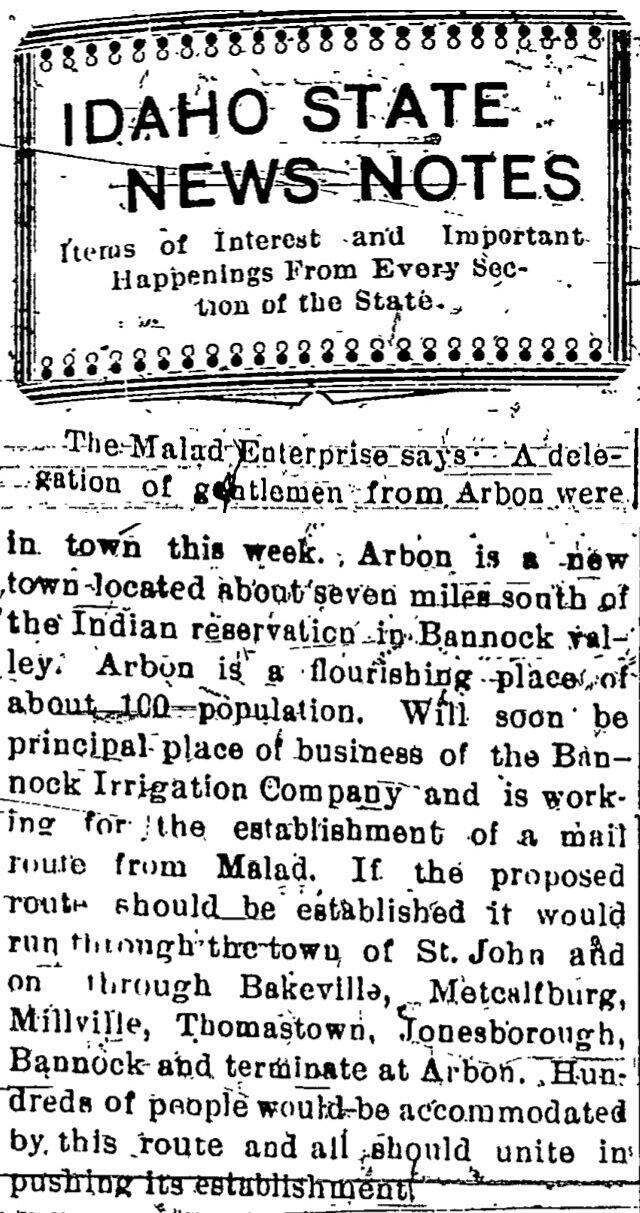
Sometime in the first weeks of 1898, a party of men came into Malad City from a settlement so new that the paper had to explain where it was. The Malad Enterprise took note of the visitors and of the place they spoke for. Arbon, the paper told its readers, was “a new town,” a flourishing place of about 100 people some seven miles south of the Indian reservation, and it wanted a mail route from Malad.
The Pocatello Tribune picked up the item and ran it on February 23 among its “Idaho State News Notes.” Of all the papers searched for this site, it holds the earliest description of Arbon under that name.
A valley still called Bannock
The town the delegates described sat in what was then Bannock Valley, in Oneida County; Power County would not exist until 1913. Settlement there was only a few years old. One early account has Joe Arbon and his father George spending the winter of 1895 and 1896 in a dug-out, and the families who held on through the following winter came through a hard one.
Even the reservation line the Enterprise measured from was about to shift. That same February, the Shoshone and Bannock people made the agreement that gave up the southeastern part of their reservation, the Crystal basin included. It was ratified in 1900, and in 1902 the land opened to homesteaders, as another post in this series tells.
The paper did not name the delegates. Nineteen years later, telling the American Falls Press’s farm writer how Arbon began, D. J. Bowen listed the settlers living near the townsite in 1898: himself, E. H. Davis, George Arbon, J. R. Bailey, L. H. Evans (as the paper spelled it), the Ward brothers and the Anderson brothers (the Andersens, as the family spells it). The men who went to Malad most likely came from those households, though no record says which ones. Bowen’s full account is retold in D. J. Bowen tells the Pilgrim how Arbon began.
The Enterprise also predicted that Arbon would soon become the main place of business for the “Bannock Irrigation Company.” That was almost surely the Bannock Valley Irrigation Company, the first organization the valley had. It held its first meeting in 1893 and was formally filed at Samaria in 1895, and Bowen remembered surveying its canal with a Davis, using nothing better than an ordinary spirit level. Whether the company ever did shift its business to Arbon, no later source says.
Eight stops to Arbon
The route the delegation wanted would leave Malad, pass through St. John, and go on by way of Bakeville, Metcalfburg, Millville, Thomastown, Jonesborough and Bannock before ending at Arbon. “Hundreds of people would be accommodated by this route,” the Enterprise said, urging everyone to get behind it.
Except for Malad and St. John, none of those names appears in any other paper read for this site. The 1900 census of St. John Precinct does show several Thomas and Jones households and a Frank Metcalf, so a few of the stops may have been neighborhoods known by the families living in them, but that is no more than a guess. The papers are silent, too, on whether the contract route of 1899 kept to this line. Later accounts bring the mail from Malad over Rocky Ridge instead.
A post office in the works
The trip fell in the weeks when the settlers’ bid for a post office was under way. In the National Archives papers behind this site’s entry on the first post office, a Post Office Department location paper dated January 8, 1898, proposes an office at “Mountain Side,” to be named Arbon. It counted about seventy people to be served, fewer than the Enterprise’s hundred, with supply by special arrangement from Malad City, 35 miles off. Bowen signed it as the would-be postmaster on February 16, one week before the Tribune printed the Malad item. Just when the Enterprise ran its story, and so when the delegation came to town, is not known, and neither is whether the visit had anything to do with the paperwork or whether Bowen went along.
The office took the name of George Arbon, the oldest man among the settlers. Bowen received his appointment on June 21, and that August the post office opened in his log cabin. Its first quarter century is told in Who kept the Arbon post office, 1898–1922.
An office was not yet a mail route. For six months after it opened, Bowen recalled, the government let no contract, and the patrons took turns fetching the mail from Malad on their own. Mrs. E. A. Logan, whose history of the valley ran in the American Falls Press in 1917, wrote that the mail “came by chance from Samaria,” a remark she makes right after telling how the settlers named their “little township” for George Arbon, without saying when. The first carrier the settlers paid was a young lad, Fred Paine (Logan spells it Payne), who by her account kept at it three months; once winter set in, the settlers went back to carrying it in turns. Bowen and Logan may well be describing the same stretch of months.
The government finally let its first mail contract in the spring of 1899, as told under the first mail carriers. Until then, the town that had sent its delegation to Malad got its letters home the same way: by going after them itself.
The original article
Pocatello Tribune, February 23, 1898, page 7. Transcribed from the page scan. The item, credited to the Malad Enterprise, is one of many in the column “Idaho State News Notes”; it begins at the foot of the first column and continues at the head of the second. Only the Arbon item is given here.
IDAHO STATE NEWS NOTES
Items of Interest and Important Happenings From Every Section of the State.
The Malad Enterprise says: A delegation of gentlemen from Arbon were in town this week. Arbon is a new town located about seven miles south of the Indian reservation in Bannock valley. Arbon is a flourishing place of about 100 population. Will soon be principal place of business of the Bannock Irrigation Company and is working for the establishment of a mail route from Malad. If the proposed route should be established it would run through the town of St. John and on through Bakeville, Metcalfburg, Millville, Thomastown, Jonesborough, Bannock and terminate at Arbon. Hundreds of people would be accommodated by this route and all should unite in pushing its establishment.