Sixteen teams pulled out of the Arbon settlement on a Monday morning in November 1908, every wagon stacked with sacked wheat and every one headed for the same empty freight car. The car stood waiting at Michaud switch, a siding on the railroad between American Falls and Pocatello. By Tuesday morning it was full and bound for Ogden, and that Saturday, November 21, the American Falls Press put the trip on its front page under the heading “Caravan of Arbon Wheat,” naming each man who had driven a team.
The Monday was most likely November 16. A Cache Valley firm had bought the grain, the paper said, and more loads would follow before long. The firm’s name was not given; Cache Valley is the country around Logan, Utah, and runs north across the line into Idaho.
A crop with no railroad
Arbon then lay in Oneida County, since Power County would not exist until 1913, and no rail line came near the valley. Earlier that fall the Press had passed along the count kept by Julius Abter, who ran the valley’s threshing machine (the Stories page on the first threshing machines tells how such machines came to Arbon): 45,000 bushels of wheat, or roughly twenty-five to the acre. Arbon’s postmaster, J. R. Bailey, came to town a week later, and the paper repeated the 45,000 as the wheat still waiting “to be hauled out,” adding that a common team could carry some thirty sacks to market.
The caravan did better than that. Each of the sixteen loads averaged thirty-five sacks, each sack about 120 pounds, and the Press put the whole train at about 1,100 bushels. Moving the year’s harvest, it figured, would take “about forty such caravans.” The arithmetic stands up. At sixty pounds a bushel, sixteen wagons of that size carry close to 1,100 bushels, and forty trips would come to about 44,000, near enough to the fall estimate.
Why Michaud
The Press called American Falls “the natural market for Arbon,” and some valley wheat did go there. Page 4 of the same issue noted that Willard Bailey, “one of the prosperous settlers of Arbon,” had brought a load into town on Saturday. But the machinery for the town’s new grain elevator was late, and Manager Bennion of the American Falls Milling Company had nearly every warehouse he could find already filled. The machinery turned up the following week, for an elevator the paper said would hold 100,000 bushels. Until then Bennion stacked sacked grain anywhere there was space.
The valley was working on the distance, too. The same front page told how the settlers had picked Adam Affleck, Lorenzo Evans and John Payne to answer letters from would-be homeseekers, and how $300 was to go right away into a new road to American Falls that ought to cut ten or twelve miles from the haul. A week on, the Press said all the wheat still to come out of Arbon made finishing the road close to a necessity. The article does not say which road the caravan took to Michaud.
The men who drove
The sixteen men “in charge of the wagons,” as the paper listed them, were Joe Arbon, Jim Payne, Chance Payne, Ed. Davis, Eynon Davis, Jule Horton, J. R. Bailey, Willard Bailey, Parley Bailey, Lorin Bailey, W. J. Barnes, John Roderick, Bert Evans, Victor Evans, Joseph Evans and Adam Affleck.
Joe Arbon was Joseph N. Arbon, made the first bishop of the newly organized Arbon Ward that July; more of his people are in the Arbon family history. J. R. Bailey, the postmaster, had three younger brothers driving with him, Parley, Willard and Lorin, all in the Bailey family history. Ed Davis was probably George Arbon’s son-in-law. He and Eynon Davis belonged to two separate Davis families, and the records do not show the two families to be kin; the Davis family history covers both.
Bert Evans was a son of Tom and Susannah Evans, part of the larger Evans family story, and Adam Affleck had married Bert’s sister Maud. Affleck himself figures in a Stories entry from December 1908, only weeks after the drive. Bert would not live to see the next harvest. He died on February 16, 1909, three months after the caravan, following five days of illness. He was twenty-two, and he was buried in the Arbon cemetery.
Jim and Chance Payne were probably sons of the John Payne on the settlers’ letter committee. Jule Horton was probably Jewell Horton, who had filed on a homestead near Pauline around January 1905. The records found so far leave W. J. Barnes and John Roderick unidentified, and do not settle which Evanses Victor and Joseph were.
The pictures
Word of the valley’s harvest spread across the state in early December 1908. A short item on Arbon Valley appeared in the state news of the Mountain Home Maverick, the Montpelier Examiner, the Idaho Recorder of Salmon and the Idaho Republican of Blackfoot, giving 45,000 bushels, about fifty families and a place that had “never been a crop failure.” It also said, following the Press of November 14, that farming there had started some seven years earlier. That was wrong: the Press of November 21 put the first settler fourteen years back, and the valley’s own histories date the first crops to 1892–94.
The Press came back to the caravan in pictures. On February 6, 1909, its front page carried a photograph captioned “Hauling Dry Land Wheat to Market From the Arbon Country,” noting that the sixteen teams in the train had brought in a full carload. On April 17, and once more on April 24, it ran one captioned “Marketing Arbon Wheat. There Were Sixteen Loads in This Caravan.” Neither caption is dated, and the text cannot tell whether the two were one photograph or two, but each most likely shows the November drive.
That April 17 front page, in a piece written for homeseekers, looked back over the season:
An ordinary team of horses will haul thirty sacks of wheat to market and two good teams will bring seventy sacks or more. Last fall about 45,000 bushels of wheat were hauled from the valley, the farmers co-operating and loading a car at a time.
The road to the switch
The wagon trains to Michaud kept running. On December 7, 1911, the Press told of forty Arbon residents who had arrived at Michaud that week with about 160,000 pounds of wheat, traveling together and loading cars as they came “so that they will not have to stand on the tracks.” There was a time, the paper remarked, when a train that size would have carried off the valley’s entire crop; this one barely dented it.
The old route did not last much longer. In December 1915 the North Arbon column of the Press reported that “the old road over the reservation to Michaud” had just been abandoned for a new county road on level ground. Stories has more on the first engineered road out of the valley. The sixteen wagons of 1908 had made their way to the railroad over the old one.
The original article
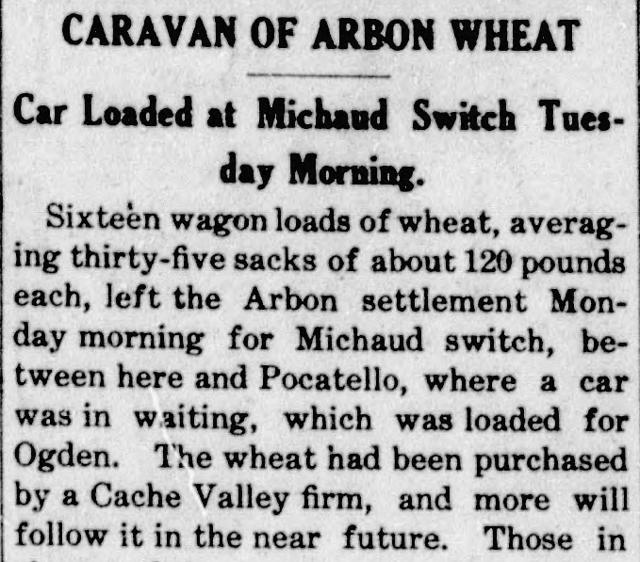
American Falls Press, November 21, 1908, page 1. Transcribed from the page scan.
CARAVAN OF ARBON WHEAT
Car Loaded at Michaud Switch Tuesday Morning.
Sixteen wagon loads of wheat, averaging thirty-five sacks of about 120 pounds each, left the Arbon settlement Monday morning for Michaud switch, between here and Pocatello, where a car was in waiting, which was loaded for Ogden. The wheat had been purchased by a Cache Valley firm, and more will follow it in the near future. Those in charge of the wagons were Joe Arbon, Jim Payne, Chance Payne, Ed. Davis, Eynon Davis, Jule Horton, J. R. Bailey, Willard Bailey, Parley Bailey, Lorin Bailey, W. J. Barnes, John Roderick, Bert Evans, Victor Evans, Joseph Evans and Adam Affleck. The sixteen wagons contained about 1,100 bushels, and it will require about forty such caravans to market the wheat grown there this year.
American Falls is the natural market for Arbon, but owing to the failure of the elevator machinery to arrive, this year’s grain is handled with difficulty. Manager Bennion of the American Falls Milling Company has almost every available warehouse filled, and until the elevator machinery arrives it is with difficulty that the daily receipts of grain can be handled.
A new road is being built from Arbon to American Falls, which will shorten the distance ten or twelve miles, and bring the settlement that much nearer [illegible]
Sources
- American Falls Press, November 7, 1908, page 1
- American Falls Press, November 14, 1908, page 1
- American Falls Press, November 21, 1908, page 1
- American Falls Press, November 21, 1908, page 4
- American Falls Press, November 28, 1908, page 1
- Mountain Home Maverick, December 3, 1908, page 3
- Montpelier Examiner, December 4, 1908, page 6
- Idaho Recorder, December 10, 1908, page 4
- Idaho Republican, December 11, 1908, page 3
- American Falls Press, February 6, 1909, page 1
- American Falls Press, March 20, 1909, page 8
- American Falls Press, April 17, 1909, page 1
- American Falls Press, April 17, 1909, page 3
- American Falls Press, April 24, 1909, page 4
- American Falls Press, December 7, 1911, page 1
- American Falls Press, December 2, 1915, page 3