Four of American Falls’ leading men drove out one spring afternoon in 1909 to learn the best way to Arbon and tell the public about it. They came home on foot at daybreak, slipping down back alleys, and the automobile followed hours later behind a team of mules.
The American Falls Press had the story firsthand, because its editor was one of the four. On May 8, 1909, it put the account on page one under the headline “ROAD VIEWING IN AUTO” and played it for laughs at the expense of every man in the car.
A town that wanted the valley’s wheat
Arbon and American Falls were both in Oneida County then, with the county seat at Malad. Power County would not be formed until 1913. American Falls, which the Press liked to call the Power City, was after the trade of the dry farms spreading across Arbon Valley, a place the paper put that summer at “twenty-five miles southeast of town.” In April it had praised the wheat the valley grew while conceding it had “every advantage except nearness to market.”
In November 1908 the county had started a new road across the foothills toward Arbon, with valley men helping to lay it out, as the site’s Firsts page tells. By spring the Press spoke of a “proposed road” linking the two places, without saying whether it meant that route or another.
The pathfinders set out
The party met on a Tuesday afternoon, probably May 4. The automobile belonged to D. W. Davis, president that year of the First National Bank of American Falls, whom the paper called “our estimable townsman.” Riding with him were Wilford Bennion of the American Falls Milling Company, O. H. Barber, the Press editor, and Roe, one of the Oneida County commissioners. Roe had come to town with his own team and stabled the horses so he could try the newer way of getting about. Davis lived in American Falls, and the papers give no sign that he was connected to the Davis family of Arbon.
The aim, as the Press put it with mock grandeur, was to study the route and then report to “the lowly public” on its merits as the way “from the rich Arbon valley to the Power City.”
They rolled through town and into the sagebrush, sending jack rabbits down their holes with every blast of the horn. Before long they left the main road for a shorter line across country. The driver handled the car so well, the paper said, that his passengers spent the ride admiring him and took no notes at all on the grades and bends they were supposed to be judging. Every one of them pronounced the road as good as a paved city street.
About thirty miles out, at a spot the paper called Rattlesnake gulch, Davis was telling his guests how long he had searched for a car that would never leave its riders to walk home, and how lucky they were to be sitting in one. At that moment, the Press reported, “something happened!” It declined to go into detail. The subject was “too painful.”
The long walk home
The four started back on foot. Three hours on, they were still trudging toward American Falls, which the editor here dubbed the “Spokane of Idaho,” with nothing ahead of them but more hills. At first light each man crept home by his own back alley. Some hours behind them came the automobile, hauled in by a mule team.
The paper reported the aftermath with a straight face. Before the day was out Commissioner Roe had left town behind his horses without a glance to either side. The flour mill was closed, and Bennion, in a sentence the digitized text partly garbles, seems to have come down with “the grip,” as influenza was then called. Davis passed his evenings learning “cuss words in seven different languages” and his days shut in the garage, talking to the car. The last line was the only plain one: no report had yet been made on the proposed road.
The same front page carried a second breakdown. The “Pathfinder car,” a sixty-horsepower Thomas Flyer the paper credited with winning the New York to Paris race the year before, had come through American Falls at noon on Tuesday. By three o’clock it had broken a mended steering rod out in the desert eight miles from Raft River, its fifth breakdown since it entered Idaho.
The car runs again
On May 26 county commissioners Harding and Rowe, very likely the same man as Roe, came up from Malad “on road business.” The Press noted that “they came overland, via Arbon,” but did not say which road was on their minds.
By June 26 Davis had his repair parts and the automobile was running. The paper could not let the matter rest. Davis, it said, would choose his passengers with more care from now on:
He will be careful whom he invites to ride hereafter. A touring car was not designed to carry heavy articles, and until someone imports an automobile van Mr. Bennion will have to walk.
A gulch on no map
The Press never located Rattlesnake gulch. Rattlesnake Creek runs out of the Crystal country into Bannock Creek, and near the north end of the valley, described on the Pauline and West Fork page, the Lusk and Bolingbroke families held some of the first water rights on it. If the gulch lay along that creek, the car nearly reached the valley’s northern edge. That is only a guess, and “some thirty miles” came from a paper enjoying itself.
The valley’s earliest automobile on record, according to the Firsts page, arrived about December 31, 1910, when Walter Sparks of American Falls drove two companions out for the county-division meeting. Davis’s car was on the Arbon road some twenty months sooner, but nothing in the account puts it among the valley’s homes. The Firsts page has more on the valley’s first built road and first automobiles.
The pathfinders’ report never appeared in the 1909 issues of the Press searched for this post. That December a letter writer quarreling over another road, near Igo, predicted it would suffer “the same fate that the Arbon road has.” He left the fate unexplained, and so did everyone else.
The original article
American Falls Press, May 8, 1909, page 1. Transcribed from the page scan.
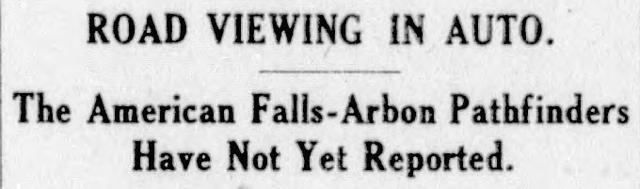
ROAD VIEWING IN AUTO.
The American Falls-Arbon Pathfinders Have Not Yet Reported.
It was Tuesday afternoon, the sun shining brightly not a breath of air stirring and [illegible] nature was happy in spring attire that our estimable townsman, D. W. Davis, apppeared on our streets in his choo-choo car, accompanied by Hon. Wilford Bennion, of the American Falls Milling Company, O. H. Barber, editor of the Press, and County Commissioner Roe, who had driven in but had assigned his lowly horses to a barn while flirting with the more pretentious method of locomotion.
The object of this opulent assemblage was a trip along the proposed route to Arbon, with a view to gaining knowledge and to impart to the lowly public the advantages of that particular route from the rich Arbon valley to the Power City.
Plebeian eyes gazed in envy, and dilated nostrils eagerly inhaled the gasoline perfume as the huge car swept through the town and out into the sea of sagebrush, and jack rabbits scampered into their burrows at the sound of the honk! honk!
On and on they flew, covering miles in minutes, until the main road was ignored and a more direct route sought, and with such grace and dexterity did “the man at the wheel” perform his duty that his associates gazed at him in awe and wonder instead of taking notes of dips, angles or curves of the proposed road. And well they might, for he made hills and valleys look like level ground, to the surprise of the “pathfinders,” who unanimously agreed that the road was equal to a city pavement.
Thus some thirty miles were covered to Rattlesnake gulch, and Davis was explaining how he had for years diligently scoured the country for an automobile that required no walking back—one that could be relied upon under any and all circumstances and would not be found wanting, and that the gentlemen present had the advantage of sitting in such a machine, thanks to his research [illegible] just then something happened! An explanation in detail is too painful.
Three hours later found the quartette still tramping, with silent faces turned toward the “Spokane of Idaho,” with only hills and dales before them. At the break of dawn four silent figures sneaked painfully down different alleys toward their homes, followed several hours later by an automobile drawn by a husky mule team.
Later in the day Commissioner Roe hurried out of town behind his trusty cayuses, looking neither to the right nor to the left. The flour mill is shut down and Bennion’s smiling [illegible] firms that he has the grip. Davis spends his evenings studying cuss words in seven different languages, and during the day is locked in the garage talking to his automobile.
No report has been made on the proposed road between American Falls and Arbon.