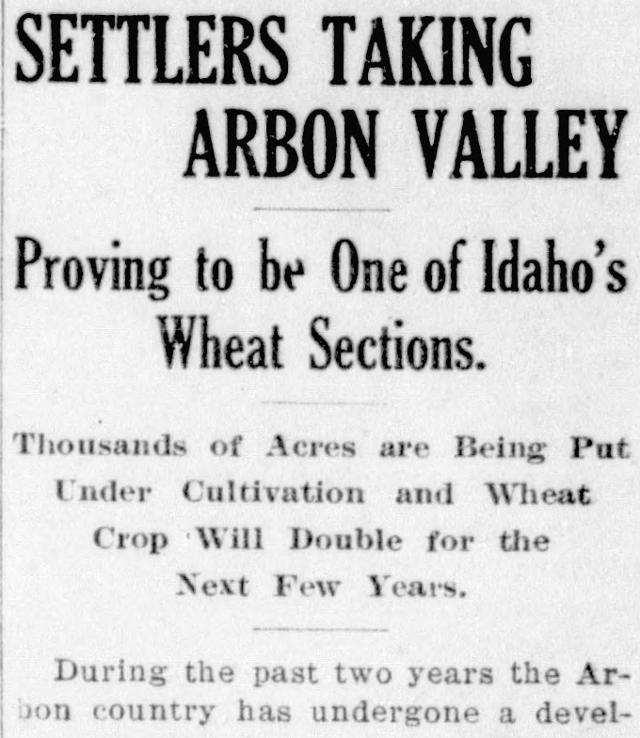
Two summers had remade Arbon Valley. When the American Falls Press took stock on its front page of September 10, 1910, under the heading “Settlers Taking Arbon Valley,” it found the families who had come in since 1908 outnumbering the old settlers two to one, and the wheat crop heading for twice what it had been.
The valley then belonged to Oneida County. Power County would not be carved out until 1913, and to the American Falls paper, Arbon was a farming country thirty miles off that it had been talking up to homeseekers since November 1908. That fall the Press put the settlement at about forty families with 45,000 bushels of wheat; a week later it said about fifty. On December 4, 1909, it wrote that the settlement near Arbon “has about doubled during the past year.”
A spring of filings
Settlers did not have to travel to the land office in Blackfoot to claim government land. They could file their homestead claims at American Falls, before the United States commissioner, L. E. Sigmond. Filing only staked the claim. The deed came later, once the settler had proved up by living on the place and working it for as long as the law required.
“Land seekers are beginning to arrive in large numbers now,” the Press reported on May 14, 1910. A fortnight later it tallied the spring at Sigmond’s office: 138 filings on 22,000 acres in three months, or about a quarter section of 160 acres apiece. It conceded the season “has not been a rush season,” yet said the claims ran in every direction from town, “but the majority being to the south in the Rockland and Arbon valleys,” and that 138 new homes would go up “within the six months.” The paper never broke out how many of those claims lay in Arbon Valley.
Doubling the wheat
By September the Press was ready to call the change in Arbon “suprising,” as its typesetter spelled it. Settlement had begun about ten years before, it said, and some fifty families were there by 1908. Since then the newcomers had come in until the valley was “settled for miles” with “thrifty and industrious” people. The paper’s own figures for 1908 never held still: forty families in one November issue, fifty the next, fifty again in this look back, and forty when it looked back once more in 1911. Its start date of about ten years earlier also runs later than the valley’s own accounts, which are gathered in the first settlers.
None of the new farms were yet far enough along to count as productive, but the paper still expected 75,000 to 100,000 bushels of wheat to be hauled out that fall, double the crop of 1908. Joe Bailey, named as one of the best-informed men in the valley and otherwise unexplained, judged from the ground already readied for seed that the next crop would run “not less than 150,000 bushels.”
The Press admitted that Arbon, some thirty miles southeast of town by the regular roads and a good deal closer across country, had grown more slowly than places nearer the market. Yet only a small share of the land that had been open two years before was still untaken, and the valley needed another school. Its best argument was the weather. Lying between parallel mountain ranges, the paper said, the valley caught summer showers that passed the plains by, drew heavier snow, and faced “not the slightest danger of a crop failure on account of drowth where the farmer half does his work.” Timber close by and good stock range in the mountains made up for the long haul to market, and it closed: “Development during the coming year or two will be marked.”
The same front page explained a law approved June 17, 1910, “familiarly known in the west as the 320 acre dry farm homestead act.” On dry land the Secretary of the Interior designated, a settler could now claim as much as 320 acres, double the spring’s average filing, though such a claim could not be commuted, or proved up ahead of time by paying cash. How the act would touch Arbon Valley, the paper did not say.
An old settler’s ranch
Not everyone in the valley was arriving. From at least March 19 to May 21, 1910, a small notice in the Press offered a “160 acre subirrigated ranch, well improved,” land watered from below by groundwater, that had “Put up about 100 tons of hay and raised about 1000 bushels oats and 300 bushels wheat.” Buyers were to write Julius Abter at Arbon.
Abter had been in the valley longer than most. In November 1908 the paper listed him among its oldest settlers, said he had come seven years earlier, and took its wheat count from him because he ran the threshing machine. In June 1909 he told the Press the valley was “settling and developing very rapidly,” and that issue too carried a “Farm For Sale” notice for land at Arbon with inquiries addressed to him. Why he was selling, and whether anyone bought, the papers read for this post do not say. He stayed on all the same. In September 1911 he was running J. T. Guthrie’s threshing machine at Arbon, and in April 1912 the Press called him “one of the oldest settlers of Arbon” when he came to town on business. Two weeks later it noted Marshal Johnson and Frank Fisher, “two of the new settlers of Arbon,” in town on land business.
The next harvest
Joe Bailey’s forecast held up. By July 1911 the Press was hearing estimates of that year’s wheat “as high as 200,000 bushels.” In the same issue it reported a visit with Joseph Arbon, “the pioneer of the valley,” almost certainly Joseph Nicholas Arbon, who had been there nearly fifteen years. “He has seen greater changes during the last two years however,” the paper wrote, “than in all the others that have gone before.” The papers read for this post do not give the final count for 1911. That harvest, brought in with what was probably the valley’s first steam thresher, is told in the first steam engine and steam thresher, and the families behind it in the Arbon area history and the homesteader family histories.
The old pioneer had it right. Two years of newcomers had changed the valley more than all the years that came before.
The original article
American Falls Press, September 10, 1910, page 1. Transcribed from the page scan.
SETTLERS TAKING ARBON VALLEY
Proving to be One of Idaho’s Wheat Sections.
Thousands of Acres are Being Put Under Cultivation and Wheat Crop Will Double for the Next Few Years.
During the past two years the Arbon country has undergone a development that is suprising.
The settlement of the valley was begun about ten years ago, and up to two years ago about fifty families had located there. During the past two years new people have come until they outnumber the old two to one, and the valley is settled for miles with a thrifty and industrious people who are making great strides in developing that section and making it productive. The valley is about [illegible] miles wide at the lower end, narrowing to three or four miles in width some twenty miles above and widening again at the lower end and is one of the most beautiful valleys in the entire state. While the new places have not been sufficiently developed to be rated as productive, it is estimated that between 75,000 and 100,000 bushels of wheat will be hauled out this year, which is double the amount produced two years ago.
Joe Bailey, one of the best informed men of the valley estimates next year’s crop at not less than 150,000 bushels, based on the acreage that is prepared for seeding.
The valley lies to the southeast of American Falls some thirty miles by regular routes of travel, but considerablly nearer across country. It has not developed as rapidly as sections nearer to market, but the land remaining to be taken is but a small per cent of what was available two years ago.
Another school is needed [illegible] and before another year the [illegible] settlement will demand school facilities.
The Arbon country is fortunately situated between parallel ranges of mountains, and gets the benefit of many summer showers which miss the plains sections. Its snowfall is also much greater, and there is not the slightest danger of a crop failure on account of drowth where the farmer half does his work. It is also near timber sufficient to meet all wants of the settlers, has excellent stock range in the mountains and other advantages which compensate for its remoteness from market. Development during the coming year or two will be marked.
Sources
- American Falls Press, November 7, 1908, page 1
- American Falls Press, November 14, 1908, page 1
- American Falls Press, June 26, 1909, page 4
- American Falls Press, December 4, 1909, page 1
- American Falls Press, March 19, 1910, page 1
- American Falls Press, April 2, 1910, page 2
- American Falls Press, May 14, 1910, page 6
- American Falls Press, May 21, 1910, page 4
- American Falls Press, May 28, 1910, page 1
- American Falls Press, May 28, 1910, page 11
- American Falls Press, September 10, 1910, page 1
- American Falls Press, July 20, 1911, page 1
- American Falls Press, September 14, 1911, page 1
- American Falls Press, April 18, 1912, page 1
- American Falls Press, May 2, 1912, page 10