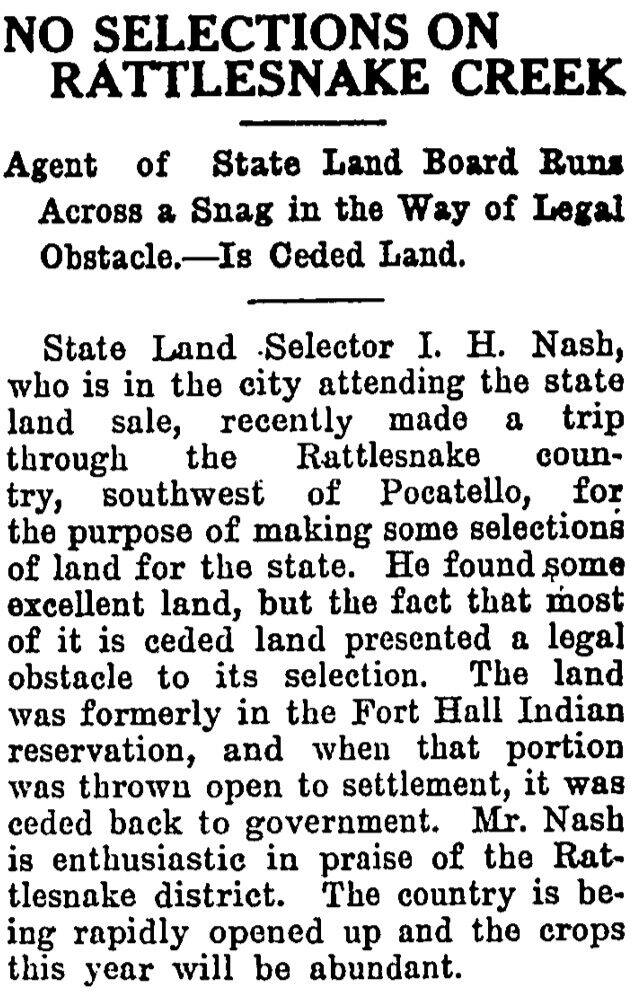
In the summer of 1911 the State of Idaho sent a man into the hills above the Bannock valley to pick out land it could call its own. I. H. Nash, the state land selector, found good ground along Rattlesnake Creek. He could not take it. Most of it, the Pocatello Tribune reported on August 4, was ceded land that had once belonged to the Fort Hall Indian Reservation, and the law stood in his way.
From Moonshine to Rattlesnake
His trip began on the other side of the hills. On July 20 the American Falls Press noted that Nash had spent Monday and Tuesday in that town “selecting some land for the state in the Moonshine country,” the hills between American Falls and Arbon, before setting out for Bannock County. The digitized text of the rest of that sentence is garbled, though scraps of it mention the Oneida County line and the Rattlesnake country.
By July 29 the Semi-Weekly Pocatello Tribune offered a reason for his visit. The state had lately reached an agreement with the Department of the Interior over its sections 16 and 36 lying inside the national forests, and it hoped to take a single compact tract in their place. The paper put it this way:
That the state of Idaho, under the terms of an agreement recently reached with the department of the interior relating to sections 16 and 36 of state land in national forests, may select in lieu a compact body of land in the Pocatello forest reserve, along the summit of the Mink creek divide and along Rattlesnake creek, is indicated by the presence in that country of I. H. Nash, state land selector, who, following an inspection of lands in the Moonshine country, came to Bannock county to look over the Battlesnake [Rattlesnake] region.
The Rattlesnake country lay southwest of Pocatello. It was most likely the basin drained by Rattlesnake Creek, where settlers had begun to call their new community Crystal. That reading is probable rather than certain. None of the three items names Crystal, and the Semi-Weekly placed the region in Bannock County, while Crystal belonged to Oneida County until 1913, so Nash may have looked partly at land on the Bannock side of the line. The papers do not say where along the creek he went, which tracts he examined or whom he met there.
A snag on ceded land
When Nash came back to Pocatello in early August for the state land sale, the daily Tribune had his answer. The land along Rattlesnake Creek was excellent, but since most of it was ceded, that “presented a legal obstacle to its selection.” The two Tribune pieces frame his errand a little differently, the first as a hunt among forest lands and the second as a hunt across ceded ground, and each is quoted here as it ran.
The Tribune said only that the land had been part of the reservation and was “ceded back to government” when it was thrown open to settlement. Under an agreement signed in 1898 and ratified in 1900, the Shoshone and Bannock people gave up the southeastern part of the reservation, the Crystal basin with it, and in 1902 that country opened to homesteaders. The 1900 Act laid down how the ceded land could be disposed of: under the homestead, townsite and mining laws, or at public auction, as told in the site’s account of the cession. Which of those rules blocked the state, the Tribune did not say, and the papers read for this post leave the point open.
Nash came away a booster all the same. He praised the Rattlesnake district warmly, and the paper added that the country was filling up quickly and that crops there would be heavy that year. That fits what the American Falls Press had heard from Crystal in June: a settlement so young that few of its people had been on the land more than two years, with fields as large as 300 acres and plans for two schoolhouses, as Crystal, the hidden settlement up Rattlesnake Creek recounts. The same summer, surveyors laid out a road over Moonshine across the divide toward Arbon.
The man who chose the land
The papers link Nash to none of the valley’s families. The Press appears to call him Isaac in 1910, when he was already at work for the state land board, though that item is muddled. That November the Caldwell Tribune described him as a onetime Oneida County assessor when it passed along his remark, first printed in the Malad Enterprise, about the wagons hauling Arbon wheat. In 1912 he went to the Oneida County Republican convention in American Falls as a delegate from Franklin precinct. In January 1914 he was still selecting state land, alongside Arthur Budge, and by August 1919 he had become Idaho’s land commissioner.
Whether the state ever claimed an acre along Rattlesnake Creek, on the Mink Creek divide or in the Moonshine country, no later report has turned up to say. What survives is his verdict on the district: excellent land, and not the state’s to take.
The original article
Pocatello Tribune, August 4, 1911, page 6. Transcribed from the page scan.
NO SELECTIONS ON RATTLESNAKE CREEK
Agent of State Land Board Runs Across a Snag in the Way of Legal Obstacle.—Is Ceded Land.
State Land Selector I. H. Nash, who is in the city attending the state land sale, recently made a trip through the Rattlesnake country, southwest of Pocatello, for the purpose of making some selections of land for the state. He found some excellent land, but the fact that most of it is ceded land presented a legal obstacle to its selection. The land was formerly in the Fort Hall Indian reservation, and when that portion was thrown open to settlement, it was ceded back to government. Mr. Nash is enthusiastic in praise of the Rattlesnake district. The country is being rapidly opened up and the crops this year will be abundant.
Sources
- Pocatello Tribune, August 4, 1911, page 6
- Semi-Weekly Pocatello Tribune, July 29, 1911, page 3
- American Falls Press, July 20, 1911, page 4
- American Falls Press, September 10, 1910, page 4
- Caldwell Tribune, November 24, 1911, page 1
- American Falls Press, May 9, 1912, page 1
- American Falls Press, January 15, 1914, page 5
- Idaho Republican, August 5, 1919, page 7