The American Falls Press had done the arithmetic for Joseph Arbon. If the county’s road bonds carried, the paper worked out in January 1914, his taxes would rise by $5.41 the following year. “Will good roads be worth that much to him,” it asked, without a question mark.
Arbon gave its answer at the polls on January 27. The new Power County wanted to borrow $125,000 for roads and bridges, and one of the roads was to run out of the valley itself. Arbon precinct voted the bonds down.
A new county asks for money
Power County was barely a year old. It had been carved in 1913 out of parts of four counties, and until then Arbon had been a precinct of Oneida County, governed from Malad. On December 9, 1913, the commissioners called a special election on the bonds, which needed two-thirds of the vote to pass. Arbon would cast its ballots at schoolhouse No. 12, where William E. Dawson and T. B. Evans were to serve as judges and William Allard as clerk. Crystal voters would go to schoolhouse No. 14.
The Press backed the bonds, and by December 18 it was worried. Resistance “from the very people who are to be most benefitted comes as somewhat of a surprise,” it wrote. It blamed rumors, one of which seemed to have reached the most distant corners of the county:
It is stated that the purpose of the commissioners is to build a system of good automobile roads within a radius of ten or fifteen miles of American Falls and that those sections farther out are to be left without improvement.
The paper called that “probably the farthest from the truth” and promised that the roads would reach every part of the county, with spurs running out to the far districts.
A road from the Paine place
On January 15 the three commissioners, Andrew May, W. S. Sparks and A. Winter, put their own case in print under the heading “A Straightforward Statement.” They pledged six trunk roads, roughly 80 miles altogether, none of them climbing a grade of more than four per cent. One was meant for the valley:
Another trunk line from a point to be selected by said engineer, at or near the John Paine place in Arbon to an intersection with the State road leading from American Falls to Pocatello, and along a route selected by said engineer.
The Paine place was most likely the land of John Payne, the son-in-law of George Arbon, in Section 23 in the middle of the Arbon floor. How long the Arbon road was to be cannot be read, because the figure is garbled in the digitized page. Ed Smith, the state highway commission’s engineer, had put the cost at $800 a mile, and the commissioners said only $75,000 of the bonds would be sold at the start.
That same issue ran “Facts and Figures for the Voters.” The Press pulled names from the assessment rolls, from Rockland to American Falls, and figured what each taxpayer’s share of the interest would be. One of them farmed in the valley:
The next man is away up in Arbon. Mr. Joseph Arbon. His valuation is $4,920, and his taxes as follows: ... A special tax of some kind brings his total tax to $69.72. If the bonds carry he will next year pay $5.41 more. Will good roads be worth that much to him.
This was almost surely Joseph Nicholas Arbon, who with his father George is remembered as the first to winter in the valley. The paper’s $5.41 sat on top of the taxes he already paid, though it also explained that the commissioners planned to meet the interest from the road levy already in place, which would “not increase the taxes at all.” It had kind words for the valley, too: “And Arbon? Its growth has been like the other sections almost too great to be comprehended.”
A hopeless defeat
A few days before the election, Sheriff Jeffries and Billy Wall made a Sunday trip out to Bannock Valley, as the Press still called it, and Wall left the ballots for the Arbon and Crystal precincts.
Two days after the polls closed, the paper conceded “a hopeless defeat.” In the precincts heard from, the bonds had failed to draw even a bare majority, and American Falls itself had approved them by only thirteen votes. A week later more returns were in: Landing, 12 for and 98 against, and Crystal, 25 for and 17 against. About the valley’s main precinct the Press knew little. “Figures on the vote at Arbon were not obtainable but it is understood to be against the bonds.”
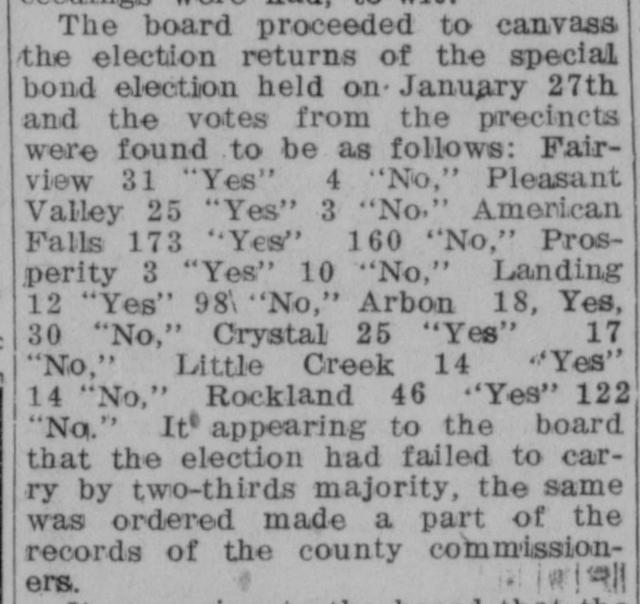
The commissioners canvassed the returns early in February, and the Press printed their proceedings on February 26. The board found that the bonds had not reached two-thirds. As printed, Arbon’s line reads 18 for and 30 against, though the count has also been read as 130 against. On that reading Arbon’s 148 ballots were outnumbered only by those of American Falls and Rockland, only American Falls cast more “no” votes, and the county as a whole stood at 347 for and 558 against.
Why Arbon turned the bonds down, the Press never said, and no letter from the valley explaining the vote has come to light. Crystal, the valley’s other precinct in the county, gave the bonds a majority, if not the two-thirds they needed.
Roads left to the overseers
The Press had expected a highway district to come next. In April a petition asked for one covering the county west of the Snake River and the land east of it along the state highway. As it was described, it likely left the valley out. An election was called for June 9, and by late July the commissioners’ minutes spoke of a highway district formed from part of the county.
Arbon’s roads stayed in the hands of the county and its local overseers. Two weeks before the bond vote, the board had granted a petition from W. F. Kowallis (probably the Meadow Ward bishop at Pauline) and others to name W. E. Dawson road overseer for the Arbon district. In April it put off a petition from Mrs. D. B. Evans, as the text seems to read, until the commissioners could visit Arbon precinct themselves, and in July it paid her damages over a county road. She was probably Hannah Evans, whose husband, David Bowen Evans, had died on December 30, 1913. The July bills also covered H. Boyd’s trip over the Arbon road with Sparks and Evans, and a payment for road work to Joseph N. Arbon, one of many on the list.
The valley did not get a highway district of its own until 1918. After a special election on June 12 of that year, the commissioners declared a territory including Arbon and Pauline “created and established into Highway District No. 3.” Later that year voters in the district’s Arbon and Pauline precincts went to the polls on $50,000 in bonds. The minutes of November 8, 1918, give the count only for Pauline, 56 for and 10 against, and note that the issue carried. In 1919 a state highway from Pocatello to Arbon was designated, and the district asked for bids to gravel the Bannock Creek road. That story is told in the first state highway and graveled road, and the roads that came before 1914 in the first engineered road out of the valley. The Arbon area history tells of the settlement itself.
Four years after the valley said no to the county’s road bonds, it was asked about bonds for roads of its own, and this time they carried.
The original article
American Falls Press, February 26, 1914, page 5. Transcribed from the page scan.
COMMISSIONERS’ PROCEEDINGS
American Falls, Ida., Feb. [illegible], 1914
The board of county commissioners of Power county met this day as per recess taken January 29th, Commissioners May and Winter being present and the following proceedings were had, to-wit:
The board proceeded to canvass the election returns of the special bond election held on January 27th and the votes from the precincts were found to be as follows: Fairview 31 “Yes” 4 “No,” Pleasant Valley 25 “Yes” 3 “No.” American Falls 173 “Yes” 160 “No,” Prosperity 3 “Yes” 10 “No,” Landing 12 “Yes” 98 “No,” Arbon 18, Yes, 30 “No,” Crystal 25 “Yes” 17 “No,” Little Creek 14 “Yes” 14 “No,” Rockland 46 “Yes” 122 “No.” It appearing to the board that the election had failed to carry by two-thirds majority, the same was ordered made a part of the records of the county commissioners.
It appearing to the board that the warrant of $110.00, previously allowed to the Remington Typewriter company, for one typewriter, was excessive and more than the said company had offered to place other machines in the county for, the same was ordered cancelled and a new order drawn for $90.00.
The board being advised that the present office space for the county officers is inadequate and it appearing to the board that two rooms in the rear of the First National Bank building could be had upon the following terms, to-wit $20.00 for five months in the year and $15.00 for 7 months in the year, the same to include heat and lights therefor, the board thereupon rented from the said First National Bank the afore mentioned rooms for the offices of the county superintendent and probate judge.
The board thereupon acted upon the following road matters:
Whereas, the board has heretofore declared open a certain road known as the Grief Boulevard, the same travelling the lands of Herman F. Comnick from cor. to sec. 14, 15, 22 and 23, T. 9 S., R. 30 E.
[illegible] 1 S81° 30’ W 195 ft. to pt. 1
1—2 S36° 03’ W 106 ft. to pt. 2
2—3 S 2° 56’ E 229 ft. to pt. 3
3—4 [illegible] 17’ W 208 ft. to pt. 4
4—5 S21° 28’ W 471 ft. to pt. 5
5—6 S 4° 09’ W 198 ft. to pt. 6
6—7 S 3° 06’ W 111 ft. to pt. 7
7—8 S25° 31’ W 224 ft. to pt. 8
8—9 S22° 40’ W 394 ft. to pt. 9
9—10 S 9° 30’ W 630 ft. to pt. 10
10—11 S 0° 41’ W 320 ft. to pt. 11
11—12 S 0° 34’ E 380 ft. to pt. 12
12—13 S 2° [illegible] W 608 ft. to pt. 13
13—14 S24° 17’ W 109 ft. to pt. 14
14—15 S46° 27’ W 235 ft. to pt. 15
15—16 S33° 49’ W 300 ft. to pt. 16
16—17 S10° 59’ W 172 ft. to pt. 17
17—18 [illegible] 07’ W 147 ft. to pt. 18
Thence south along the line between the SW 1-4 SE 1-4 and SE 1-4 SE 1-4 sec. 22, to the SW. corner of the SE 1-4 SE 1-4 of said sec. 22 said township 9 south, range 32 east Boise meridian, And it appearing that the owner, Herman Comnick, refuses to permit the said road to be opened and demands an excessive sum by way of damages.
Now therefore, it is ordered that the prosecuting attorney institute condemnation proceedings to procure a right of way across the land of the said Herman Comnick.
Whereas, the board has heretofore declared open a certain road known as the Ferry Hollow Sunbeam road, the same traversing the lands of S. H. McCullough beginning at a point 1067 ft. north of the SW corner of NE 1-4 of SW 1-4 section 4, tp. 8 S. R. 31 E. B. M. running south 38° 57’ E to the SE corner of said NE 1-4 SW 1-4 Section 4, and it appearing that the owner, S. H. McCullough refuses to permit the said road to be opened and demands an excessive sum by way of damages.
Now therefore, it is ordered that the prosecuting attorney institute condemnation proceedings to procure a right of way across the lands of the said S. H. McCullough.
Whereas, the board has heretofore declared open a certain road known as the Quinlon road, the same traversing the lands of Margaret Skeen beginning at the corner to sections 13, 14 and 23, 24, T. 11 S. R. 31 E. B. M. running west along section line between sections 14 and 23 and 15 and 22 to intersection with Landing road at the NE corner of the NW 1-4 of NW 1-4 of said section 22, and it appearing that the owner, Margaret Skeen, refused to permit the said road to be opened and demands an excessive sum by way of damages.
Now, therefore, it is ordered that the prosecuting attorney institute condemnation proceedings to procure a right of way across the lands of the said Margaret Skeen.
Whereupon, the board adjourned to meet March 2, 1914 for road meeting at 10 a. m.
ANDREW MAY, Chairman.
Attest: Paul Bulfinch, Clerk.
Sources
- American Falls Press, December 18, 1913, page 1
- American Falls Press, January 1, 1914, page 5
- American Falls Press, January 15, 1914, page 1
- American Falls Press, January 15, 1914, page 4
- American Falls Press, January 22, 1914, page 2
- American Falls Press, January 22, 1914, page 7
- American Falls Press, January 29, 1914, page 1
- American Falls Press, February 5, 1914, page 5
- American Falls Press, February 5, 1914, page 7
- American Falls Press, February 26, 1914, page 5
- American Falls Press, April 23, 1914, page 2
- American Falls Press, April 30, 1914, page 1
- American Falls Press, May 14, 1914, page 12
- American Falls Press, July 30, 1914, page 2
- American Falls Press, August 6, 1914, page 3
- American Falls Press, June 25, 1918, page 3
- American Falls Press, November 15, 1918, page 3