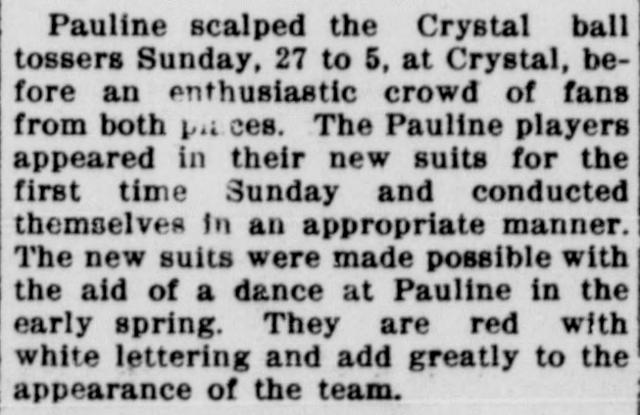
The Pauline ball club went to Crystal on a Sunday in May 1915 dressed for the occasion. Its players wore new suits, red with white lettering, for the first time, and a dance at Pauline earlier that spring had helped pay for them. They won, 27 to 5, and the American Falls Press reported that they “conducted themselves in an appropriate manner.”
That spring nearly every corner of Arbon Valley had a team. There was one at Pauline, at the north end, one in the Central school district around Arbon, one at Crystal, and one among the homesteads of the south end. They met one another on Sundays, and the valley correspondents of the weekly Press mailed in the scores with the rest of the news. The valley had belonged to Power County only since 1913; before that it lay in Oneida County.
Rain and the Daytonites
The first game the columns describe came early in May, most likely on Sunday, May 9, at the Central baseball grounds. The south-end boys played the boys of north Central. Rain was threatening, yet a big crowd turned out, and the Arbon correspondent noted that “the on-lookers stayed until the finish.” The south end won, and the correspondent called its players the Daytonites.
The nickname almost certainly pointed to Dayton, Washington. Since about 1909, families from Dayton had been taking up land at the valley’s south end, around Highland and Summit, and more kept coming. Jack Folsom and his bride had arrived from Dayton, the South Arbon column said on June 3, and “intend to make this their home.” In July the same column reported that the former Washington people had held their yearly picnic.
Red suits at Crystal
At Crystal, seven miles from Pauline, the players had been “practicing regularly” in early May. Pauline made the trip there in the middle of the month, probably on Sunday, May 16, and played before “an enthusiastic crowd of fans” from both places. That is how the page scan reads the score, though the second figure is hard to make out in the digitized text. After the score, the item, which ran without a headline among the local news, turned to the uniforms.
Dances paid for a good deal in the valley that year. In February the Pauline correspondent had listed a dance every Saturday night at the Centre School House, roller skating on Wednesday nights, and a session for the children on Saturday afternoons from two to five.
A run of Sundays
By late May the South Arbon team had beaten North Arbon “again.” The paper put the score as “seven to eight,” which seems to list the winners second, just as the same issue did for a Pauline win (“8 to 9 in favor of the Pauline boys”), though most scores in these columns put the winners first. The south-end nine had also beaten a team from Bull Canyon and was set to meet “the Daniels team” on May 30. At the Central ball park, on a Sunday that was likely the same May 30, Pauline again wore its new suits, “which made quite a showing,” and won 9 to 8 over a team the column did not name. A Dayton team was due to play Pauline on the same field a week later.
By the middle of June, Pauline and Central had pooled their players against the south. The Arbon column of June 17 told how it went:
The ball game Sunday between the Pauline-Central boys and Daytonites or South Arbon boys, was largely attended. They were helped along by several rooters. The game went 20-6 in favor of the South end boys.
The team had just been reorganized, the column said, with Ed Keeler as manager “for his part of the valley.” This was probably J. E. Keeler, the Arbon homesteader who had served in 1913 as a director of the valley’s telephone company. On the same page, the Central boys, captained by Add Affleck, lost to Pauline 32 to 2. Affleck was probably Adam Affleck, son-in-law of Tom Evans, who turns up in the story of the Evans family. The South Arbon team, meanwhile, took on the Sheep Creek nine.
Not every Sunday ended well. The North and Central Arbon column of June 24 reported that a young boy had broken his thumb “a week ago Sunday at the ball game,” when a player running for a base accidentally knocked him down.
In early July the Press reported that North and South Arbon had met at the Central school, and that the South had won once more, 32 to 15. The valley had its Fourth of July to plan as well. A meeting at the Central hall on June 20 settled on Saturday, July 3, at the Central school, and named a committee that included J. E. Keeler and Add Affleck of Central. The celebration was held on the Central school grounds.
Over the mountains
The game carried on the next summer. On June 8, 1916, the Press reported that the Arbon team had “motored over the mountains” and played twice in one day, St. John in the morning and the Elkhorn team in the afternoon. It won both, by scores the paper printed as 6 to 8 and 7 to 9. The correspondent signed off with a challenge: “Any other outside teams wish a game?” Later in June the Center boys beat Pauline 33 to 28.
The correspondents kept faithful track of scores, crowds and the color of Pauline’s uniforms. They printed no box scores and seldom named a player. Who pitched for Pauline that spring, and who pulled on the red suits at Crystal, the old columns never said.
The original article
American Falls Press, May 20, 1915, page 5. Transcribed from the page scan. The item ran without a headline among the town’s local news. Its “scalped” is the sports slang of the day, drawn from a stereotype of Native Americans, and is kept here as printed.
Pauline scalped the Crystal ball tossers Sunday, 27 to 5, at Crystal, before an enthusiastic crowd of fans from both places. The Pauline players appeared in their new suits for the first time Sunday and conducted themselves in an appropriate manner. The new suits were made possible with the aid of a dance at Pauline in the early spring. They are red with white lettering and add greatly to the appearance of the team.
Sources
- American Falls Press, February 4, 1915, page 5
- American Falls Press, May 6, 1915, page 4
- American Falls Press, May 13, 1915, page 8
- American Falls Press, May 20, 1915, page 5
- American Falls Press, June 3, 1915, page 4
- American Falls Press, June 17, 1915, page 1
- American Falls Press, June 24, 1915, page 8
- American Falls Press, July 8, 1915, page 2
- American Falls Press, June 8, 1916, page 8
- American Falls Press, June 22, 1916, page 8