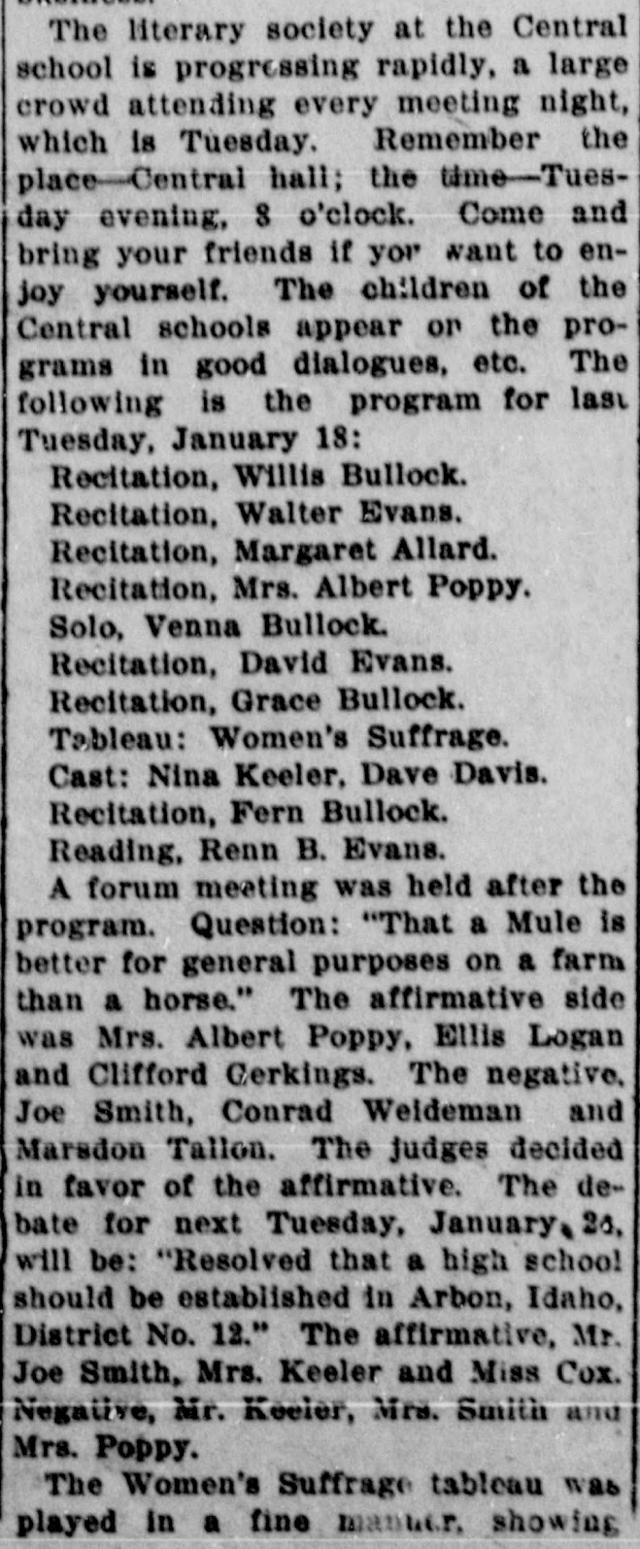
Nina Keeler sat with her nose in a book. Beside her a man bent over the washboard, scrubbing, and every so often reached out to rock the baby in its cradle. At last the baby would not settle, so he tucked it under one arm and finished the wash with the other. “This was quite laughable,” the Arbon correspondent wrote.
The scene was a tableau billed as “Women’s Suffrage,” and it was one number on the Tuesday night program of the Central School Literary Society on January 18, 1916. The man at the washtub was Dave Davis, if the smudged print is read rightly. Idaho women had been voting since 1896, though the rest of the country’s women would wait for the Nineteenth Amendment until August 1920.
All that winter, families from the north end of Arbon Valley packed into the Central school on Tuesday evenings. Children and their elders gave recitations, grown-ups read and made music, and neighbors argued questions drawn from the farm, the schoolroom and the war in Europe. From December to April, the Arbon columns of the American Falls Press kept count.
A society for the neighborhood
The Central school served District 12, the school later called Green Top. Arbon had belonged to Oneida County until 1913 and now lay in Power County. In its county school notes the Press listed two teachers at what it called the Bannock school: Alfred L. Ray, principal, and Miss Claudia Cox, who taught the primary grades. The same pair sat on the literary society’s program committee, so the Bannock school was almost surely the Central school under another name.
Ray made the case for such a society on December 9, 1915, when the teachers of Arbon and Crystal gathered at the Pauline meeting house. A literary society for the whole neighborhood, he argued, would draw in parents as well as boys and girls, and Bannock already had one going. Another speaker turned to the rural high school, which the Press called the big question of the hour in the Arbon valley.
The society itself had been organized two days earlier, on December 7. The paper printed its president as M. V. Talon, most likely Marsden V. Tallon. John Fuller was vice president, and Miss Nina Keeler kept the minutes and the money. By January the crowds were growing fast. “The interest has been increasing rapidly,” the Press reported on January 13, “there being about 95 present at the last meeting.”
That meeting had taken up whether the horse did a farmer more good than the gasoline engine. Ren Evans and two neighbors stood up for the horse. Emerson Fuller, May Ripley and Nina Keeler spoke for the engine, and lost. The following week the society asked whether the United States should declare “an immediate embargo on military supplies,” with Mrs. Albert Poppy, as the paper spelled the Poppie name, and Ren Evans among those arguing yes. No verdict on that one turns up in the columns. The January programs also carried two dialogues whose titles, as the paper printed them, used the racial language of the day.
Tuesday nights at Central hall
By late January the society hardly needed to advertise, but the North Central Arbon column did anyway. “Remember the place—Central hall; the time—Tuesday evening, 8 o’clock,” it urged on January 27. “Come and bring your friends if you want to enjoy yourself.”
The January 18 program shows what they came for. Willis, Grace and Fern Bullock recited, along with Walter and David Evans, Margaret Allard and Mrs. Albert Poppie. Venna Bullock sang a solo, and Renn B. Evans gave a reading. The suffrage tableau came in the middle.
When the program was done, the floor opened for a forum on whether a mule served a farm better than a horse for general purposes. Mrs. Albert Poppie, Ellis Logan and Clifford Gerking took the mule’s side. Joe Smith, Conrad Weideman and Marsden Tallon spoke for the horse. The judges sided with the mule.
A high school for District 12
Then the weather closed in. The same January 27 column told of the worst storm Bannock Valley had seen in many years, with wet snow, a wind that seldom rested and roads that could not be traveled. The Saturday basket dance was called off. The high school debate, set for January 25, had to wait.
The society did not gather again at Central hall until February 8, and even then the turnout was good, the column said, “considering the long lapse between meetings on account of the storms.” The question at last was “That a High School Should be Established In District 12, Arbon, Power County, Idaho.” Joe Smith, Mrs. Keeler and Miss Claudia Cox argued in favor. Mr. Keeler and Mrs. Smith argued against. The judges voted for the high school, though the columns are silent on what came of the idea that winter.
The society put out a paper of its own as well. “The literary paper was quite enjoyable,” the column said, praising the “fine work” of its editor, Mrs. Logan. She was most likely Mrs. E. A. (Jennie) Logan, who played an instrumental number that same night and a year later wrote the valley’s first history. Around that time L. B. “Ren” Evans, on a trip to American Falls, told the Press that Arbon had “a literary society that would be a credit to any community.”
Pie at Highland, a kangaroo court at Central
The south end of the valley, the Summit area, ran a society of its own at the Highland school, “twelve miles south of Central Arbon.” Plenty of young people came down from Central for its March 4 meeting. “After the meeting adjourned a pie social was given, some of the pies selling quite high,” and then everyone danced.
At Central, three meeting nights went by without a session. When the society met again in late March it held a forum, the chairman calling up debaters as they were needed. One question, the Press reported on April 6, “caused a good deal of merriment”: whether “a Toothless Man at a Full Dinner Table Is in More Misery than a Tailess Horse in Fly Time.” Another weighed the cow against the horse as the more useful animal on a farm.
On Tuesday, April 4, the society adjourned “for the summer months only,” and it went out with a kangaroo court. The defendant, printed as Brigg Bower and probably Brig Bowen, stood accused of making off with 23 thoroughbred chickens belonging to Conrad Weideman on the 29th or 30th of February. The joke, the column explained, was that Weideman had never kept a chicken there, and the two men remained “as good friends as ever.”
Whether the society came back the next winter, the papers read for this post do not say. Nor do the 1915–16 reports mention Henri H. Mills, a stockman and onetime Arbon resident whose 1941 obituary credited him with founding a literary society there. More of the neighborhood’s story is in the Arbon area history and the schools of Arbon Valley. For one stormy winter, at least, the place to be on a Tuesday night was Central hall at eight o’clock.
The original article
American Falls Press, January 27, 1916, page 4. Transcribed from the page scan.
NORTH CENTRAL ARBON NEWS.
Mr. and Mrs. Joe Evans went to St. John and Malad a few days ago for a short stay.
Mr. Ebner postponed his meeting here with us on the 20th, but we hope all things, weather included, will permit his visit here sometime in the near future.
Bannock valley is experiencing the worst storm they have had for many years and there is no sign of its abating. The snow has been wet the past few days making it very disagreeable. Some roads are impassable, the wind is blowing most of the time. The weather man must have had an accident as there were two days last week that the wind forgot to blow. The mercury has dropped quite low here several times.
F. E. Jones left for Pocatello a few days ago to spend the rest of the winter. He says there is too much snow and wind here for him.
[illegible] Davis was in Malad last week on business.
The literary society at the Central school is progressing rapidly, a large crowd attending every meeting night, which is Tuesday. Remember the place—Central hall; the time—Tuesday evening, 8 o’clock. Come and bring your friends if you want to enjoy yourself. The children of the Central schools appear on the programs in good dialogues, etc. The following is the program for last Tuesday, January 18:
Recitation, Willis Bullock.
Recitation, Walter Evans.
Recitation, Margaret Allard.
Recitation, Mrs. Albert Poppy.
Solo, Venna Bullock.
Recitation, David Evans.
Recitation, Grace Bullock.
Tableau: Women’s Suffrage.
Cast: Nina Keeler, Dave Davis.
Recitation, Fern Bullock.
Reading, Renn B. Evans.
A forum meeting was held after the program. Question: “That a Mule is better for general purposes on a farm than a horse.” The affirmative side was Mrs. Albert Poppy, Ellis Logan and Clifford Gerkings. The negative, Joe Smith, Conrad Weideman and Marsdon Tallon. The judges decided in favor of the affirmative. The debate for next Tuesday, January 25, will be: “Resolved that a high school should be established in Arbon, Idaho, District No. 12.” The affirmative, Mr. Joe Smith, Mrs. Keeler and Miss Cox. Negative, Mr. Keeler, Mrs. Smith and Mrs. Poppy.
The Women’s Suffrage tableau was played in a fine manner, showing Miss Keeler sitting down reading a book, and Mr. Davis was busy working on the wash board and once in a while rocking a baby in a cradle close by. Finally the baby would not keep still so he had to take it up under his arm and complete the washing. This was quite laughable.
Mr. and Mrs. Wm. Allard are the proud parents of a fine baby boy, born Tuesday, January 21, at Pocatello. Everyone is feeling fine, especially Mr. Allard, who is wearing a smile that won’t come off.
It is reported that another one of our bachelors is in communication with Dan Cupid. The lucky fellow is Newell Leishman and we are all listening for the wedding bells.
Clarence Knowles, W. D. Dawson, and Joe Dawson spent several days in Pocatello on business last week.
Carlyle Dawson has been suffering with a painful arm the last few weeks, ring worms being the cause. He is much better at present.
The scholars at Central school have been busy the past week taking the examinations.
The storm was so severe last Saturday night that there was no basket dance as advertised.
Mr. John Butler, Mr. Featherstone and Merl Johnson returned last week from the Black Pine country where they went on business.
A baby daughter was born to Mr. and Mrs. Dave Lusk of this place, at St. John, Idaho, Wednesday, January [illegible]. The little one was too frail for this earth dying a few hours after birth. We extend our heartfelt sympathy to the bereaved parents. The mother is getting along nicely at present.
Mrs. J. R. Bailey went down to be with her daughter.
Sources
- American Falls Press, December 23, 1915, page 6
- American Falls Press, January 6, 1916, page 2
- American Falls Press, January 13, 1916, page 4
- American Falls Press, January 20, 1916, page 5
- American Falls Press, January 27, 1916, page 4
- American Falls Press, February 10, 1916, page 4
- American Falls Press, February 24, 1916, page 8
- American Falls Press, March 16, 1916, page 7
- American Falls Press, April 6, 1916, page 3
- American Falls Press, April 13, 1916, page 7
- Davis County Clipper, November 28, 1941, page 1
- Washington County News, February 17, 1983, page 21
- Women’s suffrage in the United States, Wikipedia