The wind had been blowing snow across the north Arbon floor for days, hard enough that the grain freighters were having a miserable time of it. On Thanksgiving night, November 25, 1915, people came out to the Central school anyway. The pupils had a program ready, and the house was well attended in spite of the storm.
The American Falls Press thought the evening worth a full listing. Its December 2 column from North Arbon said the program “was excellent and was greatly praised by those present,” and that “the evening was later spent in a social dance.” A week later the paper printed every number on the bill, and three weeks after that it printed the school’s Christmas Eve program as well. Read together, the two lists amount to a roll call of the valley’s children that winter.
A school made ready for winter
The Central school of District 12, which some called Green Top, stood on ground T. B. Evans had given, and it doubled as the community hall for the north end of the Arbon area. Arbon had belonged to Oneida County until 1913; it was now part of Power County. Two teachers ran the school that year, Alfred Ray as principal and Miss Claudia Cox in the primary grades, though the Press sometimes called their building the Bannock school.
The building had needed work that fall. Early in November the paper noted that Miss Cox was on vacation because “the school she had at Arbon” was “in the hands of carpenters,” and the December 2 column said she had passed a few days with her parents at Rockland while the building “was being equipped for winter.” That column opened on the weather:
The storms have been quite numerous here lately. We have had some strong winds, which, with the snow, has made it very disagreeable, especially for grain freighters.
It also reported that T. B. Evans had moved his family into a new house just west of the school. The next week, announcing that long-distance telephone service had come to the valley, the Press said the switchboard had been moved to that house too.
Pilgrims, pumpkins and a dressed turkey
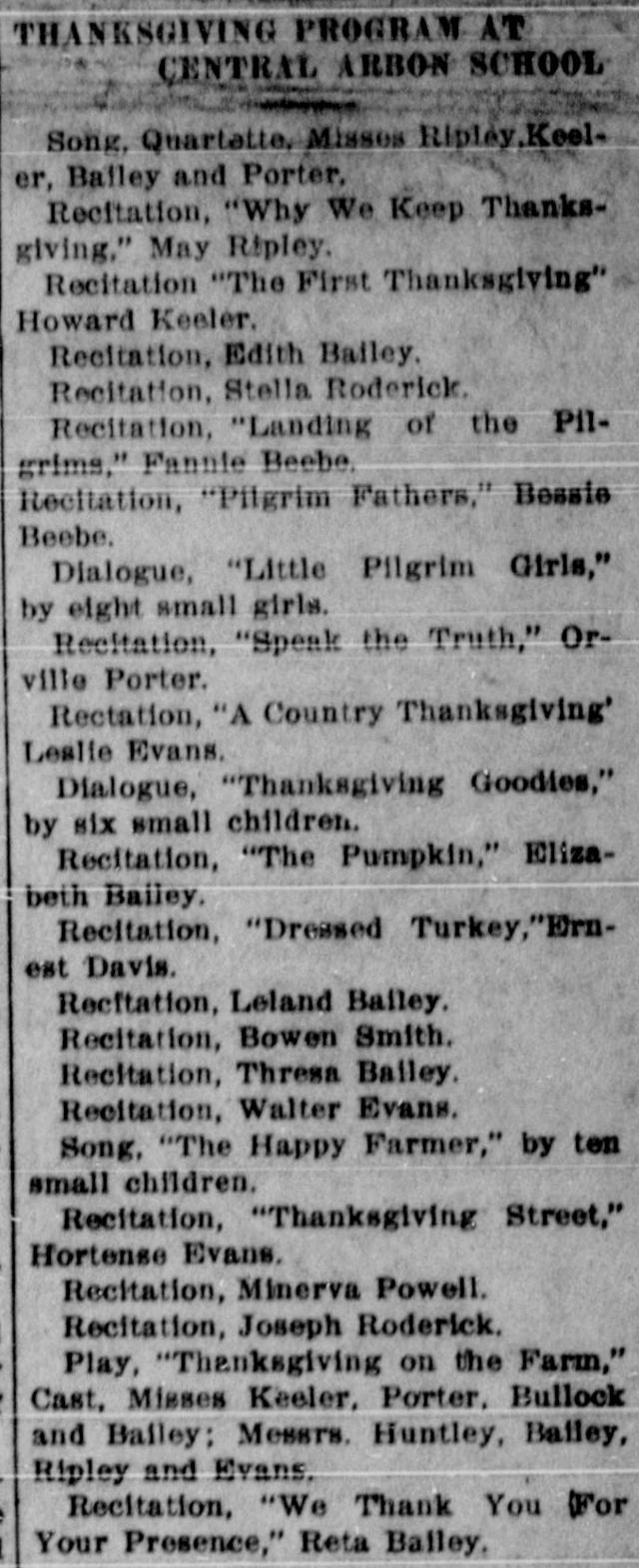
The Thanksgiving bill opened with a quartet of girls, the Misses Ripley, Keeler, Bailey and Porter. Then the recitations came one after another. May Ripley explained “Why We Keep Thanksgiving,” Howard Keeler told of “The First Thanksgiving,” Fannie Beebe gave “Landing of the Pilgrims” and Bessie Beebe “Pilgrim Fathers.” Orville Porter recited “Speak the Truth,” Leslie Evans “A Country Thanksgiving,” Elizabeth Bailey “The Pumpkin,” Ernest Davis “Dressed Turkey” and Hortense Evans “Thanksgiving Street.” Edith Bailey, Stella Roderick, Leland Bailey, Bowen Smith, Thresa Bailey, Walter Evans, Minerva Powell and Joseph Roderick each had a piece too, though the paper did not give their titles.
The smallest pupils had their turn. Eight little girls played “Little Pilgrim Girls,” six small children gave a dialogue called “Thanksgiving Goodies,” and ten more sang “The Happy Farmer.” The play of the night, “Thanksgiving on the Farm,” had a cast of four girls and four boys, named only as the Misses Keeler, Porter, Bullock and Bailey and Messrs. Huntley, Bailey, Ripley and Evans. Reta Bailey closed the evening with “We Thank You For Your Presence.”
Christmas at Finnegan’s Flat
By then Christmas was on the way. “A fine Christmas cantata is being prepared at the Central school which will be held Christmas eve,” the North Central Arbon column said on December 23. The same column brought news of a new pupil. Charles Johnson of Twin Falls, a brother of Mrs. Melvin Bailey, had moved in with his sister and enrolled at the Central school. He was very likely the Charlie Johnson whose “Daddy’s Xmas” was the first recitation of Christmas Eve.
The Press printed that program on December 30, headed “Given by the Pupils of the Central School at Arbon, December 24.” The whole school sang a carol, Charlie gave his piece, and then came the first act of “Xmas at Finnegan’s Flat.” Joe Evans was Pat Finnegan and Bessie Beebe was Biddy, his wife. Ernest Davis played Prof. Button, Hortense Evans was Miss Neversick, Erma Bailey was Miss Goodheart and Myron Bullock was Dooley, the policeman, with a group of children around them. After “Jolly Old St. Nicholas” the second act went on. David Evans then recited “The Brave Little Tree” and Fern Bullock “Christmas Long Ago.”
A second play, “The Model School,” put Nina Keeler at the teacher’s desk over eight pupils, Paul Ripley and Constance Evans among them, while five visitors looked on, Elizabeth Bailey and Leslie Evans among those. Edna Bailey recited a piece whose title can be read only in part. Mrs. Albert Poppy, probably of the valley’s Poppie family, gave “Convict’s Xmas Eve.” The cantata came last. Its title seems to be “Santa in Southland,” but the scan has scrambled it along with part of its cast, and only Filmer Roderick, Alta Beebe, Mary Bailey and Welling Evans can be made out. Nothing has turned up to say how the night went.
The names on the two programs reach into most of the valley’s families. Every Evans child who can be placed came from one of the three Evans brothers’ households: Hortense and probably David were children of Dave Evans, who had died in 1913; Leslie, Walter and Welling were sons of L. B. “Ren” Evans; and Constance was the daughter of T. B. Evans, whose land the school stood on. More of the Evans family is told elsewhere on this site. Erma, Elizabeth and Edna Bailey were daughters of the postmaster, James R. Bailey, one branch of the Bailey family, and May and Paul Ripley were children of D. B. Ripley.
A literary society, and a fire on the tree
The school kept the community busy all winter. A literary society organized there on December 7, and by early January the Press reported about 95 people at one of its meetings. Nina Keeler kept its minutes and its money, Miss Cox and Mr. Ray planned its programs, and the schoolchildren took their places on them. In February L. B. Evans told the paper this was the best school they had had in years. “I place our teachers second to none in the county,” he said.
Five Christmases later the Central school was still holding its holiday program, this time on a Thursday evening, with a pie auction afterward to buy hot lunches for the pupils. On January 7, 1921, the Press told what nearly happened:
The Xmas tree was beautifully decorated with trimmings, treats and presents for the school children. One of the candles which was lighted in some way caught a Xmas bell afire on the tree and in a few moments the top of the tree was all ablaze. By quick work of the men the tree was pulled over and the fire extinguished, but not until it had burned about half of the tree and a few presents.
A strong south wind was blowing that night, and the paper said the fire “would have soon taken the building” had it spread. The pies raised $14. The Press also printed a verse, “Why We Need the Hot Lunch,” probably recited that evening. Its young speaker grumbles that Pa warms milk for the calf and Ma heats food for the chicks, “But my lunch is cold as bricks,” until the school starts serving soup “hot as the dickens.” The rest of the valley’s school story is told in the schools of Arbon Valley.
The original article
American Falls Press, December 9, 1915, page 1. Transcribed from the page scan.
THANKSGIVING PROGRAM AT CENTRAL ARBON SCHOOL
Song, Quartette, Misses Ripley, Keeler, Bailey and Porter,
Recitation, “Why We Keep Thanksgiving,” May Ripley.
Recitation “The First Thanksgiving” Howard Keeler.
Recitation, Edith Bailey.
Recitation, Stella Roderick.
Recitation, “Landing of the Pilgrims,” Fannie Beebe.
Recitation, “Pilgrim Fathers,” Bessie Beebe.
Dialogue, “Little Pilgrim Girls,” by eight small girls.
Recitation, “Speak the Truth,” Orville Porter.
Rectation, “A Country Thanksgiving’ Leslie Evans.
Dialogue, “Thanksgiving Goodies,” by six small children.
Recitation, “The Pumpkin,” Elizabeth Bailey.
Recitation, “Dressed Turkey,”Ernest Davis.
Recitation, Leland Bailey.
Recitation, Bowen Smith.
Recitation, Thresa Bailey.
Recitation, Walter Evans.
Song, “The Happy Farmer,” by ten small children.
Recitation, “Thanksgiving Street,” Hortense Evans.
Recitation, Minerva Powell.
Recitation, Joseph Roderick.
Play, “Thanksgiving on the Farm,” Cast, Misses Keeler, Porter, Bullock and Bailey; Messrs. Huntley, Bailey, Ripley and Evans.
Recitation, “We Thank You For Your Presence,” Reta Bailey.
Sources
- American Falls Press, November 11, 1915, page 5
- American Falls Press, December 2, 1915, page 3
- American Falls Press, December 9, 1915, page 1
- American Falls Press, December 23, 1915, page 7
- American Falls Press, December 30, 1915, page 7
- American Falls Press, January 6, 1916, page 2
- American Falls Press, January 13, 1916, page 4
- American Falls Press, January 27, 1916, page 4
- American Falls Press, February 10, 1916, page 4
- American Falls Press, January 7, 1921, page 5