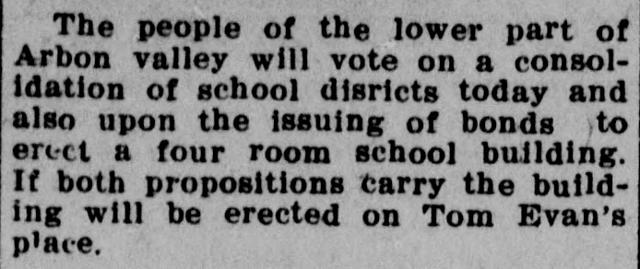
Settlers at the lower end of the Arbon valley went to the polls on Thursday, June 29, 1911, with two questions before them. Should their school districts become one? And should they borrow to put up a four-room schoolhouse? If both carried, the American Falls Press told its readers that day, the new building would go “on Tom Evan’s place.” The paper spared the vote only a few lines, and no word of the outcome has turned up. Yet its scattered notices over the next two years trace how the valley’s Central school came to stand on Evans land.
District No. 46
In 1911 the valley still lay in Oneida County, which it would leave for Power County in 1913, and its school was one of Oneida’s numbered districts. The settlers had held their first school in the log building they put up in 1901–02, with Maude Evans teaching. In August 1907 the Press printed the school apportionment for “this end of the county,” and the valley’s line read “Arbon No. 46, $132.41.” Among the nine shares on that list, only American Falls, one of the Rockland districts and Neeley drew more.
A year later there seems to have been a second schoolhouse, for a November 1908 meeting to bring new settlers into the valley met “at the upper schoolhouse in Arbon.” One teacher of those years may have been Frank F. Durfey of Box Elder County, Utah. A campaign profile of him printed in 1938 says he studied at Brigham Young College from 1907, with the year he left lost in the scan, and that he spent two years teaching at Arbon, though it gives neither the years nor the school.
When the Press ran a front-page report on the valley’s settlement in September 1910, it summed up the need in four words: “Another school is needed.”
A building for the lower valley
The June vote came nine months after that. Bannock Creek heads at the top of the valley and flows north toward the Fort Hall Reservation, so the “lower part” was most likely the northern, downstream end. In 1917 Mrs. Logan would speak of the Pauline settlement as “the lower end of the Bannock valley.” Tom Evans farmed toward that end, on the Arbon floor north of the Valley View school. He was almost surely T. B. Evans of the Evans family, whom the Press called “Tom” in 1914 and named in 1917 as the man who gave the Central school its land.
That September the district went to the polls again. A legal notice headed “NOTICE OF BOND ELECTION IN ARBON SCHOOL DISTRICT NO. 46” summoned its voters to “the South End School House” on September 30, 1911, to decide whether the trustees might issue bonds at 6 percent interest or less, retired one-tenth at a time starting ten years after issue. The amount and the purpose are lost in the scan, and the notice never says where the south end schoolhouse was, nor whether the newly joined district was borrowing for its new building. It was signed by the trustees’ clerk, printed as O. S. Butler. That was probably G. S. (George) Butler, in whose home the valley’s first Protestant Sunday school had been organized that April. How this election came out has not been found either.
Contractor Hooker in the valley
The next sign of building came on August 22, 1912, when a front-page local item said that “Contractor Hooker, who is building a school house in Arbon valley, spent Sunday at home with his family.” He was probably H. E. Hooker, who had run advertisements in the Press as an American Falls contractor and builder. The item names no school. It could have been the Central school, but Crystal’s District 14 was also building that year, putting up its Crystal Central School in 1912.
A new county and new numbers
On January 30, 1913, Power County was created, and its boundary left the south end of the valley in Oneida. That April the new county’s commissioners recorded that School District No. 46, on account of the new county, had been reorganized to take in the part lying within Power. Their minutes, printed in May, are badly damaged in the scan.
At the end of July the commissioners gave every school district in the county a number and a name. Valley View, Bannock Center, Meadow and Crystal all appear on their list, though the numbers cannot be read. By July 1916 the Arbon precinct voted at the “Central school house, district No. 12,” with Pauline as District 13 and Crystal as District 14. Mrs. Logan put the Valley View school about three miles south of the Central school, near E. Davis’ store, and the Arbon column of 1914 mentions a “South End school” too, where the teacher, Mr. Walker, was planning a literary society.
A school and a hall
The Central school was standing by mid-1913. According to Mrs. E. A. Logan’s history of the valley, which the Press printed in 1917, the Protestant Sunday school had met in members’ homes for two years, until the Central school was finished, and on July 13, 1913, a Congregational church was organized there. In September the meeting to organize the valley’s telephone company was called for “the Central school building, in Arbon.” The Christmas tree and program on Christmas Eve 1913 were held there too, with presents, candy, nuts and oranges for 125 children. By the spring of 1914 the Arbon correspondent could report: “The weekly public dances are held every Friday night in the public hall of the Central school building.”
“A graded school was built in the center of the district, known as Central school,” Mrs. Logan wrote. It had two rooms and a large basement for community use. A jumbled passage of her history seems to say that H. Perry Howell, who had started Pauline’s first school in 1911, also taught at the Central school when it first opened. And she put on record that “T. B. Evans, one of our most public-spirited citizens, gave the land for the Central school building.”
The school had two rooms where the 1911 plan called for four, and no paper found explains why. But it stood where the voters of that June day had been asked to put it, on Tom Evans’ land.
The Arbon area history tells more about Valley View and the old log building, and the schools of Arbon Valley follows the rest. In the part of the valley left in Oneida County, the story of the first school at Summit is told separately.
The original article
American Falls Press, June 29, 1911, page 2. Transcribed from the page scan.
The people of the lower part of Arbon valley will vote on a consolidation of school disricts today and also upon the issuing of bonds to erect a four room school building. If both propositions carry the building will be erected on Tom Evan’s place.
Sources
- American Falls Press, August 31, 1907, page 1
- American Falls Press, November 21, 1908, page 1
- American Falls Press, September 10, 1910, page 1
- American Falls Press, October 15, 1910, page 7
- American Falls Press, June 29, 1911, page 2
- American Falls Press, September 28, 1911, page 8
- American Falls Press, August 22, 1912, page 1
- American Falls Press, May 22, 1913, page 2
- American Falls Press, August 21, 1913, page 5
- American Falls Press, September 4, 1913, page 1
- American Falls Press, January 8, 1914, page 8
- American Falls Press, April 2, 1914, page 11
- American Falls Press, July 20, 1916, page 8
- American Falls Press, March 29, 1917, page 7
- Box Elder News Journal, September 8, 1938, page 4