The stove had lost three of its legs and sat on rocks carried up from the creek. There was no table at all. A nail keg held the scrap paper, and with a board laid across its top it gave one of the bigger pupils somewhere to sit. In that schoolhouse on Clifton Creek, in the Crystal district of Arbon Valley, Lola Skartvedt and her pupils began cooking a warm meal at noon in the 1915–16 school year. By the last week of December the American Falls Press was telling the whole county, and the state beyond it, to follow her lead.
“She has started something,” the paper’s editorial page announced on December 30.
A school up Clifton Creek
Crystal, a high basin of springs and creeks, made up School District 14 of Power County. Its area history counts five other schools there besides the Crystal Central School of 1912, and the site’s Stories look at the first schools at Crystal. In April 1914 the district called an election on $1,600 in bonds to put up three more schoolhouses, Clifton Creek among the sites. A 1917 farm column put one homestead “up on Clifton creek, two and a half miles northeast of Crystal.” The papers read for this post never report how the bond vote went, so whether Miss Skartvedt taught in one of those new buildings is unknown. The Press named her school two ways, as the Clifton Creek school and as the Gabbert school, and a boy named Clay Gabbert sat among her pupils.
Something hot at noon
She told in her own words how it started. Her pupils would “gulp down their food and wash it down with cold water,” and afterward she found them dull and hard to keep in order. So she had them raise the question of a hot noon dish with their parents, and every one of them came back wanting it.
The children organized a Domestic Science Club. A boy was elected president, a girl took on the secretary’s and treasurer’s jobs, and two mothers joined the teacher as advisers. Each child put in a dime to lay in provisions and another dime whenever the stock gave out. The president did the shopping and the secretary kept the books. On Fridays they planned the next week’s meals and named two cooks for every day. “Even the boys have their turn,” she wrote. The first weeks had been lean:
The first month we borrowed a kettle and often had to borrow dinner pails, using the wash basin for a double cooker, and the first week we used the floor as a table. Now I have a kitchen table made by two of my boys during recess, noons and after school hours.
A woman with no children in the school gave them a kettle and a can opener, and the pupils carried in dishes from home, so the school spent just fifty cents on the whole kitchen. Shopping turned into arithmetic and more. She taught them that a quart of milk at eight cents held as much nourishment as a quart of oysters at sixty-five. From the stove the club moved to the needle, turning out dish cloths, dish towels, holders, caps and aprons. Two of her boys, eight years old, sewed aprons, and one of them, she wrote, meant to grow up to be a “restaurant man.” The older boys used tools brought from their homes. The table the two boys had built, with the porch for a workbench, now held both the cooking and the carpentry.
A paper read at Pauline
She told all this to her fellow teachers on Thursday, December 9, 1915, when the Arbon and Crystal division of the Power County Teachers’ Association met for the first time, in the Pauline meeting house in Pauline and West Fork. Notices before the meeting gave the date as December 8, but the 9th fell on a Thursday, as the report says. The trustees’ wives laid out a picnic dinner. County Superintendent Madge Whistler and County Agent Kjosness came out to join teachers from Crystal, Valley View, Bannock Center and Pauline, along with several patrons of the Crystal schools. Kjosness spoke on the “Rural High School,” then the question everyone in the valley was discussing, the paper said, and Miss Whistler laid out a plan to let pupils earn school credit for their chores at home.
Miss Skartvedt titled her paper “City School Features Adapted to Rural School Needs.” The meeting report credited her with turning “a bare shack school” in the Clifton Creek neighborhood into a lively one. Its headline hailed the Crystal school, evidently hers, as “the First Rural School to Include Manual Training and Domestic Science.”
The Press ran her paper in full on December 23. A week later came the editorial. Few teachers, it said, would have tried such a thing with so little, yet now “listlessness has become attention,” the pupils were better behaved, and a middling school stood “in the very front rank, all because a teacher had an ideal.” The editor drew the lesson plainly: “What this little, poorly equipped school can do, any school in the state can do.” He hoped every trustee and parent in the county had read her paper the week before.
The rest of the winter
At Christmas her pupils gave a dinner for the school’s patrons, with the room trimmed in red and green; the school note said they had learned proper table service and manners so they could cook and serve it. At the mid-year examinations in January, Clay Gabbert earned four marks of 100.
Late that month Miss Skartvedt came in from the Crystal district to American Falls for the county meetings of teachers and trustees. The school notes from those sessions said she was still serving warm lunches and still giving credit for work done at home, and that “cleanliness is one of the indispensables in her school.” A young German who had taken an interest in her work had presented the school “a carpenter bench and a set of the most necessary tools,” and she and her boys were at work on a doll house.
In May 1916 she stopped at American Falls on her way home to East Stanwood, Washington, and the Press told its readers she would not be returning:
Miss Skartvedt had some most flattering offers if she would accept the same position for next year, but a Washington city has offered her the supervision of the domestic science and art work. She is so eminently well qualified for this that scarcely a rural school in all Power county could afford the salary she is able to command.
The papers read for this post lose track of her after that, and they never name the next teacher on Clifton Creek. More of the valley’s classrooms are gathered under the schools of Arbon Valley. Her idea, at least, did not leave with her. By that January, Olive Beale was serving a warm noon lunch at the Crystal school too.
The original article
American Falls Press, December 30, 1915, page 2. Transcribed from the page scan.
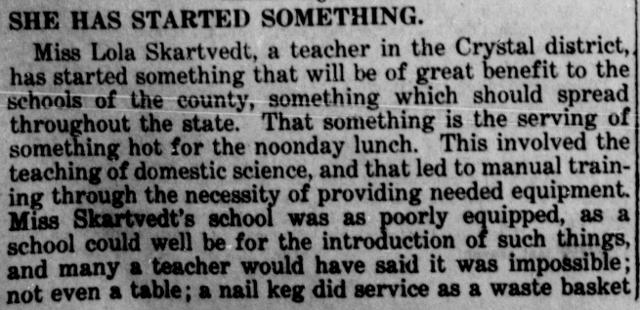
SHE HAS STARTED SOMETHING.
Miss Lola Skartvedt, a teacher in the Crystal district, has started something that will be of great benefit to the schools of the county, something which should spread throughout the state. That something is the serving of something hot for the noonday lunch. This involved the teaching of domestic science, and that led to manual training through the necessity of providing needed equipment. Miss Skartvedt’s school was as poorly equipped, as a school could well be for the introduction of such things, and many a teacher would have said it was impossible; not even a table; a nail keg did service as a waste basket and covered with a board served as a seat for one of the larger pupils; a stove minus three legs, proped up with stones, these are samples of the equipment. With tools brought from the homes needed furniture was made cooking utensils were borrowed from the parents, and later were donated, only fifty cents having been paid out by the school for this purpose. Listlessness has become attention on the part of the pupils; discipline has improved, and an indifferent school has been placed in the very front rank, all because a teacher had an ideal. What this little, poorly equipped school can do, any school in the state can do. Instead of cold lunches and uninteresting lessons, real live schools can be made. Every school trustee and every parent who received last week’s Press, it is hoped, read Miss Skartvedt’s paper printed in last week’s issue, and resolved to bring their own school up to the same standard.
Sources
- American Falls Press, April 9, 1914, page 2
- American Falls Press, November 25, 1915, page 1
- American Falls Press, December 9, 1915, page 1
- American Falls Press, December 23, 1915, page 6
- American Falls Press, December 30, 1915, page 2
- American Falls Press, January 6, 1916, page 2
- American Falls Press, January 27, 1916, page 4
- American Falls Press, February 3, 1916, page 3
- American Falls Press, May 11, 1916, page 2
- American Falls Press, November 2, 1917, page 3
- Jacob Andersen, “Crystal,” area history on this site