By the spring of 1916 the farmers around Arbon and Holbrook had put their names to it: a note for a dollar on every acre they owned, payable in two years, secured by a mortgage, and void unless a railroad was running by then. On a Tuesday in late May the men promoting the road, Harris, Cummings and Ford of Pocatello, carried that news to the American Falls Board of Trade in the county recorder’s office and asked the town for $50,000 more. The American Falls Press put the meeting on its front page on May 25.
It was the high point of an eight-year hope. Between 1914 and 1922 the people of Arbon Valley, then often called Bannock Valley, backed one railroad plan after another to carry out their wheat. No line was ever built.
A hundred days instead of a hundred years
The valley had belonged to Oneida County until 1913 and now lay in Power County. Every bushel it raised left by wagon, most of it bound for Michaud, a Short Line siding some eight miles west of Pocatello. In the spring of 1914 the United Bannock Valley Booster association, then behind the Double-P Construction company’s carrier system, adopted a slogan with some swing to it: “A railroad in Bannock valley in the next hundred days instead of the next hundred years.”
That June, mass meetings in the Bannock, Curlew, Blue Creek and Pocatello valleys chose a committee to go to the Oregon Short Line. Among its members was J. R. Bailey of Arbon, likely the homesteader James R. Bailey. The Press gave his initials as J. L., but he was J. R. The farmers wanted a sixty-mile branch running from the railroad’s Utah line up to the main line near American Falls, and they offered free right of way and a bonus to get it. Reporting their talk with the general manager, E. E. Calvin, one account said that “the cost of getting a crop out of the valleys to a railroad point is equal to the cost of raising it.” If no steam road would come, they said, they would put up an electric line themselves.
Late that summer L. B. Evans of Arbon told the Pocatello Tribune the farmers had been promised that “the line would receive the most favorable consideration.” In September the Short Line’s chief engineer, Carl Stradley, traveled overland from Malad through Holbrook, Landing and Rockland and returned by way of the Arbon Valley. He had nothing to announce.
Two towns after the wheat
By late 1915 Pocatello and American Falls were each courting the valley’s grain, roughly a million bushels a year as the Salt Lake Tribune reckoned it. “Pocatello wants Bannock valley trade,” ran the Arbon column of the Press that July. In December a Pocatello street-railway company was said to be arranging a right of way “to and through Arbon Valley,” with surveyors to come after. A month on, T. S. Becker, an attorney at American Falls, said plans were close to finished for a narrow-gauge road from his town into the valley, driven by gasoline motor. Its backers promised it in five months.
A dollar an acre
On March 10, 1916, a party of Arbon ranchers went before the Pocatello city council and asked that any street-railway franchise carry a road to their valley. The same day they contracted with two attorneys, B. A. Cummings and J. M. Stevens, to “pay a bonus of $1 per acre on their land and give the company a right-of-way to construct a railroad into the valley.” S. E. Harris of Pocatello acted as the promoters’ trustee. The line would go to Michaud first, and whether it continued on to Pocatello or to American Falls, Cummings told the Tribune, was “strictly up to Pocatello.”
A crowd described as very large filled the Central school on March 18. W. A. Nunnelley, B. D. Lindley, D. B. Ripley, J. H. Fuller and L. B. Evans, the subscription committee, told them how much land had been signed. By now the scheme had swelled into an independent road from Wells, Nevada, to Silver Bow, Montana, by way of Ogden, Michaud, Holbrook, Crystal and Arbon, and it would pay, its backers said, because “the tonnage is already here.” Reaching Michaud meant crossing the Fort Hall Reservation, which answered to the Secretary of the Interior, Franklin K. Lane at the time. The Arbon correspondent passed the word along:
The right of way is assured through the reservation by Secretary Lane. The Arbon Valley Railway Co. is only the temporary name. They cannot predict a railway here by next fall but there is a good chance in two years. We are sure to appreciate it as soon as we can get it.
L. B. Evans went over to the Holbrook country “in the interests of the Arbon Valley railroad,” and through April the meetings moved from Pauline to Central to Valley View to the Nunnelley school house. “We are earnestly looking forward to our railroad,” wrote the Arbon column.
Turning to American Falls
In May Pocatello’s council declined to hold its street-railway franchise in escrow, and the promoters turned to American Falls. At the Board of Trade meeting the Press reported on May 25, they said the road was meant to reach Ogden through Holbrook and the Pocatello valley. For a deeded right of way, terminal facilities and $50,000 they would build from American Falls to Rockland; beyond Rockland to Holbrook they wanted more right of way and a further bonus. President M. J. Unger named a committee of five to sound out the townspeople and called a public meeting for the following Monday at the court room.
The paper also printed the mortgage form. It bound Harris to build and run “a standard gauge railroad extending from American Falls southerly into the Rockland valley, via Rockland and Landing, Idaho,” within two years, and left a blank where the length of the line belonged. It said nothing of Arbon, and the papers never say whether the valley’s farmers had signed that same form.
By June 19 Harris could report that “the ranchers throughout the valley are a unit for the project.” The road had a new name, the Bannock Valley, Rockland & Southern, and a new route, from Michaud to the Utah line through Arbon, Rockland and Holbrook, with an eastern bond house to put up the money.
Too costly
The end came quietly. On October 1, 1916, the Tribune reported that eastern engineering and bonding firms had looked the project over favorably but found it too expensive to build “under present conditions.” Pocatello’s Commercial Club appointed a committee to study a forty-mile wagon road over Trail Creek in its place.
The next March, writing about the neighboring Rockland valley, the Press looked back on how often promoters had come asking farmers for so much an acre: “Each time the farmers have agreed to contribute liberally, but the road has never been built.” In July 1918 the farmers of Arbon and Crystal were still “considerably concerned over the question of getting their crops to market this fall.” And in March 1922 a group in Pocatello talked of reviving the dormant traction company of 1915 to run a sixty-five-mile electric line to a valley said to be “exceptionally anxious to get hooked up with Pocatello.” No later word of it has turned up.
The valley’s grain did reach market in the end, though not by rail. It went out over the first state highway and in the first trucks, and the dollar-an-acre notes, by their own terms, came to nothing.
The original article
American Falls Press, May 25, 1916, page 1. Transcribed from the page scan.
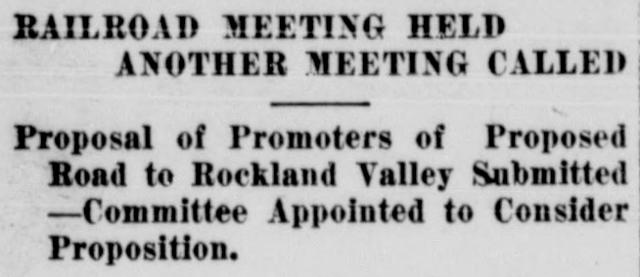
RAILROAD MEETING HELD
ANOTHER MEETING CALLED
Proposal of Promoters of Proposed Road to Rockland Valley Submitted—Committee Appointed to Consider Proposition.
At the office of the county recorder Tuesday, Messrs. Harris Cummings and Ford of Pocatello, who have been promoting a railroad through the Bannock valley, met with the Board of Trade and submitted their proposition. It was stated that the road was planned to extend to Ogden, through Holbrook and the Pocatello valley.
The promoters ask for a deeded right of way and a bonus of $50,000 to build from here to Rockland; from Rockland to Holbrook they want right of way and additional bonus.
The work of signing up the farmers around Arbon and Holbrook has been completed. The plan of raising the money is for farmers along the line to give a note secured by mortgage, for $1 per acre, payable in two years from date, provided the road is built and in operation by that time. Otherwise the note and mortgage are to become void. The mortgage reads as follows:
For one dollar and other valuable considerations the receipt whereby is here acknowledged ........ Mortgagor, hereby mortgages to S. Harris, Trustee, mortgagee, all that certain personal property located in ........ county; Idaho, and described as follows:
This mortgage is given to secure the payment of a certain promissory note of even date herewith and hereto attached. And these presents shall be void if such payment is made, but in case of default in such payment of either principal or interest, as in said note provided, the whole of said amount shall become due and payable and second party may thereupon enter said premises and sell the same according to law, in which event first parties shall pay a reasonable atorney’s fee.
“This mortgage and the attached note are given with the understanding that the same shall be null and void unless the said S. E. Harris, his successors or assigns, shall construct and have in operation a standard gauge railroad extending from American Falls southerly into the Rockland valley, via Rockland and Landing, Idaho, for a distance of not less than ........ miles, with two years from the date hereof.”
At the conclusion of their presentation President M. J. Unger appointed Jay Gibson, S. A. Forter, O. R. Baum, E. E. Zaring and Chester Greene a committee to take up the matter with the people. It has been decided to hold a meeting next Monday evening at the court room, to which all interested people are invited.
Terminal facilities are asked for in addition to right of way and bonus.
Sources
- American Falls Press, April 9, 1914, page 1
- Salt Lake Telegram, June 25, 1914, page 9
- American Falls Press, July 30, 1914, page 1
- Lincoln County Times, September 3, 1914, page 1
- American Falls Press, September 17, 1914, page 1
- American Falls Press, October 15, 1914, page 5
- American Falls Press, July 8, 1915, page 2
- Salt Lake Tribune, January 2, 1916, page 57
- Electric Railway Journal, January 22, 1916
- Ogden Daily Standard, January 28, 1916, page 5
- Salt Lake Tribune, March 12, 1916, page 5
- American Falls Press, March 30, 1916, page 7
- American Falls Press, April 6, 1916, page 3
- American Falls Press, April 27, 1916, page 6
- Salt Lake Tribune, May 7, 1916, page 40
- American Falls Press, May 25, 1916, page 1
- Ogden Daily Standard, June 20, 1916, page 10
- Salt Lake Tribune, October 1, 1916, page 14
- American Falls Press, March 29, 1917, second edition, page 1
- Salt Lake Tribune, July 2, 1918, page 7
- Salt Lake Telegram, March 31, 1922, page 24