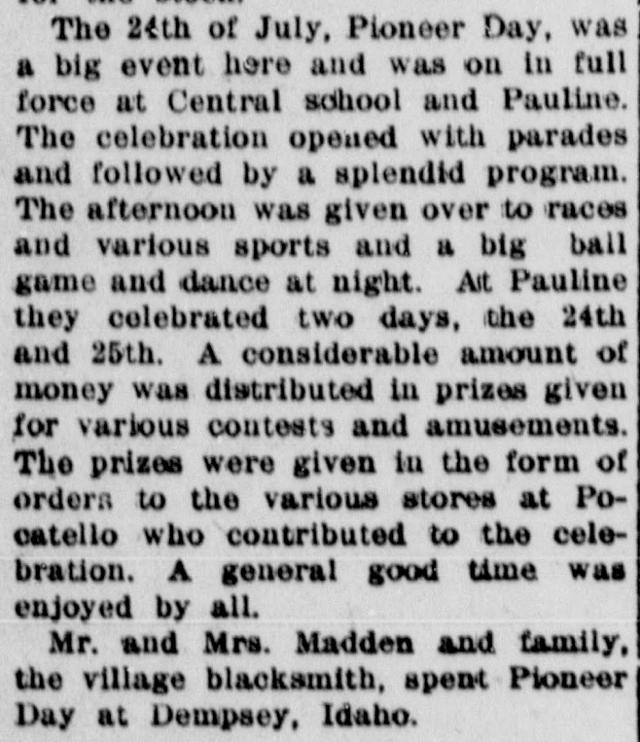
At ten o’clock on the morning of July 24, 1916, a parade set out from Joe Evans’s corner and made its way to the Central school. Joe Arbon and Joe Evans raised the flag and fired the guns, and a program followed. The afternoon belonged to races and sports, and the day closed with what the paper called “a big ball game and dance.” At Pauline, at the valley’s north end, the celebration ran two days, the 24th and the 25th.
Every July 24 the Latter-day Saints mark Pioneer Day, the anniversary of the first pioneer company’s arrival in the Salt Lake Valley in 1847. Many of Arbon Valley’s first families had come from Latter-day Saint towns such as Samaria, Mendon and Wellsville, and they kept the day in their new home. For two decades the American Falls Press, and later the Salt Lake Tribune, told how.
The early notices were brief. In 1909, while the valley still lay in Oneida County, the Arbon column looked forward to “an enjoyable time” on the 24th. In 1915 a large crowd gathered at the Pauline L.D.S. grounds for a morning program and racing of various kinds.
Brush for the bowery
The fullest account came in the Press’s Arbon News column of August 3, 1916, which printed the whole program and every committee. The Central school was the District 12 schoolhouse on the north Arbon floor, built on land T. B. Evans had given; the valley later knew it as Green Top. The two men at the flag were probably Joseph N. Arbon, the Arbon Ward’s first bishop, and T. B. Evans’s son Jonah E. “Joe” Evans. The marshal of the day, printed as E. T. Anderson, was Ezra Taft Andersen, according to the Andersen family history. A male quartette sang under a Bailey whose first name the digitized text garbles, most likely Lorin Bailey, who led the Arbon choir. Mrs. May Fuller and her son played, Mrs. Annie Smith directed a dialogue, and somewhere among the songs and recitations came a stump speech.
Behind the program stood a long list of neighbors. E. H. Davis and J. R. Bailey handled the money. Mrs. T. B. Evans, Mrs. Ren Bailey and Mrs. Annie Smith had charge of the floats. The bowery, a shelter roofed with brush, took a crew of its own: George Iverson, Frank Turner, Mr. Thyberg and Eddie Davis were among the men sent for brush, Jim and Chance Payne helped set the poles and posts, and John Payne, Chas. Porter and David Ripley saw to the seats. Mrs. Beth Arbon, Mamie Arbon, the John Bullocks, the Ren Evanses, the Julius Abters and the John Andersens were among those named for the pioneer parade. David Ripley and John Payne also took charge of an auto parade, an early sign of the automobile in the valley.
The prizes were generous, though not paid in cash. “A considerable amount of money” went out in prizes, the column said, in the form of orders on the Pocatello stores that had contributed to the day. Not everyone stayed home: the village blacksmith, Mr. Madden, and his family spent the holiday at Dempsey.
Rain on the bucking contest
The next summer the country was at war. In 1917 the same Press page that listed the draft numbers of Pauline and Arbon men reported that Pauline had kept the day “with usual ceremony and the usual good time, in honor of the early settlers who came to this section of the west.” The celebration centered on a store, its owner’s name garbled in the digitized text, where refreshments were served to all comers. Then “a heavy rainstorm came up during the bucking contest,” and the crowd ran for cover.
Racers and a watermelon at Crystal
In 1918 the news came from Crystal, the high basin of homesteads on Midnight and Rattlesnake creeks, where the celebration was probably held. A finance committee, apparently Crystal’s own, had gone to Pocatello ahead of time and “secured about 25 or 30 handsome premiums” for the race winners. On July 30 the Crystal column called the day “quite a success.” Many in the crowd had come from Pocatello, and “quite a number of the Indians came and did some racing which was quite interesting,” though the paper gave neither their names nor where they came from. More than 30 prizes went to winners of the races. That night two more went to the best lady waltzers, Mrs. Spencer Breeze among the young and Mrs. J. Smith among the older ladies. Ray Poorman auctioned off a watermelon donated by Hugh Poling, and it brought something over $15 for the Red Cross.
Lemonade in the warehouse
In 1920 the Arbon correspondent reminded readers that the day was “set apart for observation in commemoration of those who endured the hardships incident to the early settlement and development of the intermountain west.” On Saturday, July 24, a large crowd came to Pauline, where “the warehouse was decorated up, and opened to the public. Free lemonade was served at all times.” It was probably the valley’s first grain warehouse. There were foot races, horse races, bucking contests and a program, and the Pauline nine beat Crystal at baseball. Mr. and Mrs. Wm. Cruse of Crystal played for a dance in the warehouse that lasted “until a late hour.”
Not all of it was lemonade. Drink was “quite in evidence,” the correspondent wrote, and people had to stay out of the way of “the drunken ones on horseback.” Women and children had several narrow escapes from injury.
Three wards by the oil well
On July 24, 1924, the Salt Lake Tribune carried a dispatch from Pocatello saying the valley’s three wards had joined forces for the day, at “the schoolhouse near the oil well of the Gem State Petroleum company.” The well, one of the valley’s oil tests, had reached 730 feet that May. It stood on the Tom Evans place, as the Evans family history records, and the next year the county school report placed the District 12 school “next door to the Arbon oil well.” The 1924 celebration, then, was most likely at the Central school, where the 1916 parade had ended.
George Jorgenson of Pocatello was to be “orator of the day” at the morning exercises. A basket picnic would follow at noon, then an afternoon of bucking contests, races and sports, and many Pocatello people were expected. The Tribune did not name the three wards, and no account of how the day went has turned up.
A new hall
By 1929 the valley had a building to match the occasion. The Tribune announced that Pioneer Day would bring “a community and sports program at Arbon, marking completion of the $11,000 meeting and amusement hall there,” with sports in the afternoon and dancing at night. More of the building’s story is in the entry on the first meetinghouses; accounts differ on when the new church house was dedicated.
Who gave the stump speech in 1916, who won most of the races and who rode in the bucking contests, the papers never said. What they kept was the shape of the day, the same from one summer to the next: a parade or a program in the morning, races in the afternoon, and a dance that ran late.
The original article
American Falls Press, August 3, 1916, page 4, the “Arbon News” column. The paragraph on Pioneer Day and the one after it are transcribed from the page scan; the rest is from the Library of Congress text of the page, so its paragraph breaks are inferred. The program was printed in two columns, items and performers, which that text reads apart: they are given here in the order it reads them, and which performer went with which item cannot be recovered. Five performers and two items that the text sets among the committees are given with the program.
ARBON NEWS.
Our rainy days have come. We have had several hard showers, also severe lightning. The grain is turning fast which means harvesting in a few days.
Harry Hill is passing the treats. It’s a girl which came to gladden their home several days ago. Mother and child progressing nicely.
F. [illegible] Jones was in Arbon a few days ago talking with old acquaintances.
[illegible] Affleck and family were visitors at the home of Mrs. Affleck’s parents, Mr. and Mrs. T. B. Evans, last week.
A petition is in circulation for turning Knox canyon and tributaries into a forest reserve. The petition is to keep the sheep back and have pasture for the stock.
The 24th of July, Pioneer Day, was a big event here and was on in full force at Central school and Pauline. The celebration opened with parades and followed by a splendid program. The afternoon was given over to races and various sports and a big ball game and dance at night. At Pauline they celebrated two days, the 24th and 25th. A considerable amount of money was distributed in prizes given for various contests and amusements. The prizes were given in the form of orders to the various stores at Pocatello who contributed to the celebration. A general good time was enjoyed by all.
Mr. and Mrs. Madden and family, the village blacksmith, spent Pioneer Day at Dempsey, Idaho.
Program for the 24th of July.
Raising of flag and firing of guns Joe Arbon and Joe Evans.
Marshal of Day E. T. Anderson
J. R. Bailey
Loran Bailey
Choir
Chaplain
Choir
Chaplain of Day
Chorister
Singing
Prayer
Singing
Instrumental music Mrs. May Fuller and Son.
Recitation
Song
[illegible]
Song
Dialogue, direction of Mrs. Annie Smith
Male Quartette, direction of Loran Bailey.
Stump Speech
Song
Instrumental Music Mrs. Tracy [illegible]
Mrs. W. K. [illegible]
May Ripley and [illegible] Bowen
Sarah Payne
James and Lila Ripley
Mrs. Stella Bailey and Sister
Cliff Gerking
Mrs. L. B. Evans
Recitation
Song
Committees.
Finance E. H. Davis and J. R. Bailey
Floats Mrs. T. B. Evans, Mrs. Ren Bailey and Mrs. Annie Smith.
Pioneer Parade.... Mrs. Beth Arbon, Mamie Arbon, Mr. and Mrs. John Bullock, Mr. and Mrs. Ren Evans, Mr. and Mrs. Julius [illegible], Mr. and Mrs. John Anderson.
Auto Parade David Ripley and John Payne.
Sports Jerry Baker and [illegible].
Brush for Bowery Ora Darling, [illegible] Porter, Cliff Gerking, Joe and Ren Evans, Chas. and Thomas Bailey, Emerson Fuller, Ralph Ripley, Mr. [illegible], Eddie Davis, Frank Turner, Mr. Thyberg, George Iverson, Roy and Homer [illegible].
Poles and Posts Melvin [illegible], Jim and Chance Payne.
Seats John Payne, Chas. Porter and David Ripley.
Parade started at 10 a. m. from Joe Evan’s corner and ended at Central school house.
Sources
- American Falls Press, July 24, 1909, page 3
- American Falls Press, July 29, 1915, page 1
- American Falls Press, August 3, 1916, page 4
- American Falls Press, July 31, 1917, page 1
- American Falls Press, July 26, 1918, page 3
- American Falls Press, July 30, 1918, page 2
- American Falls Press, August 6, 1920, page 2
- American Falls Press, May 22, 1924, page 4
- Salt Lake Tribune, July 24, 1924, page 16
- American Falls Press, October 29, 1925, page 1
- Salt Lake Tribune, July 17, 1929, page 3