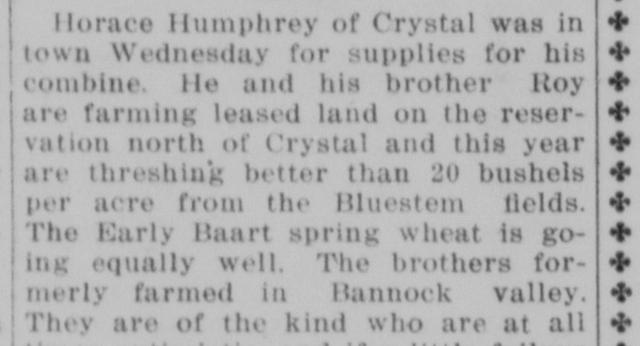
Horace Humphrey came in to American Falls on Wednesday, September 11, 1918, to buy supplies for his combine, and he had good news to bring with him. He and his brother Roy were threshing better than twenty bushels an acre from their Bluestem wheat on leased land north of Crystal, and their Early Baart spring wheat was doing just as well. The American Falls Press took the measure of the pair in a sentence: they were “of the kind who are at all times optimistic.”
The paper had been watching the Humphreys off and on for years, and it kept on until 1922. Decades later, obituaries in Utah papers picked up the thread with two of Horace’s sons, both born at Arbon. One went north to the Arctic coast of Alaska. The other served in the Korean War years, dry farmed in the valley and worked at a rocket plant in Utah.
Two brothers in Bannock Valley
Roy made the paper first. In February 1911 the Press’s Rockland Valley column mentioned a visit from “Roy Humphrey, of Arbon.” Arbon then belonged to Oneida County; Power County, with American Falls as its seat, did not exist until 1913. In June 1915 the South Arbon column had Roy spending a Sunday at the Lee home. Later that month the North and Central Arbon column named Humphries, probably Roy, as one of four neighbors who had gone in together on a combine harvester, one of the valley’s first combines.
Horace’s name surfaces in July 1917, when the Press ran the county’s draft registrants with their numbers for the drawing. Number 490 belonged to Horace Watrous Humphrey of Arbon. His own early life comes only from his 1959 obituary, and the scan of that page is badly jumbled, its text tangled with several other notices. Read with care, it seems to say he was born in Washington, married Leah M. Hargett there in December 1915, and took up a homestead in Arbon Valley in 1916. Where that homestead lay, the papers read for this post do not say.
In October 1917 the Press’s roving column, “Along the Highways,” made the rounds of farm news near Arbon and Pauline and paused at Roy’s place:
Roy Humphrey has sold all his mules except one team. He disposed of two spans of mules last week for $650, and one other span brought $300. Mr. Humphrey has a ranch two miles east of Arbon and will hereafter use horses on the farm. Besides raising grain he intends to go into the business of raising horses, range grazing land being close at hand in the mountains to the east of the valley.
Leased land north of Crystal
A year later the brothers had shifted their work north to Crystal. That community had been settled on ceded Fort Hall Reservation land, thrown open to entry in 1902, as the Crystal history tells, and the reservation still began beyond it. The ground the Humphreys leased for the 1918 crop lay on the reservation side. When the Press wrote that “the brothers formerly farmed in Bannock valley,” it meant the valley around Arbon, known by that older name, as the Arbon history explains, and it was marking off those earlier seasons from the new lease.
Those earlier seasons had not always paid. The paper allowed that “a little failure in past years” had come their way now and then, and said the brothers had met it with a smile, saving a wider one for the good years along with plans for a better one to follow.
A family at Arbon
Horace and Leah’s son William R. Humphrey was born at Arbon on December 6, 1918, three months after that trip to town, his obituary says. In November 1922 the Arbon column reported that Mr. and Mrs. Horace Humphreys of Crystal had come to Arbon to spend the winter. Another son, Hubert S. Humphrey, was born at Arbon on December 26, 1928, and grew up and went to school there. The Press called the family “of Crystal” in both 1918 and 1922, so exactly where in the valley each boy was born is not clear. It was a big household. When Hubert died, his obituary counted five brothers and a sister gone before him and three sisters still living.
Horace farmed in the valley until he retired. His obituary, again as best the scan can be read, has him and Leah moving to Pocatello in 1957. He died at his home there on September 14, 1959, at sixty-nine, remembered as a retired Arbon Valley farmer.
From Barrow to Promontory
William’s obituary says only that he was reared in Idaho. He went on to work for the Intermountain School, probably the federal boarding school for Native American students at Brigham City, Utah. By 1971 he was living at Barrow, Alaska, on the Arctic coast, the town now called Utqiaġvik, as an executive of the Barrow Council on Alcoholism. He died in an Ogden hospital on June 13, 1971, at fifty-two, and was buried in the Brigham City cemetery. The Brigham City Box Elder Journal, which carried his obituary, listed his mother at Pocatello and his brothers and sisters at Arimo and Pocatello in Idaho, Brigham City and the town of Roy in Utah, Reno in Nevada, and other places.
Hubert served in the Army from December 1950 to November 1952, in the years of the Korean War. His obituary says he dry farmed in Arbon Valley for several years and worked at Promontory, Utah, for Thiokol, the maker of rocket motors, though it gives no dates for either. He died at Pocatello on July 9, 1995, at sixty-six, and was laid to rest at Restlawn Memorial Gardens there with military graveside rites.
As for Roy, the brother who sold his mules to raise horses in the shadow of the east mountains, these papers lose sight of him after that good harvest at Crystal in 1918.
The original article
American Falls Press, September 13, 1918, page 6. A local news item printed without a headline. Transcribed from the page scan.
Horace Humphrey of Crystal was in town Wednesday for supplies for his combine. He and his brother Roy are farming leased land on the reservation north of Crystal and this year are threshing better than 20 bushels per acre from the Bluestem fields. The Early Baart spring wheat is going equally well. The brothers formerly farmed in Bannock valley. They are of the kind who are at all times optimistic, and if a little failure in past years was their fate now and then they greeted it with a smile just the same, if success rewards their efforts they smile a little more and make plans to obtain still more success in another year.
Sources
- American Falls Press, February 4, 1911, page 3
- American Falls Press, June 3, 1915, page 4
- American Falls Press, June 24, 1915, page 8
- American Falls Press, July 10, 1917, page 8
- American Falls Press, October 30, 1917, page 3
- American Falls Press, September 13, 1918, page 6
- American Falls Press, November 16, 1922, page 8
- Salt Lake Tribune, September 15, 1959, page 26
- Box Elder Journal, June 17, 1971, page 13
- Ogden Standard-Examiner, July 10, 1995, page 20