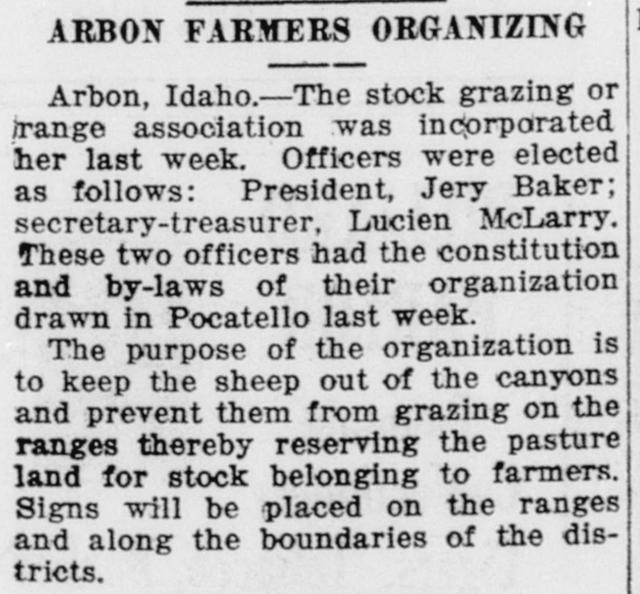
The grass in the hills above Arbon was the best anyone had seen in several years in the spring of 1920, and the valley’s farmers meant to save it for their own stock. In the week before May 7 they incorporated a “stock grazing or range association” with one plain aim, as the American Falls Press put it that day: to keep the sheep out of the canyons. By midsummer a deputy sheriff was patrolling the hills, sheepmen were under arrest, and a justice of the peace was holding court in his own home at Pauline.
Homesteads climb the canyons
The quarrel had been building for years. Arbon had belonged to Power County since 1913, and by 1915 the homesteads were working their way up into the canyons. On June 3 of that year the Central Arbon correspondent told of several newcomers who had filed on land in Knox Canyon, whose creek fed the valley’s first irrigation ditch, and were putting up buildings there. “Even the mountain ranges are being homesteaded,” the correspondent wrote, “which is gradually crowding out the sheepmen.”
The sheepmen were not gone yet. A fortnight later the Arbon news had the Eliason brothers and a crew busy at their shearing corral in that same canyon, and in June 1916 the column noted that the brothers had “recently finished the shearing of their sheep in Knox canyon.” Neither their first names nor their home is given.
In June 1918 a cloudburst broke over a canyon in the middle of shearing. The scanned page calls it “Hull canyon”; Bull Canyon, at the valley’s south end, is likely meant. The flood “carried many bales of wool several miles down the canyon, causing a loss of several thousand dollars.” Whose wool it was, the column did not say.
Some of the sheep were the valley’s own. The Summit area history recalls boys minding family flocks on the mountain, and homesteaders crossing east over it to earn wages in the shearing sheds around Daniels. But the outside bands far outnumbered the home flocks. Power County’s 1919 tax roll, which the Press printed on July 2, 1920, listed 3,671 “common” sheep and 17,616 migratory ones. And tempers had already flared: in June 1919 a sheepherder pulled a revolver on an Arbon farmer.
The association
Jerry Baker, an Arbon rancher married to George Arbon’s daughter Mayme, was chosen president. Lucien McLarry, probably the man who bought the Parley H. Bailey place at Arbon in 1918, became secretary-treasurer. The pair went to Pocatello to have a constitution and by-laws written up. The plan was to hold the pasture for farmers’ stock and to put up signs on the ranges and along the district lines.
A deputy on the ranges
The first arrest came within weeks. The Arbon News of June 11 reported that a sheepman, Eugene Berard, had been taken in the week before for grazing his sheep on Brigham Bowen’s land. “He paid his fine and trailed through to the shearing corral at Dairy Creek,” east across the mountains near today’s Daniels Reservoir. The Range Association, the correspondent wrote, was “making it disagreeable for the sheepmen,” and with the sheep kept off, the hills and canyons would carry plenty of feed for the farmers’ herds. In the same column the Servel company was clipping its sheep near Bull Canyon, in the south of the valley, while trucks hauled the wool to Schiller’s Spur, apparently the Schiller siding on the Oregon Short Line.
The Servel outfit was next. Two weeks later T. D. Jones, a Pocatello attorney, arrived in Arbon to handle “the Range Association vs. Servel Sheep company for trespassing.” In July J. R. Bailey and Jerry Baker made a trip to Malad on association business.
“Mr. Hy Secrist, Deputy sheriff, has been very busy the past two weeks riding the ranges,” the Arbon column said on July 16. He had been watching for sheepmen and had arrested several for trespass. Baker, McLarry and others, the column went on, had been “doing good work in keeping the sheep back,” and the cases were being heard in justice court at the home of Wm. E. Dawson of Pauline.
The deputy was probably Hyrum Secrist, a homesteader at Arbon, and Dawson was then the justice of the peace at Pauline. There the trail goes cold. The Press never named the other sheepmen arrested, gave no verdicts, and did not say how the Servel suit came out. The range association does not appear in the papers again.
The bands come back
The sheep kept coming. In late May 1921 the Roy correspondent wrote of a shearing crew that expected to clip 26,000 head at the Holloway corrals and 6,000 more at the Bull Canyon corrals. The road through Bull Canyon heads west out of the valley’s south end, the old route the Buist area history describes, and in 1924 three Roy men went home from Arbon “through Bull Canyon,” so these were most likely Arbon’s corrals. Where the Holloway corrals were is not recorded.
In April 1922 the Ogden Standard-Examiner reported that Xavier Servel, “pioneer sheepman,” was in danger of losing some 1,000 sheep that had arrived in Idaho weak from a long journey and been unloaded at American Falls. Close to 300 lay dead in one bunch near Michaud. According to the Press, the flock had wintered in Nevada and was the property of “the Servel interests.” That fall a herder shot a mountain lion “in Bull canyon, south of Arbon.”
By 1926 at least one Servel lived in the valley. Pierre Servel “left his home at Arbon early Tuesday morning for his sheep shearing corral on Marsh creek, sixteen miles south of Pocatello,” the Salt Lake Tribune reported on May 16. That Tuesday was May 11. The next morning one of his men found him dead under his car, roughly a mile south of the corral. The Bannock County sheriff’s inquiry concluded that his shotgun had most likely discharged by accident as he was pulling it from the back seat. A requiem mass was said for him at St. Anthony’s Catholic church in Pocatello, and he was laid to rest in Mountain View cemetery. His widow and his brother Xavier survived him. No paper says in so many words that the two brothers were the Servel company the farmers had hauled into court in 1920, though it is likely.
Sheep stayed a source of trouble in the valley; in 1927 came the case of the Ward brothers’ stolen sheep. The farmers of 1920 had set out to keep the bands out of Arbon’s canyons. The busy corrals in Bull Canyon suggest they never quite managed it.
The original article
American Falls Press, May 7, 1920, page 5. Transcribed from the page scan.
ARBON FARMERS ORGANIZING
Arbon, Idaho.—The stock grazing or range association was incorporated her last week. Officers were elected as follows: President, Jery Baker; secretary-treasurer, Lucien McLarry. These two officers had the constitution and by-laws of their organization drawn in Pocatello last week.
The purpose of the organization is to keep the sheep out of the canyons and prevent them from grazing on the ranges thereby reserving the pasture land for stock belonging to farmers. Signs will be placed on the ranges and along the boundaries of the districts.
Sources
- American Falls Press, June 3, 1915, page 4
- American Falls Press, June 17, 1915, page 1
- American Falls Press, June 22, 1916, page 8
- American Falls Press, June 25, 1918, page 2
- American Falls Press, May 7, 1920, page 5
- American Falls Press, June 11, 1920, page 6
- American Falls Press, June 25, 1920, page 6
- American Falls Press, July 2, 1920, page 4
- American Falls Press, July 16, 1920, page 3
- American Falls Press, November 19, 1920, page 7
- American Falls Press, May 27, 1921, page 2
- Ogden Standard-Examiner, April 27, 1922, page 2
- American Falls Press, April 28, 1922, page 1
- American Falls Press, November 2, 1922, page 2
- American Falls Press, June 19, 1924, page 5
- Salt Lake Tribune, May 16, 1926, page 11