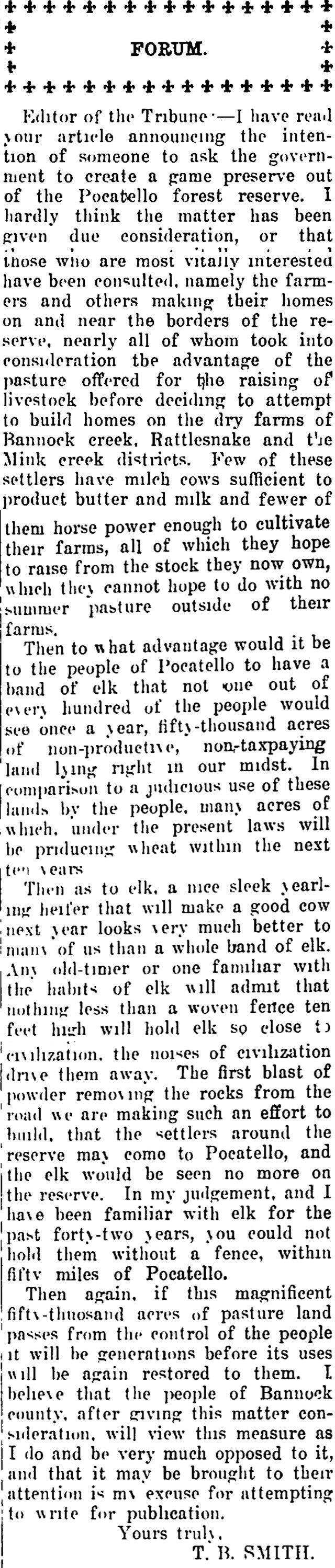
To a homesteader on the dry farms south of Pocatello in 1913, a young heifer was worth more than any herd of wild game. T. B. Smith put it plainly in a letter the Pocatello Tribune printed on June 28 of that year: “a nice sleek yearling heifer that will make a good cow next year looks very much better to many of us than a whole band of elk.”
He was answering a proposal to turn the Pocatello forest reserve into a game preserve. The reserve was the national forest on the Mink Creek divide, the ridge between Pocatello and the head of Bannock Valley, and that June it was already the subject of a quarrel. It had been opened to sheep, and the homesteaders on the valley side of the divide wanted its summer grass for their own cattle and horses.
Sheep on the divide
The quarrel reached the Pocatello city council on the night of June 5. A petition asked the council to help get “the stock lease of the Pocatello reserve draining into Bannock creek abrogated.” Some argued that sheep had always used that range, but the council took the petitioners’ side and told the city attorney to prepare a protest “against the monopoly” for the forestry department.
Eleven days later the Tribune laid out the settlers’ case. A hundred and twenty settlers and homesteaders “residing just over the Mink creek divide in Oneida county” had written to the district forester at Ogden and asked the council and the Commercial Club for support. Complaints to Supervisor Bruins, who ran the reserve, had gotten them nowhere. The sheep had first gone onto a fork of Mink Creek below the intake of the Pocatello water company, where they posed no danger to the city’s water, and so the settlers’ objections had counted for little. The paper named that fork the west one and then, a few lines on, the east. After it came permits for the south slope of the divide, the settlers’ own side:
Until recently that district has been waste land, but during the last few years many homesteaders have filed on land, just outside the reserve, and built homes. Their protests against the grazing of sheep on the reserve are based on their own need for a free range for cattle and horses and on the assertion that their water supply would be polluted.
Protecting Pocatello’s water, the paper noted, was the main reason the reserve existed, and the water company was said to want sheep kept off all of it.
No settlement was named. The valley side of the divide drains toward Bannock Creek, and among the settlers there were probably the people of the young Crystal settlement on Rattlesnake Creek, where most homestead entries date from 1909 or later; Crystal, the hidden settlement up Rattlesnake Creek tells more of it. The Tribune still placed them in Oneida County, but Power County had been carved from that part of Oneida earlier in 1913.
A game preserve
Late that month the Commercial Club held a special meeting about a proposed Trail Creek road to the Arbon, Crystal and Pauline settlements. There Fletcher R. Burrus spoke against making the forest reserve “a national big game preserve or refuge and prohibiting homestead entries and grazing thereon.” The club took no formal action. The Tribune article that first announced the plan has not been found, and no one knows who stood behind it.
Some game was already off limits on the valley side. In November 1911 Deputy Game Warden L. A. Lehrbas had warned that for five years no one could hunt deer, antelope, mountain sheep, mountain goat or ibex in Oneida County, whose line followed the divide. That put every stream running into Bannock Creek inside what he called “this game preserve.” His list did not include elk.
A yearling heifer
Smith’s letter doubted that anyone had asked the people with the most at stake, the farmers living on and near the edges of the reserve. Nearly all of them, he wrote, had counted on its pasture when they decided to take up the dry farms of the Bannock Creek, Rattlesnake and Mink Creek districts. Few owned enough milk cows to supply their own butter and milk, and fewer had enough horses to work their ground. They meant to build up both from the animals they had, and without summer range off their farms they could not.
A preserve, as he saw it, would lock up fifty thousand acres of land that produced nothing and paid no taxes, when much of it might be raising wheat within ten years. And he did not think the elk would stay. Claiming forty-two years of familiarity with the animals, he said nothing short of a woven fence ten feet high would hold them so near town. The first blast of powder on the road the settlers were building to Pocatello would scatter them. The paper gave no address for Smith, and these pages do not say who he was.
The summer road
That road mattered to the settlers as much as the grass. On July 2 the semi-weekly Tribune reported that Supervisor Bruins wanted the Mink Creek road fixed and its old line along the valley floor opened again. Early homesteaders had fenced across it and forced the grade onto a steep hillside. The Forest Service was ready to put several hundred dollars into the stretch inside the reserve and felt the county ought to do its part outside. The Rattlesnake Creek farmers followed the matter closely:
Farmers along Rattlesnake and Bannock creek valleys use the Mink creek road as their summer highway to Pocatello and bring a large and growing trade to the Gate City.
The road’s later years, and the mail and grain it carried, are told in Mail, grain and the Mink Creek road to Pocatello.
Sheep and elk, later
The pages read for this story do not say whether the sheep permits were pulled, how the forester at Ogden answered, or whether the preserve idea went any further that year. The argument over the range did not end, though. Grazing had a long history in the valley, told in When Bannock Valley was cattle range, and in 1920 Arbon farmers banded together to keep the sheep out of their canyons. And by 1930 a Crystal farmer was complaining of elk and deer from what he called the Pocatello game preserve eating grain at Crystal, as told in The State’s Elk at Crystal and the Hired Elk Puncher. How that preserve came to be is a story still untold here. Smith had predicted the elk would never stay without a fence. Seventeen years later, they were in the settlers’ grain.
The original article
Pocatello Tribune, June 28, 1913, page 4. Transcribed from the page scan. The misprints “product,” “priducing” and “thuosand” are as printed; the period after “ten years” is faint in the scan and is taken from the paper’s reprint of July 2.
FORUM.
Editor of the Tribune:—I have read your article announcing the intention of someone to ask the government to create a game preserve out of the Pocatello forest reserve. I hardly think the matter has been given due consideration, or that those who are most vitally interested have been consulted, namely the farmers and others making their homes on and near the borders of the reserve, nearly all of whom took into consideration the advantage of the pasture offered for the raising of livestock before deciding to attempt to build homes on the dry farms of Bannock creek, Rattlesnake and the Mink creek districts. Few of these settlers have milch cows sufficient to product butter and milk and fewer of them horse power enough to cultivate their farms, all of which they hope to raise from the stock they now own, which they cannot hope to do with no summer pasture outside of their farms.
Then to what advantage would it be to the people of Pocatello to have a band of elk that not one out of every hundred of the people would see once a year, fifty-thousand acres of non-productive, non-taxpaying land lying right in our midst. In comparison to a judicious use of these lands by the people, many acres of which, under the present laws will be priducing wheat within the next ten years.
Then as to elk, a nice sleek yearling heifer that will make a good cow next year looks very much better to many of us than a whole band of elk. Any old-timer or one familiar with the habits of elk will admit that nothing less than a woven fence ten feet high will hold elk so close to civilization, the noises of civilization drive them away. The first blast of powder removing the rocks from the road we are making such an effort to build, that the settlers around the reserve may come to Pocatello, and the elk would be seen no more on the reserve. In my judgement, and I have been familiar with elk for the past forty-two years, you could not hold them without a fence, within fifty miles of Pocatello.
Then again, if this magnificent fifty-thuosand acres of pasture land passes from the control of the people it will be generations before its uses will be again restored to them. I believe that the people of Bannock county, after giving this matter consideration, will view this measure as I do and be very much opposed to it, and that it may be brought to their attention is my excuse for attempting to write for publication.
Yours truly,
T. B. SMITH.
Sources
- Pocatello Tribune, June 28, 1913, page 4
- Semi-Weekly Pocatello Tribune, July 2, 1913, page 4
- Pocatello Tribune, June 16, 1913, page 8
- Semi-Weekly Pocatello Tribune, June 18, 1913, page 4
- Pocatello Tribune, June 6, 1913, page 4
- Semi-Weekly Pocatello Tribune, June 7, 1913, page 8
- Semi-Weekly Pocatello Tribune, June 28, 1913, page 5
- Semi-Weekly Pocatello Tribune, July 2, 1913, page 7
- Pocatello Tribune, November 13, 1911, page 5
- Semi-Weekly Pocatello Tribune, November 15, 1911, page 8