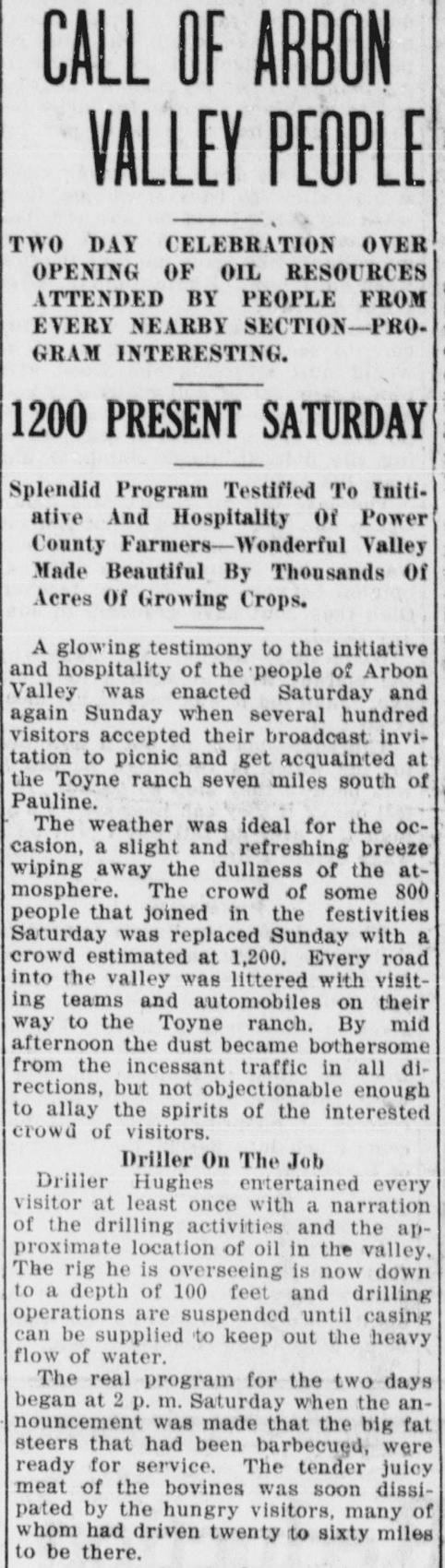
Nobody in Arbon Valley had seen oil come out of the ground, and most of them meant to wait until they did. “There is some talk here about drilling for oil,” the Arbon column reported on May 6, 1921. “Most of the Arbonites think seeing is believing.” Seven weeks later about 2,000 people drove in over two days to see the derrick anyway, eat barbecued beef and watch the Arbon Bears play ball.
The well stood on Thomas S. Toyn’s ranch, about six miles south of the Pauline store; the July 1 article put it at seven. The American Falls Press, the weekly at the Power County seat, kept up with it for sixteen months and nearly always spelled the family’s name Toyne.
A dome under the valley
The drilling company came out of Pocatello. The Idaho Research and Development Co., headquartered there, filed its articles of incorporation in June 1920 with $1,000,000 in capital stock. A Pocatello accountant, George Stoll Sr., had raised money for a survey, and by the company’s telling it followed oil seeps westward to a “dome” lying beneath Arbon Valley. One of its first subscribers was Lorenzo B. Evans of Arbon, the early settler Ren Evans, one of the Evans family of the valley.
That same May column had Stoll visiting Mr. and Mrs. Toyn, who had likely bought the old Ripley ranch in 1920. By June the company had leased more than 35,000 acres and had money enough for machinery that could reach 3,600 feet. It raised its derrick on the Toyn place, which was said to sit right on the dome. On Sunday, June 12, Charles Hughes, an oil man from Oklahoma, was drilling the first oil well in that territory.
Barbecue at the derrick
The valley set June 25 and 26 to open the well. The Press promised barbecue, ball games, horse races, dancing, fireworks, chicken dinners and an automobile excursion to “usher the oil industry into Arbon Valley and incidentally entertain the people of American Falls, Pocatello, Rockland, Holbrook, Malad and a score of other towns.” Meals and a place to sleep cost nothing, though guests were told to bring their own bedding. The paper urged its readers to go while making plain, in an editorial, that it did not expect much from the hole:
We are naturally skeptical about the finding of oil on the Toyne Ranch near Pauline. The probabilities are that a dry hole will result from the drilling. But there is the big chance, the one worth taking, that there is oil buried several thousand feet below the crust of the earth. A few thousand dollars may be invested in a dry hole. Then again a great oil district may be opened to the world, bringing with it untold wealth, overnight fortunes, industrial developement, and progress.
The party, the editors added, was not a scheme to sell stock. It showed only that the people of the valley were “awake to their possibilities.”
Early that week sixty men put up a dance floor and a shelter of wild hay thrown over a frame of scantling. Some 800 people turned out on Saturday and about 1,200 on Sunday, many of whom “had driven twenty to sixty miles to be there.” Hughes “entertained every visitor at least once with a narration of the drilling activities and the approximate location of oil in the valley.” There was not yet much to show them. The rig had reached 100 feet and then stopped, waiting on casing, the steel pipe that lines a well, to hold back a heavy flow of water.
On Saturday the barbecued steers came off the fire at two o’clock. Pauline played the Arbon Bears and then a team from Daniels, and Senator Harding of Malad “told graphically of the early pioneer days when the first settlers had come to the valley.” Sunday’s crowd sat down to a chicken dinner cooked by the women of the valley, rode out on a tour of the valley and saw American Falls beat the Bears 21 to 6. A second editorial thanked the women of Arbon, Pauline and Crystal for feeding everyone and conceded that “Oil may not be found at the Toyne ranch in Arbon.”
Pockets and promises
By November a Fort Worth, Texas, man, Z. D. Terry, was running the drill, and the stories about the well no longer matched. A report out of Pocatello in the Salt Lake Tribune said the oil the drill had struck was only a pocket, the second one it had found, and that it ran for a day and quit. The damaged print mentions one of them at 207 feet. Relying on the company, the Press told it another way: several barrels had flowed on November 10 and been cased off so drilling could continue to 2,000 feet, “where the company expects to hit a gusher perhaps.” The company counted more than 150 stockholders, “mostly Pocatello and Arbon citizens,” and Evans was now its vice president.
As 1921 turned into 1922, Evans went out selling shares. In January he reported crude oil showing at 245 feet, rising with a strong flow of water. Ranchers who had leased their ground were getting “flattering offers to sell their leases to outside parties,” and the Press forecast that if Arbon struck oil, “the entire county will be drilled out.” Evans announced that thirty-four men from American Falls and Rockland had bought into what the paper now called “the Arbon Oil Company,” a name it never explained.
The talk kept growing. In March the company promised “test wells in every part of the valley” and a refinery as soon as the first well came in. A Press article in July said the drill had gone through three layers of oil and quoted an oil expert “of Pittsburg” who placed the main oil zone near 12,000 feet. Its writer looked ahead to “one of the biggest booms known to oil in recent years.”
The state geologist looks
That summer the state bureau of mines and geology sent its petroleum geologist, Virgil R. D. Kirkham, to look over the Arbon and Rockland valleys. In October he reported rocks of an age that suited oil and “a good anticline dome structure,” an upward fold in the rock layers traced by the walls of the valley, along with a good deal of faulting close by. His conclusion was measured:
There are in the state areas of greater promise, but there are possibilities in Arbon valley. This region is being tested by a well belonging to the Idaho Research and Development company of Pocatello. As yet they have not passed through the covering of volcanic and lake bed material and can expect no results until after penetrating the under-lying carboniferous limestone.
After that the papers go quiet about the Toyn ranch well. None of those searched gives its final depth or says when work stopped. The company turned up again only as a defendant, for reasons the papers do not give, in two foreclosure suits, one on Jenks land near Pauline in 1923 and one on the Toyn ranch itself in 1925, among the valley’s foreclosures of 1920 to 1925. The hope outlasted the well. In December 1923 another outfit, the Gem State Petroleum Co., with L. B. Evans among its backers, unloaded a 75-ton rig at Pocatello for a fresh try in Arbon Valley. More on that corner of the valley is in the Pauline and West Fork area history.
The original article
American Falls Press, July 1, 1921, page 1. Transcribed from the page scan.
CALL OF ARBON VALLEY PEOPLE
TWO DAY CELEBRATION OVER OPENING OF OIL RESOURCES ATTENDED BY PEOPLE FROM EVERY NEARBY SECTION—PROGRAM INTERESTING.
1200 PRESENT SATURDAY
Splendid Program Testified To Initiative And Hospitality Of Power County Farmers—Wonderful Valley Made Beautiful By Thousands Of Acres Of Growing Crops.
A glowing testimony to the initiative and hospitality of the people of Arbon Valley was enacted Saturday and again Sunday when several hundred visitors accepted their broadcast invitation to picnic and get acquainted at the Toyne ranch seven miles south of Pauline.
The weather was ideal for the occasion, a slight and refreshing breeze wiping away the dullness of the atmosphere. The crowd of some 800 people that joined in the festivities Saturday was replaced Sunday with a crowd estimated at 1,200. Every road into the valley was littered with visiting teams and automobiles on their way to the Toyne ranch. By mid afternoon the dust became bothersome from the incessant traffic in all directions, but not objectionable enough to allay the spirits of the interested crowd of visitors.
Driller On The Job
Driller Hughes entertained every visitor at least once with a narration of the drilling activities and the approximate location of oil in the valley. The rig he is overseeing is now down to a depth of 100 feet and drilling operations are suspended until casing can be supplied to keep out the heavy flow of water.
The real program for the two days began at 2 p. m. Saturday when the announcement was made that the big fat steers that had been barbecued, were ready for service. The tender juicy meat of the bovines was soon dissipated by the hungry visitors, many of whom had driven twenty to sixty miles to be there.
Pauline [illegible]
Following the barbecue was a ball game between Pauline and the Arbon Bears, then another game with the Daniels team. Pauline annexed the last game three to two in a ninth inning rally. The Cubs had been taken into camp with a comfortable margin of victory.
Senator Harding of Malad addressed the gathering following the ball game and told graphically of the early pioneer days when the first settlers had come to the valley. Interspersed during the afternoon were vocal selections in the [illegible] meeting places, and bucking contests and horse races in the arena.
Chicken A La Picnic
The Sunday crowd began to arrive early from every section of the county. American Falls contributed largely to the crowd, some thirty automobiles making the trip.
It was in every respect a tribute to the valley [illegible] The chicken dinner [illegible] women of the [illegible] who labored [illegible] in making it a success.
Then came the tour of the valley and the afternoon ball game between American Falls and the Bears, an account of which is published elsewhere in this issue of the Press.
Sixty men responded early in the week and built a dance floor and shelter for the crowd that was expected. Wild hay was thrown over a frame of scantling, water was provided and made easily accessible, and the comfort of the visitors looked after in every way.
Praise For Arbonites
Local people returned late Sunday evening filled with praise for the royal reception tendered by the Arbon Valley people and the resolve to visit their wonderfully productive valley more often. Not the least attractive part of the trip was the ride through the valley. Green wheat fields are contrasted everywhere with weedless summer fallow that testifies mutely to the excellent farming in the community [illegible]
Sources
- American Falls Press, May 6, 1921, page 2
- American Falls Press, June 3, 1921, page 1
- American Falls Press, June 17, 1921, page 1
- American Falls Press, June 24, 1921, page 1
- American Falls Press, June 24, 1921, page 6
- American Falls Press, July 1, 1921, page 1
- American Falls Press, July 1, 1921, page 6
- American Falls Press, November 11, 1921, page 4
- American Falls Press, December 16, 1921, page 14
- American Falls Press, January 6, 1922, page 1
- American Falls Press, January 27, 1922, page 1
- American Falls Press, March 24, 1922, page 4
- American Falls Press, July 13, 1922, page 5
- American Falls Press, October 19, 1922, page 1
- American Falls Press, September 20, 1923, page 7
- American Falls Press, December 6, 1923, page 1
- American Falls Press, August 6, 1925, page 3
- Salt Lake Tribune, June 20, 1920, page 4
- Salt Lake Tribune, November 18, 1921, page 18