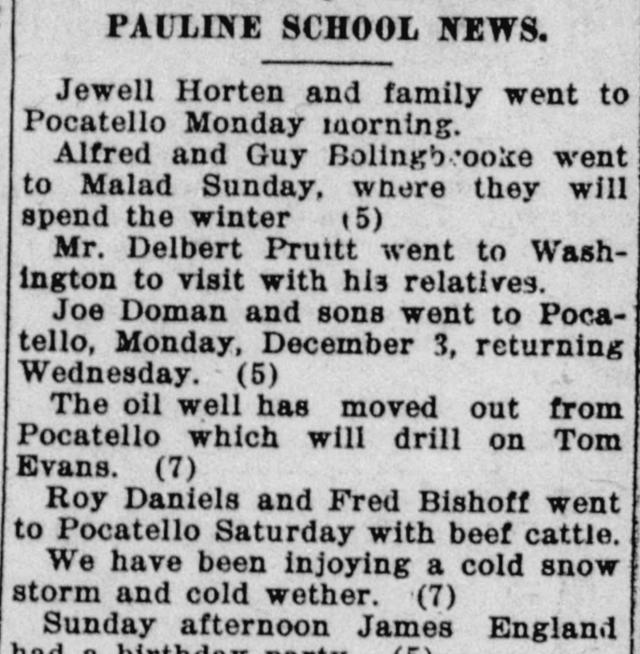
The children of the Pauline school had a yell, and in December 1923 they sent it to the American Falls Press: “Pauline City, Pauline City. Oh you lively town.” It went into print on December 20 beside their other news of the week, which ran to a birthday party, a snowstorm, cattle hauled to Pocatello and a blacksmith putting up a new shop. Pauline was never a city. For a few years, though, the grown-ups at the crossroads had hoped it might become one.
That hope had a date. In November 1917 the Pauline correspondent of the Press reported that a doctor would soon build an office there and that a drug store was promised. “This is hoped to be the beginning of the city of Pauline,” the column said.
At the crossroads
Pauline sat at the north end of Arbon Valley, against the Fort Hall Reservation, at the junction where the valley road met the roads to American Falls and Pocatello. It was in Oneida County until 1913 and in Power County after that. About 1911 John Noble opened the first store there, and a post office named Pauline came after it. By 1915 Sim Hatch was barbering in a building next to the store.
Travelers sometimes landed at Pauline without meaning to. In June 1917 the Arbon correspondent grumbled that tourists kept choosing the wrong road at Bannock, near the pole line:
There are sign boards up stating American Falls is so many miles but there is nothing to point which road to take. Owing to the fact the road to Arbon is such a nice graded road they take it for granted it will lead them to American Falls. They all generally come as far as John Noble’s store at Pauline and find out their mistake.
The doctor comes and goes
The November 1917 column had Mr. Kilgore hauling lumber for Dr. Leo Castle’s office near Clarence England’s home. Lines that are jumbled on the digitized page also seem to say Oscar Brandt would move his garage there. By January 1918 the paper was calling Dr. Castle, who had practiced in Pocatello, “the newly located doctor” of Pauline, with an office and a drug store. He is the first doctor this site has found living in the valley.
Through that winter and spring the columns sent him to a broken leg, to burns, to a schoolboy with a sliver and to a birth in the Crystal district. Then on September 27, 1918, the Arbon news reported that he had shut his Pauline office and gone back to Pocatello.
Oscar Brandt went into the army soon after, and nothing more is heard of his garage. A Mr. Campbell opened one at Tom Daniels’ residence in May 1918, and the 1920 census listed an auto mechanic living at Pauline, as this site’s first garage entry notes.
Two stores and a warehouse
Pauline had a second general store by May 1918, opened by Theo Daniels, probably the Theodore of the Thomas Daniels family. He sold it in September 1919. The Pauline column called the buyer “Mr. James Thomas”; two weeks later the Arbon column gave his name as Joe T. Thomas. In March 1920 Thomas, “the Pauline merchant,” bought a truck to bring in goods for the store.
The Noble store had known grief. In October 1917 the Nobles’ twelve-year-old daughter Isabelle, remembered as “an efficient and loving little clerk in her father’s store,” died of appendicitis. John Noble kept the store until 1923, according to his obituary as this site records it, and in 1921 he was named justice of the peace for the Pauline precinct.
Grain gave the crossroads its biggest business. In the fall of 1917 Bert Wheatley was buying for the Intermountain Milling Co. at a platform at Pauline, while a Mr. Zaring bought at Ed England’s place with England “behind the scales.” A stormy March in 1918 left the Pauline correspondent unhappy about Zaring’s platform, where the sacks were rotting and grain was spilling onto the ground. By the end of August a real warehouse stood there, and it opened with a dance:
A large crowd attended the opening of the Zaring warehouse at Pauline Saturday evening. Mr. and Mrs. E. E. Zaring of American Falls were host and hostess. The music for dancing was furnished by American Falls people of which many attended and several from Crystal were present. Mr. and Mrs. Zaring furnished the ice cream and the Pauline and Arbon people furnished sandwiches and cake. Everyone had a grand time.
The building did duty for holidays as well as harvests. For Pioneer Day, July 24, 1920, Pauline put on races, bucking contests and a program, then threw open the decorated warehouse for free lemonade and an evening dance, though the correspondent objected to riders in the crowd who had been drinking. England reported in November 1922 that 29,008 bushels had passed through the warehouse in October. Trucks carried the sacks 26 miles to the railroad at Schiller. In school notes printed in March 1924 the pupils counted 1,617 sacks hauled out on one Monday, and that winter the trucks sometimes had to wait because Schiller had no more room.
The little village
The papers of those years mention no hall at Pauline, so its gatherings went wherever there was a roof. A leap-year dance was held in the meeting house in 1916. In 1918 neighbors of several faiths began a union Sunday school in the schoolhouse, with no one church in charge. The schoolhouse also held a dance and box supper on New Year’s Eve of 1919, with John Kowallis playing the accordion, and in 1920 a program at the Meadow Ward meeting house raised money toward a new school piano. The Kowallis home held the post office, and when the family went to Logan for the Fourth of July in 1920, Madeline England minded it.
Winter could shut the place in. “The little village of Pauline is nearly snow-bound,” the column reported in February 1922, after a storm driven by a strong west wind. That September it warned that many families would soon be leaving because they had children to put in school.
Pauline City
The children had their own say the next year. In November 1923 the Press started carrying news written by rural schoolchildren, and Pauline’s pupils were the first to send theirs. At a program late that month they staged a play, “Main Street Excitement,” whose characters “represented some of the people of Pauline.” They also printed a lost-and-found notice: “FOUND—A tiny screw driver on Sage-brush avenue, Pauline, Idaho.” In December came the news that Mr. Peterson, the blacksmith, was putting up a modern shop and a garage, along with the yell.
The town they cheered for never came. This site’s history of Pauline and West Fork finds families moving away from about 1917 onward and the warehouse in use for about ten years. In 1929 the Meadow Ward was dissolved and the post office closed. The history’s author suggests that a valley that kept growing might have made Pauline a busy commercial village with a tall grain elevator.
By 1961, when a plane went down near Bannock Peak, the Salt Lake Tribune could fix the spot only as about five miles northwest of “the little settlement of Pauline.”
The original article
American Falls Press, December 20, 1923, page 2. Transcribed from the page scan.
PAULINE SCHOOL NEWS.
Jewell Horten and family went to Pocatello Monday morning.
Alfred and Guy Bolingbrooke went to Malad Sunday, where they will spend the winter (5)
Mr. Delbert Pruitt went to Washington to visit with his relatives.
Joe Doman and sons went to Pocatello, Monday, December 3, returning Wednesday. (5)
The oil well has moved out from Pocatello which will drill on Tom Evans. (7)
Roy Daniels and Fred Bishoff went to Pocatello Saturday with beef cattle.
We have been injoying a cold snow storm and cold wether. (7)
Sunday afternoon James England had a birthday party. (5)
Mr. and Mrs. Gardell from the Idaho Tech was at Chas. Connelly’s farm Sunday culling chickens.
Mr. Theo Daniels went to Pocatello Dec. 7 and came back Dec. 9th. ([illegible])
Pauline school is going to give a program at Christmas on Dec. 19. ([illegible])
Park Lusk went to Pocatello Saturday. ([illegible])
Mr. Peterson our blacksmith is building an uptodate shop and also a garage. (7)
There is going to be a program at the Pauline school house Wednesday. December the 19th. We are sure you will have a good time. Just listen to this:
Pauline City, Pauline City. Oh you lively town. You beat them all around. For we’re from Pauline City, P-A-U-L-I-N-E.
This is a yell the school has. (7)
Sources
- American Falls Press, February 4, 1915, page 5
- American Falls Press, January 20, 1916, page 5
- American Falls Press, June 12, 1917, page 4
- American Falls Press, October 26, 1917, page 5
- American Falls Press, October 30, 1917, page 3
- American Falls Press, November 20, 1917, page 3
- American Falls Press, January 8, 1918, page 4
- American Falls Press, January 15, 1918, page 3
- American Falls Press, January 22, 1918, page 4
- American Falls Press, March 8, 1918, page 4
- American Falls Press, March 26, 1918, page 3
- American Falls Press, March 29, 1918, page 8
- American Falls Press, May 10, 1918, page 8
- American Falls Press, May 24, 1918, page 4
- American Falls Press, September 3, 1918, page 3
- American Falls Press, September 27, 1918, page 4
- American Falls Press, September 26, 1919, page 8
- American Falls Press, October 10, 1919, page 6
- American Falls Press, January 9, 1920, page 4
- American Falls Press, February 20, 1920, page 3
- American Falls Press, March 12, 1920, page 3
- American Falls Press, July 16, 1920, page 3
- American Falls Press, August 6, 1920, page 2
- American Falls Press, July 22, 1921, page 11
- American Falls Press, February 24, 1922, page 7
- American Falls Press, September 28, 1922, page 1
- American Falls Press, November 16, 1922, page 8
- American Falls Press, November 15, 1923, page 8
- American Falls Press, December 13, 1923, page 6
- American Falls Press, December 20, 1923, page 2
- American Falls Press, March 13, 1924, page 2
- Salt Lake Tribune, March 25, 1961, page 21