Eleven years after Arbon Valley voted itself into Power County, a delegation from the valley came to Pocatello to talk about getting out.
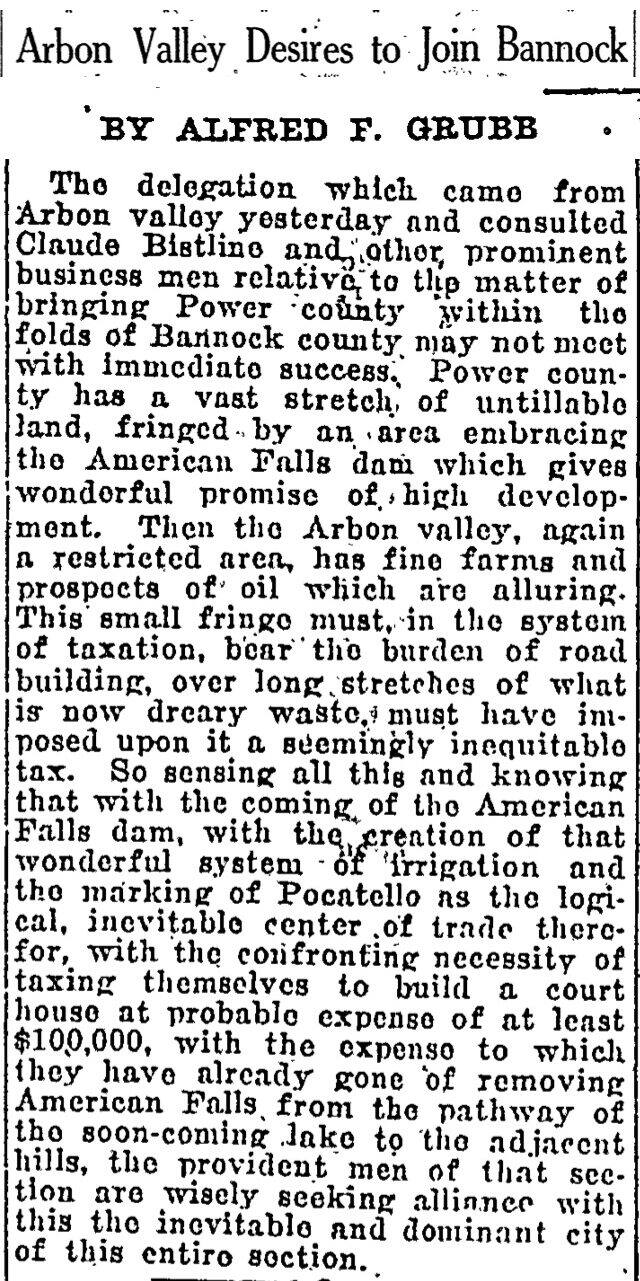
The men arrived on Tuesday, March 11, 1924, and sat down with Claude Bistline and other leading Pocatello business men about joining Bannock County. The Pocatello Tribune gave the visit a single paragraph the next day, the last item in Alfred F. Grubb’s column, under the headline “Arbon Valley Desires to Join Bannock.” No other report of the trip has turned up, and Grubb named none of the men who made it.
The valley had settled its county only a few years before. Until 1913 it belonged to Oneida County, run from Malad. Between 1908 and 1911 Arbon voted three times to throw in with a new county around American Falls, and Power County came into being in 1913, as told in how Arbon voted to join Power County. By 1924 some in the valley had turned their eyes toward Pocatello.
A columnist makes the case
Grubb did not expect the delegates to win right away, but he thought they were right to try, and he laid out why. Power County, as he saw it, was mostly untillable ground with two promising edges: the country around the American Falls dam, and Arbon Valley, with its “fine farms and prospects of oil which are alluring.” Those small edges carried the taxes that built roads across long miles of “dreary waste.” The county also faced putting up a courthouse likely to cost $100,000 or more, and it had already paid to move the town of American Falls out of the path of the dam’s coming reservoir. With Pocatello marked out as the trade center of the whole region, he wrote, the “provident men” of the valley were wise to seek an alliance with it.
The reasoning was Grubb’s own; he did not say which of these points the delegates made themselves. His paragraph also leaves the proposal unclear. The headline has Arbon Valley wanting to join Bannock, but the text speaks of bringing all of Power County into Bannock, and the costs he cites, the courthouse and the moving of American Falls, fell on the county as a whole. Whether the men wanted only their valley to switch, or the two counties to merge, his column does not say.
Oil and taxes
The “prospects of oil” were no idle phrase that spring. The Gem State Petroleum Co. was drilling beside Arbon’s Central school and drawing visitors (the Gem State oil well). Taxes were a sore point as well. On April 3, three weeks after the delegation’s trip, the American Falls Press carried complaints from the Crystal Highway District, on the valley’s east side, about how its affairs had been handled:
Crystal Highway District now pays the largest school and road tax of any section of the county.
Nothing on record ties the Crystal grievances to the March delegation, and nothing found tells how the delegation’s errand ended. Power County built its courthouse. In September 1925 the commissioners, T. B. Evans of Arbon among them, ordered the county jail’s fixtures moved into “the new building” at American Falls (Perry Lusk and T. B. Evans on the county board). The valley’s men on that board over the years are listed on the Evans family page.
Raised again in 1939
Fifteen years later the notion surfaced once more, if only for a moment. At the Bannock County commissioners’ meeting in Pocatello on Monday, February 20, 1939, Commissioner W. H. Jensen mentioned a recent call from Roy Lindley, a Power County commissioner. Lindley had brought word that moving into Bannock County was being talked of among some Arbon Valley people. That was all the Tribune printed: no names, no reasons, and no reply from either board.
The visitor was very likely Roy D. Lindley of Arbon, the valley’s man on the Power County board (Roy Lindley and the golden eagle). In January 1931 the Tribune had named a Roy Lindley as chairman of the Power County board, joining Pocatello’s chamber of commerce in seeking federal money for the Bannock Creek road. Valley farmers hauled much of their wheat over that route to be shipped from Pocatello at harvest, the paper observed, and Indian farmers on the reservation would gain from a better road too. That road is followed in Arbon’s wheat road across the reservation, and the valley’s other way to town in the Mink Creek road post. This site had put his years as a commissioner at probably 1929 to 1935; the 1939 report shows him on the board again, or still.
Who made the trip in 1924, and who raised the question in 1939, is not known. Whatever they hoped for, Arbon Valley never changed counties. It is in Power County still.
The original article
Pocatello Tribune, March 12, 1924, page 3. Transcribed from the page scan. The item is the last in Alfred F. Grubb’s column, which ran under three headlines; the column’s other items, which do not concern the valley, are not transcribed.
Arbon Valley Desires to Join Bannock
BY ALFRED F. GRUBB
The delegation which came from Arbon valley yesterday and consulted Claude Bistline and other prominent business men relative to the matter of bringing Power county within the folds of Bannock county may not meet with immediate success. Power county has a vast stretch of untillable land, fringed by an area embracing the American Falls dam which gives wonderful promise of high development. Then the Arbon valley, again a restricted area, has fine farms and prospects of oil which are alluring. This small fringe must, in the system of taxation, bear the burden of road building, over long stretches of what is now dreary waste, must have imposed upon it a seemingly inequitable tax. So sensing all this and knowing that with the coming of the American Falls dam, with the creation of that wonderful system of irrigation and the marking of Pocatello as the logical, inevitable center of trade therefor, with the confronting necessity of taxing themselves to build a court house at probable expense of at least $100,000, with the expense to which they have already gone of removing American Falls from the pathway of the soon-coming lake to the adjacent hills, the provident men of that section are wisely seeking alliance with this the inevitable and dominant city of this entire section.