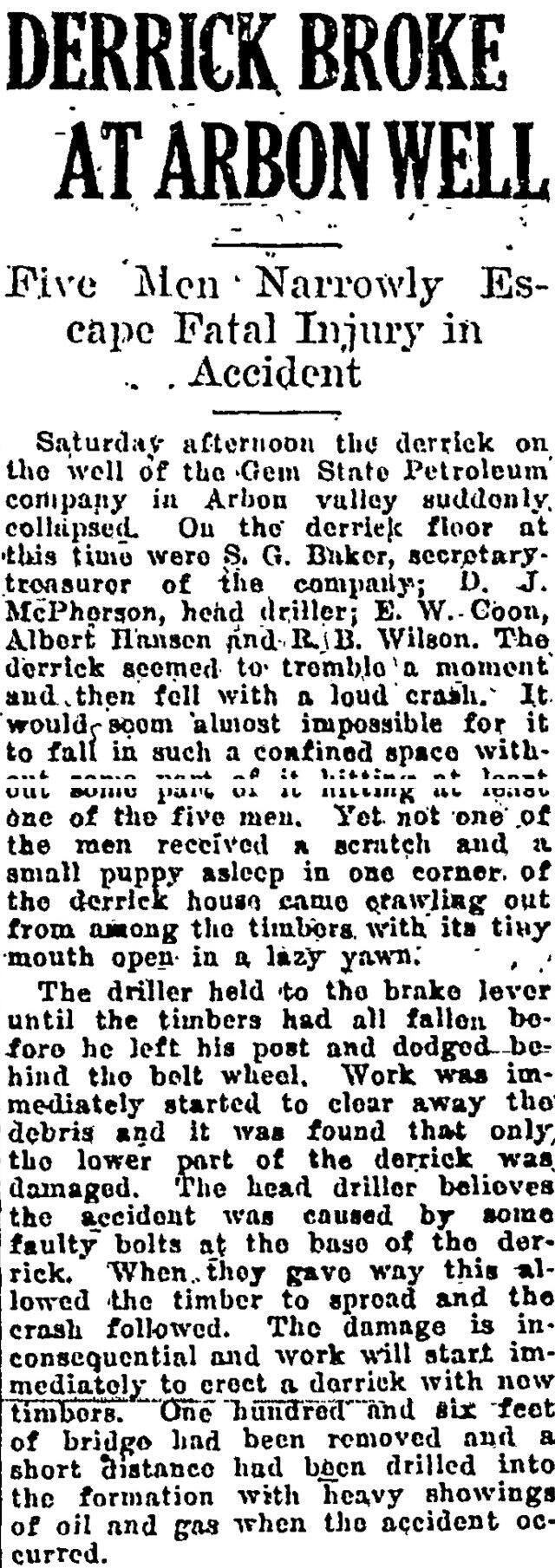
The derrick over the Arbon oil well gave way on a Saturday afternoon in June 1926. It shook for a moment, the Pocatello Tribune reported, then came down with a loud crash on five men standing on its floor. None of them was so much as scratched. A puppy that had been sleeping in a corner of the derrick house crawled out of the wreckage yawning.
It was that kind of year at the Gem State Petroleum Company’s well, which stood beside the Central school at Arbon, where Lila Wade taught next door, and most likely on land of the Evans family. The company kept its office in Pocatello, and the Tribune followed the well closely, mostly through what its officers chose to say. Nineteen twenty-six was the most hopeful season in the long run told in the Gem State oil well, 1923–1929, and a chapter in the story of the valley’s first oil well.
Hikers come to look
The crowds started before the gas did. In October 1925 the Skyline club, a hiking club newly formed in Pocatello, picked the Arbon Valley fossil beds for its first outing. The plan was to stop at the well, then follow H. C. Harris, the company’s geologist, out to the beds. Hikers from Twin Falls, Burley and Paul said they would join, and the paper noted that some of the valley’s fossil caves had never been explored and the party hoped to get into them. Forty people put their names down for Sunday, October 25. What they found is not known; no report of the day has turned up, and the papers never said where the caves lay. A second fossil trip, set for April 1926, was dropped when its sponsor and leader, Jones of the Gate City Business College, took sick.
By the middle of February 1926 the drill was down roughly 2,200 feet, cutting hard sandy lime. Men from Pocatello who drove out reported the road from Pauline in that corner of the valley “almost impassable,” but they waited to watch the hole bailed. Some of the bailer’s load spilled onto the derrick floor, and once it was swept, oil left “peacock colors” on the boards.
A control head on display
Early in March oil came up in the bailer, and the officers stopped work until a control head arrived. The steel fitting weighed upward of 700 pounds and had been tested to 2,500 pounds to the square inch. For a while it sat outside the Pocatello office, where people on the sidewalk stopped to look, before it went out to the valley. The company then advertised that drilling would resume at eleven o’clock on Sunday, March 21, so stockholders and anyone else could come see the new head. Shares sold for a dollar apiece.
A few days later the paper wrote of “a tremendous amount of gas” and said “hundreds of people” had been out. There were accidents that Sunday, though the Tribune gave no details, and afterward the company strung barbed wire around the rig and closed the well to sightseers after March 27. The head driller had already lost three days in town, laid up after a jack handle flew up and cracked his jaw.
Gas, helium and mud
To hold the gas back, the crew had set a bridge, a plug of fill, in the hole. On April 14 the gas blew through all forty-five feet of it. With the control head closed, the paper said, its roar still carried two or three hundred feet.
The crew put in a new bridge. Heavy casing was shipped from Youngstown, Ohio, and late in April Herb McCain was freighting it out to the well. On Sunday, April 25, a Tribune writer found so many cars parked at the valley that any horses tied at its log store were lost among them. He called the place, some thirty-five miles out of Pocatello, the “city” of Arbon Valley and likened it to a western town out of the movies, with “store” lettered across the front of a log building, and reported that confidence in the well ran high among the people of the district.
In May, Harris announced that the gas carried helium. It would hold up a half-pound weight in the hole, he said, which ordinary natural gas could not do “unless it was heavy with helium,” and two small samples mailed away for testing had been reported to yield it. No later word on those tests has been found, and nothing confirms the helium.
On May 23 the gas snapped the float plug at the bottom of the packer and, with a loud double report, threw water and mud mixed with oil twelve to fifteen feet over the top of the casing. Neighbors near the well came running one after another, “thinking that the well had ‘blown in.’” None of them is named; the 1926 reports never name anyone living in the valley.
The derrick comes down
In mid-June the crew began drilling out the bridge, which turned out to be more than a hundred feet thick, and the gas kept rising. They had cleared 106 feet of it and gone a little way into the rock, with strong signs of oil and gas, when the derrick fell on the afternoon of June 26.
On the floor were S. G. Baker, the company’s secretary-treasurer; D. J. McPherson, the head driller; and E. W. Coon, Albert Hansen and R. B. Wilson, whom the papers do not otherwise identify. In a space that tight, the Tribune wrote, it hardly seemed possible for the timbers to miss all five. The driller kept his hand on the brake lever until the last piece was down, then ducked behind the belt wheel. McPherson laid the collapse to bad bolts at the foot of the derrick, which let the timbers spread apart. Only the lower part was damaged, and the crew set to clearing the pile at once.
Raising a new derrick took two weeks. The first attempt to stand it up failed, so the crew hired teams and dragged a log more than two feet through down from the mountains, and the derrick rose on the evening of July 15. By late August the bit was gaining six to ten feet a day, and the driller was “very optimistic.”
Into receivership
The optimism did not reach the courthouse. On September 9, on the application of N. R. Dingman, receivers were named at Pocatello for the company. By late November J. M. Bistline was serving as temporary receiver, the court had put off the hearing, and an out-of-court settlement was expected; plenty of Pocatello people owned shares. On November 23 a Spokane man advertised for bids to haul drilling machinery from Arbon Valley to Schiller station. He did not name the company, so whose rig was leaving is not known.
By December the stockholders were at work reorganizing, and, as the longer account of the well tells, the drill at Arbon kept turning into 1929.
The original article
Pocatello Tribune, June 27, 1926, page 7. Transcribed from the page scan.
DERRICK BROKE AT ARBON WELL
Five Men Narrowly Escape Fatal Injury in Accident
Saturday afternoon the derrick on the well of the Gem State Petroleum company in Arbon valley suddenly collapsed. On the derrick floor at this time were S. G. Baker, secretary-treasurer of the company; D. J. McPherson, head driller; E. W. Coon, Albert Hansen and R. B. Wilson. The derrick seemed to tremble a moment and then fell with a loud crash. It would seem almost impossible for it to fall in such a confined space without some part of it hitting at least one of the five men. Yet not one of the men received a scratch and a small puppy asleep in one corner of the derrick house came crawling out from among the timbers with its tiny mouth open in a lazy yawn.
The driller held to the brake lever until the timbers had all fallen before he left his post and dodged behind the belt wheel. Work was immediately started to clear away the debris and it was found that only the lower part of the derrick was damaged. The head driller believes the accident was caused by some faulty bolts at the base of the derrick. When they gave way this allowed the timber to spread and the crash followed. The damage is inconsequential and work will start immediately to erect a derrick with new timbers. One hundred and six feet of bridge had been removed and a short distance had been drilled into the formation with heavy showings of oil and gas when the accident occurred.
Sources
- Pocatello Tribune, June 27, 1926, page 7
- Pocatello Tribune, October 21, 1925, page 8
- Pocatello Tribune, October 24, 1925, page 3
- Pocatello Tribune, October 25, 1925, page 12
- Pocatello Tribune, February 16, 1926, page 3
- Salt Lake Tribune, February 20, 1926, page 15
- Pocatello Tribune, March 5, 1926, page 6
- Pocatello Tribune, March 7, 1926, page 6
- Pocatello Tribune, March 11, 1926, page 10
- Pocatello Tribune, March 21, 1926, page 11
- Pocatello Tribune, March 25, 1926, page 10
- Pocatello Tribune, March 27, 1926, page 3
- Pocatello Tribune, April 15, 1926, page 10
- Pocatello Tribune, April 16, 1926, page 16
- Pocatello Tribune, April 23, 1926, page 5
- Pocatello Tribune, April 23, 1926, page 16
- Pocatello Tribune, April 26, 1926, page 3
- Pocatello Tribune, May 21, 1926, page 8
- Pocatello Tribune, May 24, 1926, page 7
- Pocatello Tribune, June 13, 1926, page 10
- Pocatello Tribune, June 22, 1926, page 8
- Pocatello Tribune, July 16, 1926, page 7
- Pocatello Tribune, August 28, 1926, page 5
- Salt Lake Tribune, September 10, 1926, page 18
- Pocatello Tribune, November 23, 1926, page 11
- Pocatello Tribune, November 30, 1926, page 3
- Salt Lake Tribune, December 30, 1926, page 14