For twenty-six miles up Arbon Valley, the telephone wires that tied the farms to American Falls were about to get a neighbor. In the spring of 1927 a high-voltage transmission line went up the length of the valley, built to carry power between the Idaho Power company’s plant at American Falls and the Utah Power & Light company’s system in northern Utah. The telephone company had reason to worry about it.
The Pocatello Tribune’s American Falls correspondent kept an eye on the work and sent in a handful of short dispatches. None of them mentions a valley farm getting any power from the new line. They are about poles, mud and telephones.
The route had been in the papers since the fall before. In November 1926 a dispatch from Malad in the Deseret News reported that surveyors had finished laying out a line to take part of the output of the new “million dollar” unit at American Falls into Utah. It would run “down the Arbon valley through the Daniels section,” cross Malad Valley and end at the new Cutler plant on the Bear River, between Cache Junction and Brigham City. By 1927 the Tribune was naming a different plant at the Utah end, the Utah company’s Wheelon plant, and nothing found so far explains why.
Poles from Schiller
The Phoenix Construction company had the contract, and in early April the weather had it stalled. The roads up the valley were too soft for motor trucks, as an American Falls dispatch of April 2 reported:
Inability to use motor trucks, coupled with heavy roads in the Arbon valley, are hampering the Phoenix Construction company in transporting poles from Schiller and distributing them along the route to be followed by the high tension line which is to connect the American Falls plant of the Idaho Power company with the Wheelon plant of the Utah Power & Light company.
The poles came off the railroad at Schiller, the siding where the valley’s wheat was shipped, some 26 miles from Pauline, and teams hauled them on up the valley from there. The correspondent did not look for much headway until warm weather had dried the side roads.
Trouble on the wires
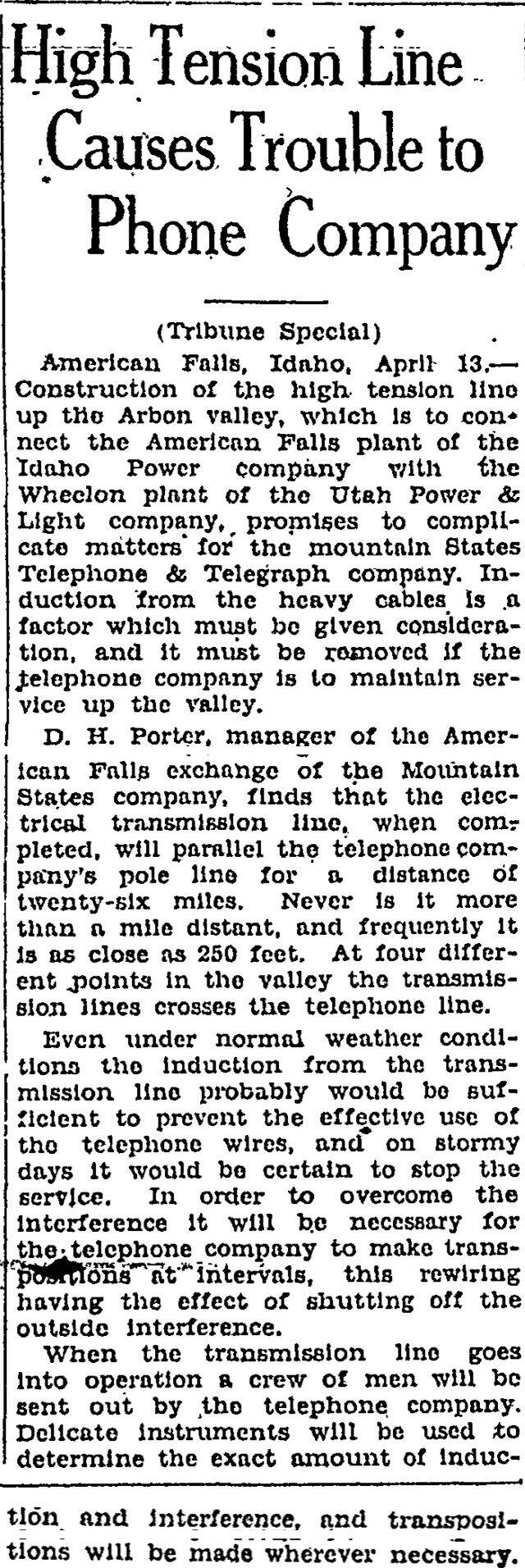
Meanwhile the telephone company was sizing up its own problem, and on April 13 the Tribune gave it a story of its own. A Mountain States Telephone & Telegraph line had run from American Falls up the valley to the Arbon central since December 1915. D. H. Porter, who managed the company’s American Falls exchange, had worked out how close the new line would come. For twenty-six miles it would follow the telephone poles, never farther off than a mile and often as near as 250 feet, and in four places it would cross them.
That nearness was the danger. Current in the heavy power cables could induce enough interference on the telephone wires, Porter expected, to spoil calls even in fair weather, and in a storm it would shut the service down altogether. The answer was transpositions, rewiring the telephone line at intervals to cancel out the interference. As soon as the power was on, the company meant to send a crew out with delicate instruments to measure the induction and find where the rewiring was needed.
A third camp near Arbon
By mid-April the roads had firmed enough for trucks to reach Pauline, and teams took the poles on from there to the higher ground. On Thursday, April 14, Phoenix carpenters started on the buildings of a construction camp two and a half miles south of the Arbon post office, the company’s third camp in the valley, the Tribune’s American Falls column reported on April 17:
Carpenters in the employ of the Phoenix Construction company, on Thursday, began the work of erecting buildings for a construction camp in the Arbon valley, two and one-half miles south of the Arbon postoffice. This is the third camp the company has established in the valley. At the present time the poles for the transmission line are being hauled to Pauline by truck, whence teams are taking them to higher points in the valley.
Where the first two camps stood, how many men lived in them and how many poles they set, the dispatches never said.
Current on, two lines down
The crews finished on Tuesday, June 28, 1927, and the current went on that same day. Writing from American Falls, the correspondent reported in the Tribune of July 3 that the Mountain States officers had found the interference milder than they had feared. The valley’s own little company did not get off so lightly:
The Bannock Telephone company was not so fortunate. Two of its five lines were so badly affected as to practically put them out of commission.
The report used only that short name, but it most likely meant the farmers’ Falls-Bannock Telephone company, whose local lines branched out from the Arbon central that Mrs. T. B. Evans kept. Whether those two lines were ever put right, and when, no later report read so far tells.
The site’s Stories follow both threads further, with the first power line through the valley and the first telephone line, and the place pages for Pauline and West Fork and Arbon describe the country the line crossed.
As far as the 1927 reports show, the line carried power past the valley, not into it. Electricity reached valley homes only in 1945 or 1947, as accounts differ, and by 1954 the valley had distribution lines of its own, the ones a frozen fog loaded with ice that February. In 1927 the farmers along the route got the poles, the camps and the trouble on their telephones, and watched the power go by on its way to Utah.
The original article
Pocatello Tribune, April 13, 1927, page 12. Transcribed from the page scan.
High Tension Line Causes Trouble to Phone Company
(Tribune Special)
American Falls, Idaho, April 13.—Construction of the high tension line up the Arbon valley, which is to connect the American Falls plant of the Idaho Power company with the Wheelon plant of the Utah Power & Light company, promises to complicate matters for the mountain States Telephone & Telegraph company. Induction from the heavy cables is a factor which must be given consideration, and it must be removed if the telephone company is to maintain service up the valley.
D. H. Porter, manager of the American Falls exchange of the Mountain States company, finds that the electrical transmission line, when completed, will parallel the telephone company’s pole line for a distance of twenty-six miles. Never is it more than a mile distant, and frequently it is as close as 250 feet. At four different points in the valley the transmission lines crosses the telephone line.
Even under normal weather conditions the induction from the transmission line probably would be sufficient to prevent the effective use of the telephone wires, and on stormy days it would be certain to stop the service. In order to overcome the interference it will be necessary for the telephone company to make transpositions at intervals, this rewiring having the effect of shutting off the outside interference.
When the transmission line goes into operation a crew of men will be sent out by the telephone company. Delicate instruments will be used to determine the exact amount of induction and interference, and transpositions will be made wherever necessary.